
Understanding Goeckerman Therapy for Psoriasis
Goeckerman therapy is one of the oldest structured combination treatments for psoriasis. Modern protocols use crude coal tar plus broadband or narrowband UVB in a controlled clinical setting.
The regimen was developed long before biologics and remains available at a limited number of specialized centers. Published cohorts and clinical experience support effectiveness, but evidence includes nonrandomized studies and results from expert centers that may not generalize to every setting.
Conventional Goeckerman Therapy
A program may include examination and baseline severity scoring, gentle scale removal, a selected concentration of crude coal tar, occlusion for a defined period, tar removal, calibrated UVB exposure, moisturizer, and daily skin-response review. The order and duration vary by center.
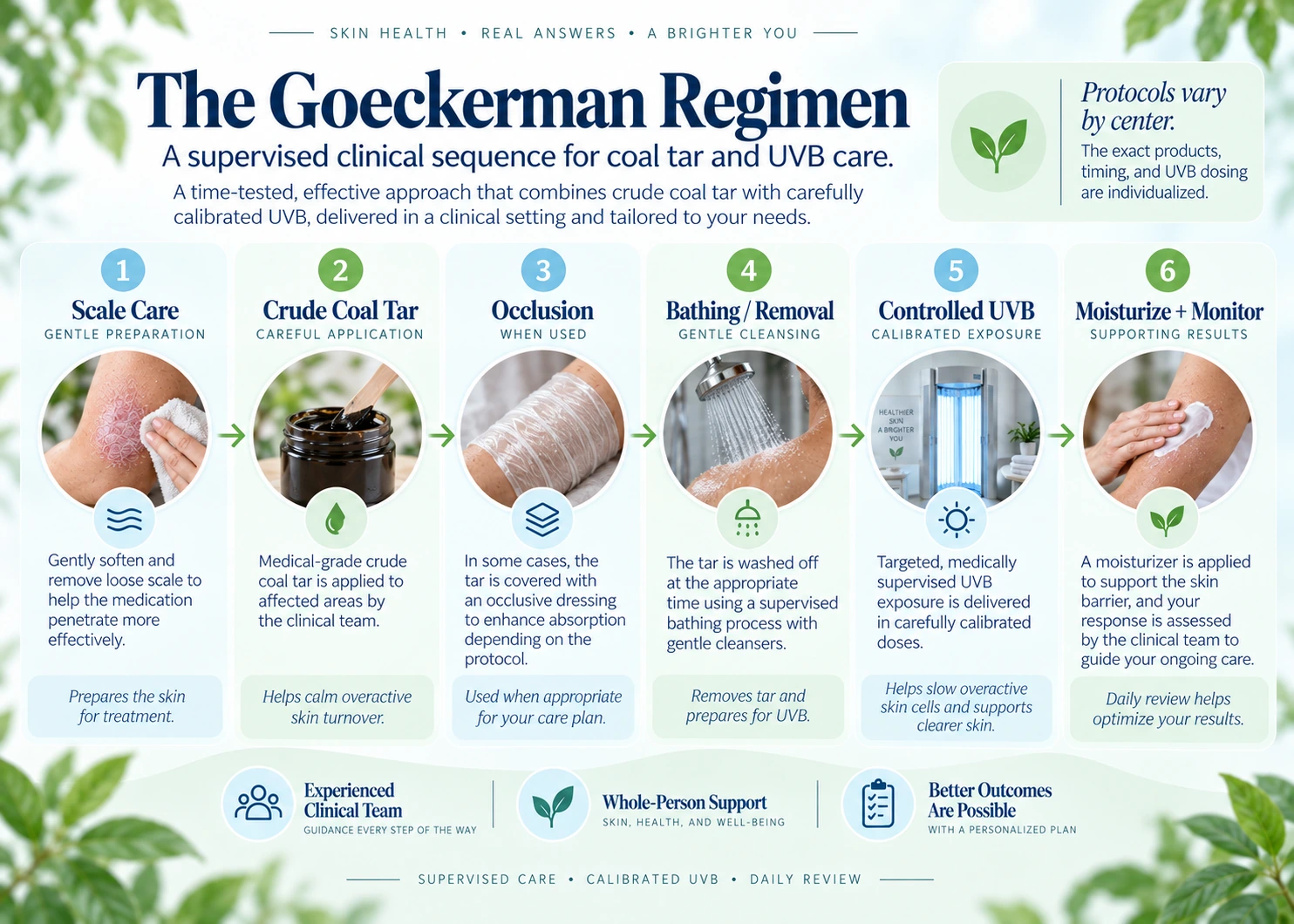
Traditional programs can require several hours a day, five days a week, for multiple weeks. Modified outpatient regimens may be shorter. Ask the treating center for the exact schedule, products, UVB type, monitoring, expected endpoints, and aftercare.
Potential Benefits and Practical Limitations
Specialty-center studies report substantial plaque improvement and meaningful remission for many participants. The regimen is non-systemic and can be considered when a person prefers to avoid or cannot use a systemic medicine, but that does not make it automatically safer or better for everyone.

Limitations include travel, cost, limited availability, daily time, odor, staining of skin or clothing, skin irritation, folliculitis, photosensitivity, and the cumulative ultraviolet exposure that accompanies phototherapy.
Safety, Monitoring, and Who May Not Be a Candidate
A dermatologist should review skin-cancer history, photosensitivity disorders, medicines and supplements that increase photosensitivity, pregnancy, age, prior phototherapy, severe irritation, and ability to attend treatment.

Do not attempt a home Goeckerman regimen with crude coal tar and sunlight or a consumer lamp. Uncontrolled tar exposure and ultraviolet dosing can cause burns, severe irritation, and delayed recognition of complications.
Coal tar products can cause folliculitis, contact irritation, staining, and odor. UVB can cause redness and burns and contributes to cumulative ultraviolet exposure. Eye protection and genital shielding may be required depending on the protocol.
How Goeckerman Compares With Other Treatments
Modern psoriasis choices include moisturizers, topical prescriptions, targeted nonsteroidal topicals, office or home phototherapy under prescription, oral systemic medicines, and biologics. Choice depends on severity, site, joints, comorbidities, pregnancy plans, preferences, access, prior response, and risk.
Goeckerman is one distinct option in the broader psoriasis treatment landscape. Understanding its time commitment, access, expected benefits, and possible side effects can help you compare it with topical treatment, phototherapy, oral medicines, and biologics.
The Functional Medicine Approach to Goeckerman Therapy
Goeckerman therapy focuses directly on the skin through crude coal tar and carefully controlled UVB. Functional medicine creates a broader opportunity to understand why psoriasis is active, what may be contributing to immune dysregulation, and why each person responds differently. Dr. Shook uses the Environmentally Induced Autoimmunity model to investigate potential triggers, drivers, physiology, and patterns across the whole person.
Gut and barrier systems
Look at digestive symptoms, intestinal barrier function, microbiome patterns, and other systems designed to keep outside material from entering the bloodstream.
Food and immune reactions
Investigate whether foods or other immune reactions may be relevant to your symptom timeline rather than assuming one universal psoriasis diet.
Nutrients, metabolism, and hormones
Assess vitamin and nutrient status, essential fatty acids, blood-sugar regulation, metabolism, and hormonal patterns that may affect immune regulation and recovery.
Stress, sleep, infections, and exposures
Review chronic stress, sleep quality, infections, medications, chemical exposures, skin injury, and environmental changes that may line up with flares.

DETECT
Establish a baseline and identify possible triggers using your history, timeline, symptoms, health records, and lab tests.
SUPPORT
Optimize diet, lifestyle, and supplementation based on your triggers and individual needs.
REASSESS
Track your symptoms, how your skin is changing, any side effects, and your ability to follow through with the recommended changes. Continue, adjust, or stop parts of the plan based on how you are doing.
A Personalized Plan for Goeckerman Therapy
Before starting, document the extent of your psoriasis, high-impact areas, itch, pain, sleep, quality of life, joint symptoms, current treatments, and photosensitivity. Make sure you understand how much time and travel the program requires, how progress will be measured, and what the next step will be if your skin is not improving or the regimen is difficult to tolerate.
During and after the program, protect the skin barrier, track changes in your plaques and symptoms, and watch for joint pain, swelling, or stiffness. Use the psoriasis doctor guide when deciding which professionals you may need on your care team.
Frequently Asked Questions
Does Goeckerman therapy cure psoriasis?
No. It can produce substantial clearing and remission for some people, but psoriasis is chronic and relapse can occur.
What does Goeckerman therapy combine?
It combines topical crude coal tar with carefully dosed UVB phototherapy in a supervised protocol.
How long does Goeckerman therapy take?
Traditional programs may require several hours per weekday for multiple weeks. Modified protocols vary by center and response.
Can I do Goeckerman therapy at home?
A do-it-yourself tar plus sunlight or lamp regimen is not recommended. Tar concentration, UV dose, skin response, eye protection, and medication interactions require supervision.
What are common side effects?
Odor, staining, skin irritation, folliculitis, photosensitivity, redness, and UV burns are practical concerns.
Is Goeckerman safer than biologics?
They have different risks, benefits, access, and treatment burdens. No single option is safest for every person.
Is Goeckerman therapy still available?
It remains available at a limited number of specialty centers, but access is much narrower than for standard topical, phototherapy, or systemic care.
How can functional medicine complement Goeckerman therapy?
Goeckerman therapy addresses the skin through supervised coal tar and UVB. Functional medicine adds a deeper investigation of possible autoimmune triggers and drivers, followed by an individualized plan using DETECT, SUPPORT, and REASSESS.
Ready for a More Individualized Psoriasis Evaluation?
Dr. Shook's process looks beyond visible symptoms to investigate potential triggers and drivers. DETECT establishes a baseline, SUPPORT builds an individualized plan, and REASSESS tracks how you are doing so the plan can change with you.
References and Clinical Resources
- Gupta et al. The Goeckerman regimen for moderate to severe psoriasis.
- Smith et al. Adapting the Goeckerman regimen for psoriasis.
- American Academy of Dermatology. Nonprescription psoriasis treatments: coal tar.