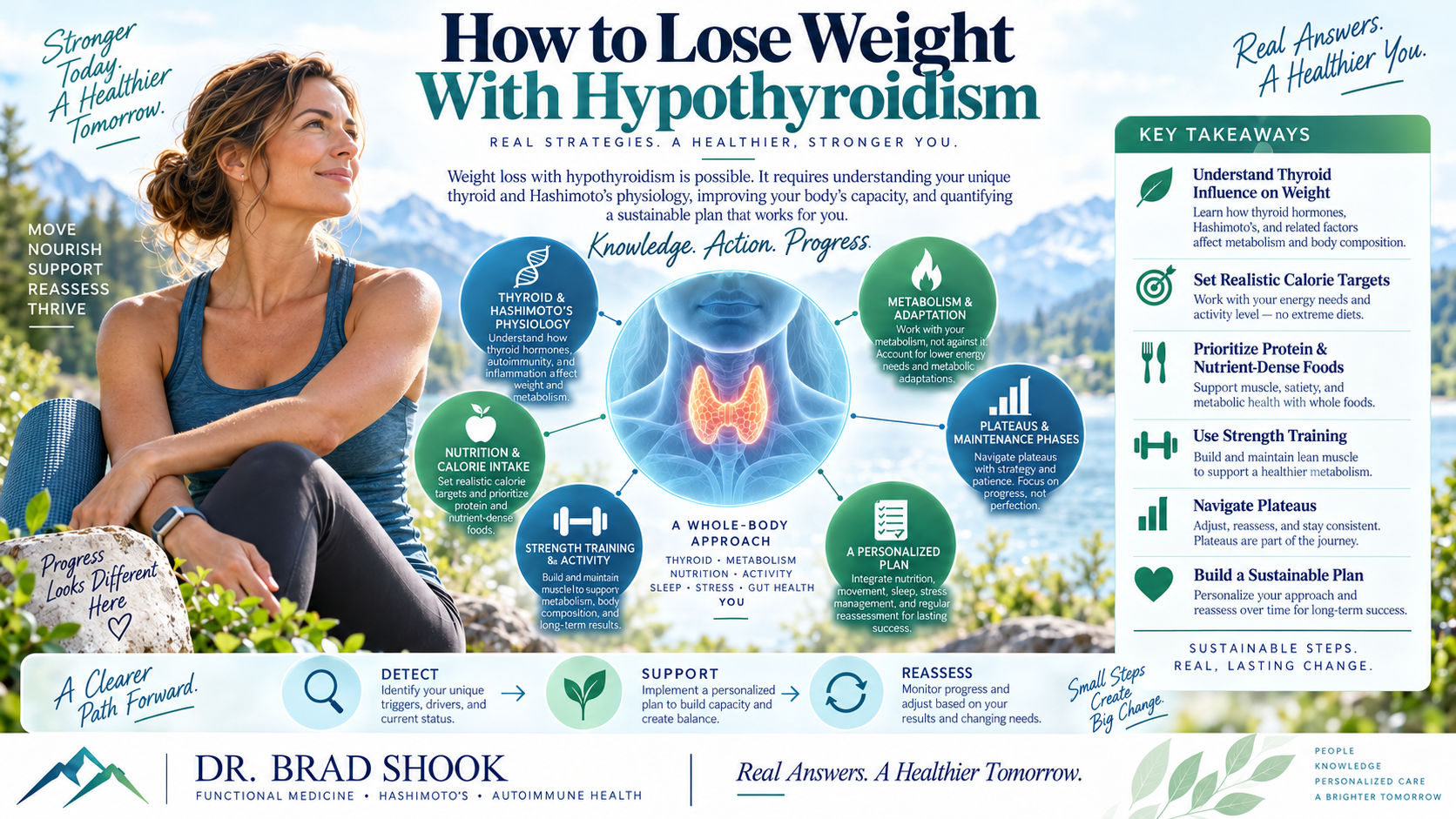
The central idea: Do not treat this as only a thyroid problem or only a calorie problem. Improve the physiological foundation that supports energy production and follow-through, then quantify the plan. Build a reliable baseline, create the smallest effective calorie deficit, preserve muscle, and keep eating as much as you can while your measured trend is moving in the right direction.
1. Improve your capacity
Investigate thyroid hormone status and use, Hashimoto's autoimmunity, blood sugar, gut function, nutrients, sleep, stress, medications, exposures, recovery, and other patterns that may be limiting energy and progress.
2. Quantify your plan
Measure current intake and weight trends, estimate maintenance needs, protect protein and muscle, create a modest deficit, and reassess before making another change.
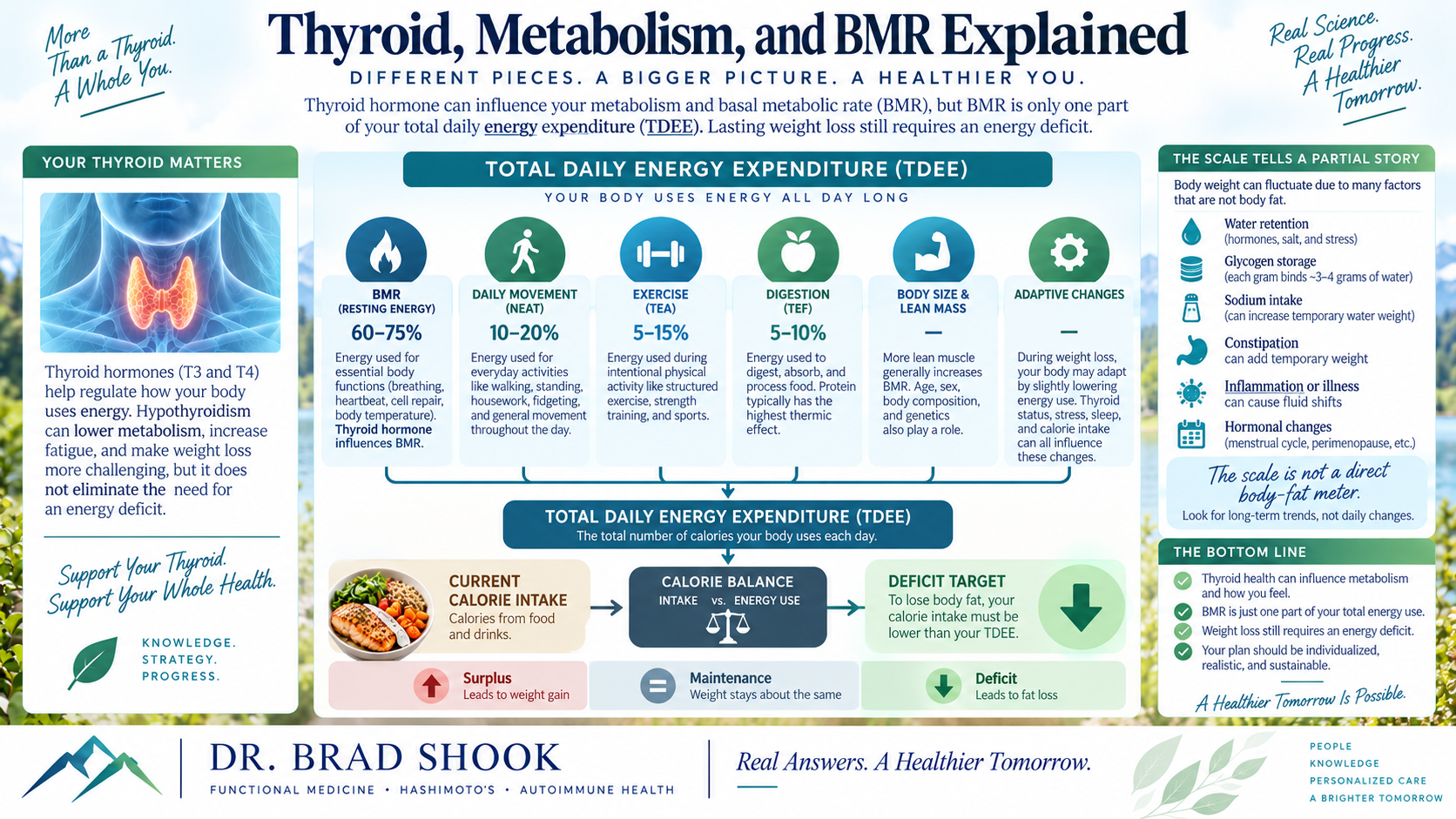
Weight Loss Still Requires an Energy Deficit
Thermodynamics does not stop working because you have hypothyroidism. If stored body fat is going to decrease, your body must use more energy than it takes in over time. What hypothyroidism can change is how much energy you use, how active you feel, how much fluid you retain, and how difficult it is to sustain the behaviors that create that deficit.
The scale is not a direct body-fat meter. Water, sodium, glycogen, food in the digestive tract, constipation, menstrual-cycle changes, inflammation, and medication changes can temporarily hide fat loss or exaggerate weight gain. This is why a seven-day average and a multiweek trend are more useful than one morning's number.
| Number | What it means | Why it matters |
|---|---|---|
| BMR | The energy your body would use at rest for basic functions. | Thyroid hormone, body size, age, sex, and lean mass influence it. |
| Total daily energy expenditure | BMR plus digestion, exercise, and all other daily movement. | This is the better comparison point for daily calorie intake. |
| Current intake | What you are actually eating now, measured as honestly as possible. | If weight is stable, it offers a practical clue about current maintenance needs. |
| Deficit target | An intake below current maintenance needs. | A modest, sustainable gap is usually more useful than the lowest number you can tolerate. |
Start With the Calories You Are Actually Eating
The first quantitative step is simple: track everything you normally eat for three to seven days, including at least one weekend day, without changing your behavior. The point is not judgment. It is to replace guessing with a usable estimate of your current daily intake.
Track three to seven typical days
Record food, drinks, oils, condiments, snacks, and portions. Include at least one day that reflects your usual weekend routine.
Average the calories
Add the daily totals and divide by the number of days. Record morning weight under similar conditions and calculate a seven-day average when possible.
Interpret the trend
If average weight is stable, average intake is a practical estimate of current maintenance. If weight is falling, maintenance is probably higher. If weight is rising, maintenance is probably lower.
Create a modest starting deficit
Begin with a change you can sustain, often about 10 to 20 percent below estimated maintenance, then review the trend before making another adjustment.
This tracking method does not directly measure metabolic rate, and food records are never perfect. It can still be more useful than an equation because it begins with your actual life. If your weight is stable during the tracking period, the average is an estimate of total daily maintenance needs, not BMR. BMR describes energy used at rest and does not include digestion, walking, work, exercise, or the rest of daily life.
If your intake is already very low, another cut may be the wrong next move. First verify the food record, weight trend, activity, fluid changes, constipation, and thyroid status. A structured period near estimated maintenance may then be useful. Calories can be increased deliberately by prioritizing protein, vegetables and other nutrient-dense foods, and enough carbohydrate and fat to support energy, movement, training, and recovery. Once intake and weight trends are stable and you have a sustainable baseline, a modest deficit can be created. The goal is not unrestricted eating or a guaranteed metabolic reset. It is to rebuild capacity before asking the body to sustain another deficit.
Find the highest sustainable intake that still produces progress
Your target is not the fewest calories you can tolerate. It is the highest intake that continues to move your measured trend in the intended direction while supporting protein intake, muscle, energy, sleep, activity, and long-term follow-through. If weight is already moving down at an acceptable rate, cutting harder can make the plan less sustainable without improving the final result.
Hypothyroidism Weight-Loss Calculator
Use your tracked intake or an equation to estimate a starting point. The calculator then shows BMR, maintenance calories, a deficit target, optional maintenance phases, macro planning ranges, and a 26-week visual projection.
Your deficit-week target is a starting estimate. Keep it steady long enough to see a real trend before adjusting. During a planned maintenance week, return near estimated maintenance rather than treating the week as unrestricted eating.
Macro planning range
A practical way to organize the calorie target is to establish protein and fat planning ranges first, then let carbohydrates fill the remaining calorie budget according to activity, tolerance, preference, and the individualized plan. The ranges below use goal weight as the reference when it is lower than current weight. They are planning ranges, not universal prescriptions.
| Target | Starting range | Calories used in the example calculation |
|---|---|---|
| Protein | 96 to 128 g | 448 calories at midpoint |
| Fat | 40 to 56 g | 432 calories at midpoint |
| Carbohydrate room | 248 g | Remaining deficit-week calories divided by 4 |
Your 26-Week Planning Projection
This is a visual estimate, not a promise. It adjusts estimated calorie needs as projected weight changes, but it cannot predict fluid shifts, adaptive thermogenesis, thyroid changes, menstrual-cycle changes, illness, medication effects, or adherence.
| Week | Projected weight | Planned phase |
|---|
Calories Determine the Direction, but Food Structure Changes the Experience
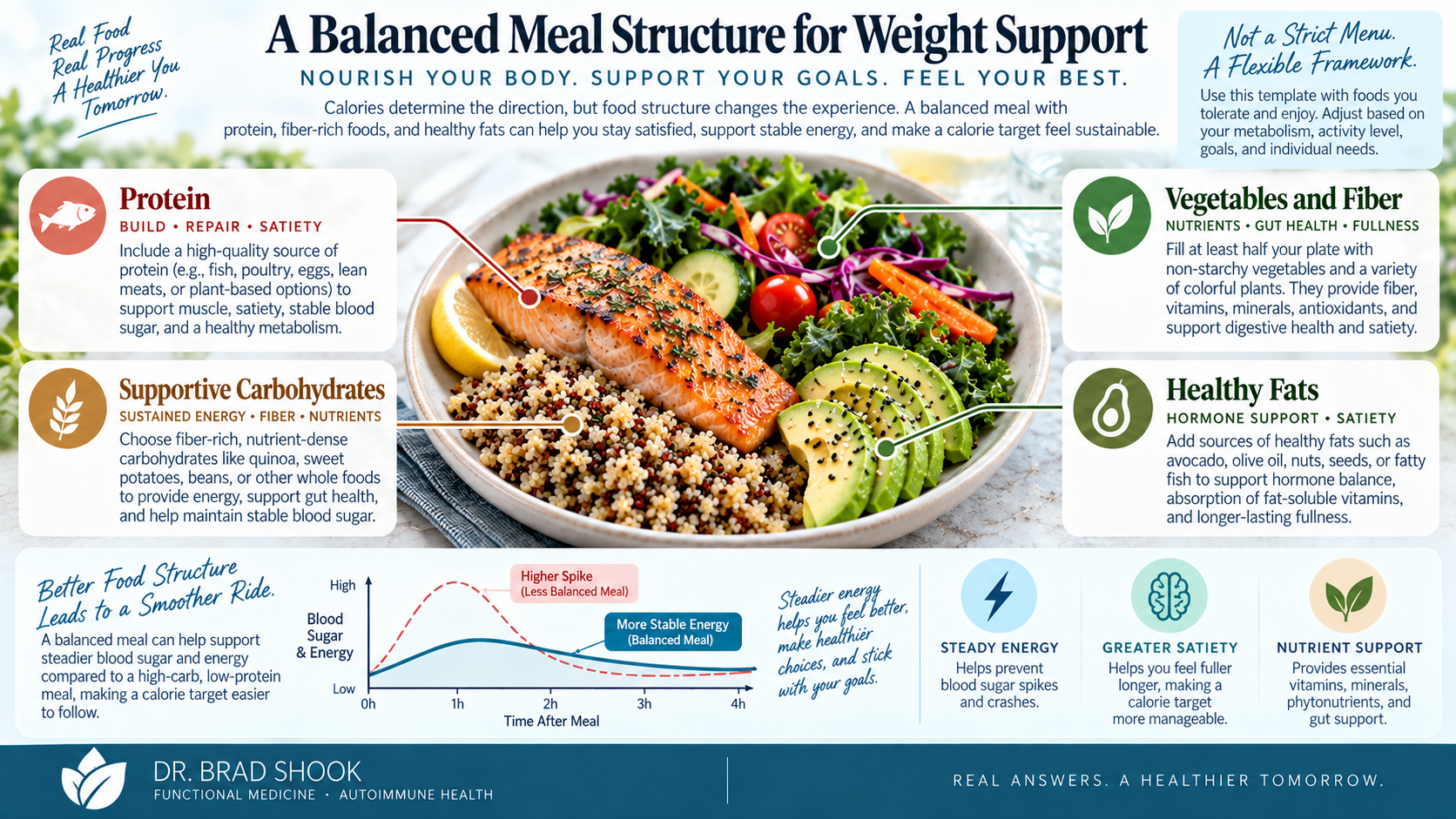
A calorie deficit determines whether stored energy must be used. Protein, fiber, food quality, meal timing, and food volume influence hunger, muscle retention, blood sugar stability, digestion, and your ability to stay consistent.
Protein and resistance training become especially important during weight loss because a smaller body is not the only reason calorie needs fall. Losing lean tissue can also reduce energy expenditure and physical capacity. Build meals around a meaningful protein source, add vegetables or fruit and other fiber-rich foods as tolerated, include enough fat for satisfaction and nutrition, and use carbohydrates according to activity, tolerance, preference, and your remaining calorie budget.
Protein and fat targets should not be copied from a generic body-weight formula. At higher body weights, per-pound formulas can produce impractical amounts. A target based on goal weight, lean mass, kidney health, food tolerance, training demands, and professional guidance is more individualized.
Diet needs to do more than lower calories. If gluten, dairy, another food, blood sugar instability, digestive function, or nutrient status may be relevant to your Hashimoto's pattern, continue with the Hashimoto's diet guide.
Calorie Cycling, Diet Breaks and Adaptive Metabolism
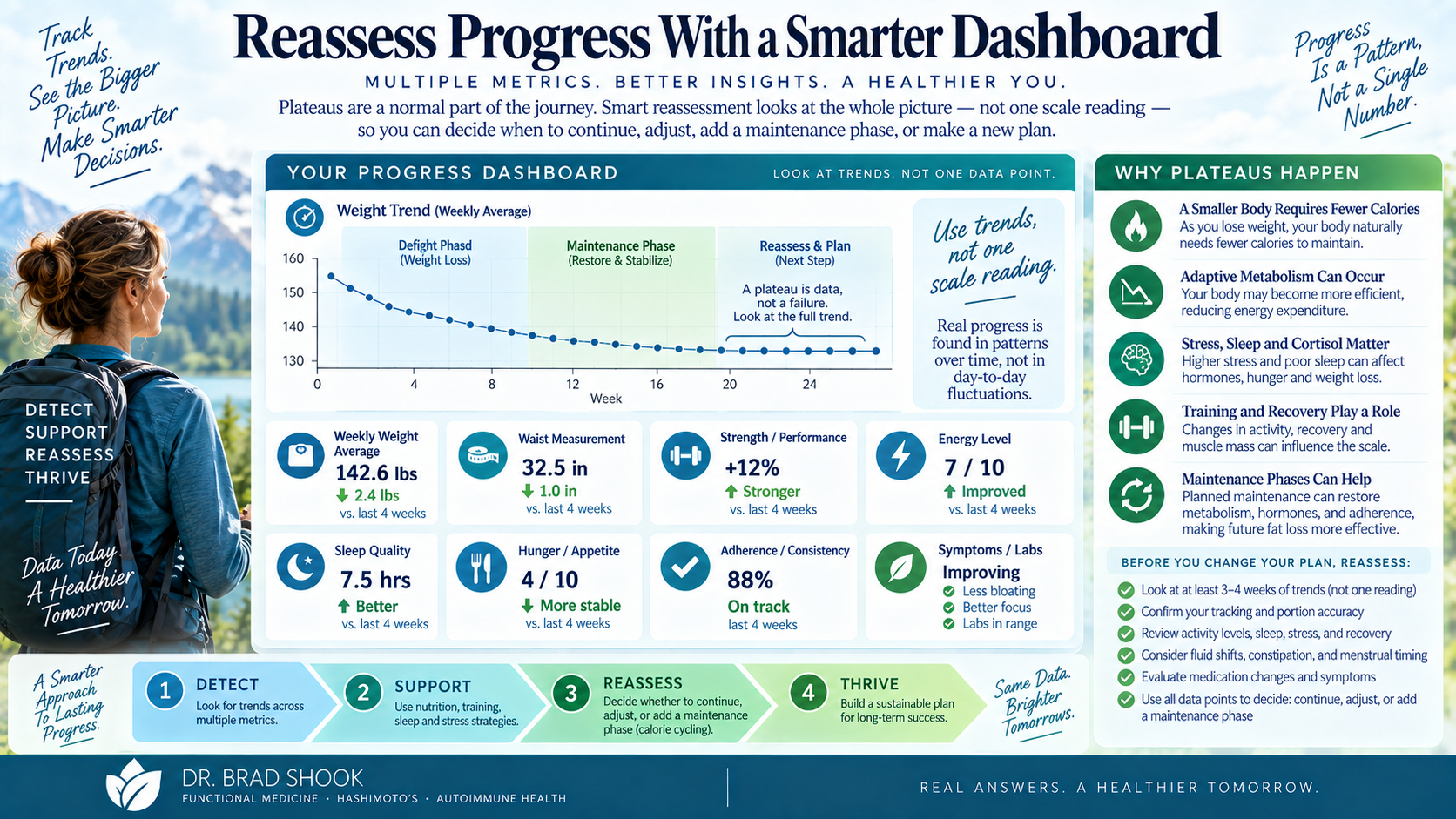
As weight falls, a smaller body generally requires fewer calories. During a sustained deficit, the body may also reduce resting energy expenditure, spontaneous movement, reproductive signaling, and other energy-demanding processes more than body-size change alone would predict. This is often called adaptive thermogenesis.
That does not mean your metabolism is broken, and it does not mean calories no longer matter. It means the energy equation is dynamic. The intake that produced weight loss at the beginning may eventually become maintenance, while a very aggressive deficit can worsen hunger, fatigue, training quality, sleep, and follow-through.
Research on intermittent energy restriction and diet breaks is promising but not absolute. Some trials and a recent systematic review suggest that planned maintenance periods may reduce the decline in resting metabolic rate or improve weight-loss efficiency in some groups. Other studies find similar body-composition outcomes to continuous restriction. The clearest practical advantage is that maintenance phases can improve training, appetite management, confidence, and the ability to continue a long plan.
Can eating more raise BMR? If you have spent months in an aggressive deficit, returning toward maintenance may allow resting expenditure, spontaneous movement, training output, and reproductive or stress signaling to recover from a suppressed state. It does not create a magical reset, guarantee a higher-than-expected BMR, or erase a calorie surplus. The purpose is to restore capacity and create a better platform for the next decision.
A true plateau is not three flat mornings. Look for at least two to three weeks without meaningful change in the weekly average, waist, or other body-composition indicators. Then verify tracking, activity, sleep, constipation, fluid shifts, menstrual timing, and medication changes before cutting calories again.
Why Hypothyroidism Can Make the Same Plan Feel Different
Thyroid hormone is critical for normal energy production and use. Overt hypothyroidism can lower metabolic rate and increase salt and water retention. It can also create fatigue, constipation, cold intolerance, muscle discomfort, and lower exercise tolerance. Those effects can reduce total daily movement and make food preparation or training harder even before calories are discussed. This is why understanding and appropriately managing thyroid function is foundational, even though thyroid care does not replace the need to quantify food intake and energy expenditure.
Hashimoto's adds another layer. It is an autoimmune condition, not simply a calorie problem or a weak thyroid. I evaluate the interconnected pattern involving thyroid hormone status and use, immune and inflammatory activity, blood sugar regulation, the gastrointestinal system and microbiome, liver metabolism, nutrient status, sleep, stress, medications, exposures, movement, and female endocrine transitions. These factors do not suspend thermodynamics. They can change appetite, energy expenditure, recovery, food tolerance, fluid balance, and the behaviors needed to create a sustainable deficit.
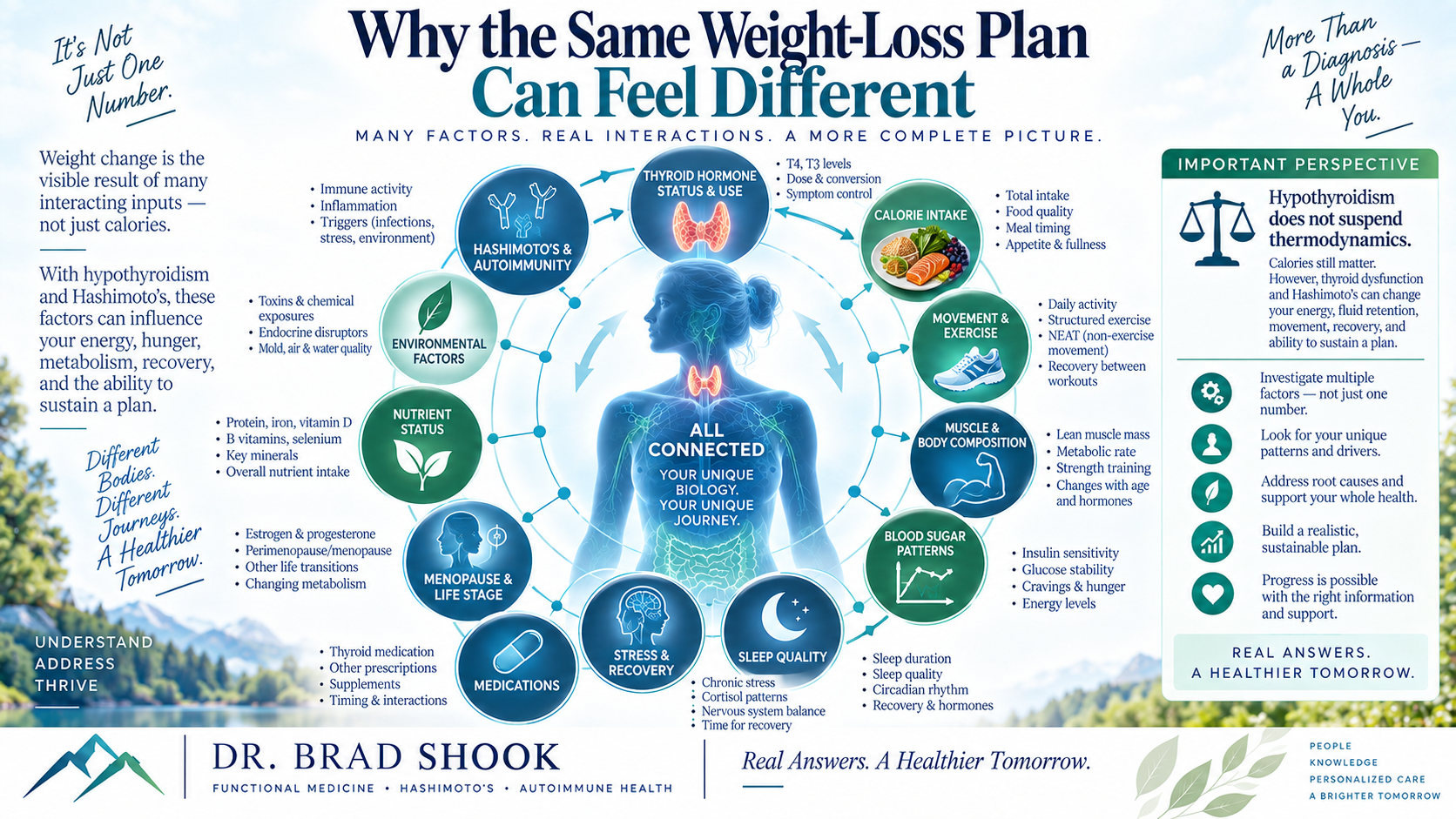
Blood sugar patterns matter
Some people feel shaky, lightheaded, anxious, or intensely hungry when meals are delayed. Others become sleepy after eating or experience strong cravings and energy swings. Those patterns can make an otherwise reasonable calorie plan hard to follow. Meal composition, meal timing, activity, sleep, and objective metabolic data may need to be considered together.
Menopause, medicines and sleep matter
Menopause can change body-fat distribution, sleep, appetite, and lean mass. Some antidepressants, diabetes medications, steroids, antihistamines, and other medicines can influence weight or hunger. Sleep apnea and inadequate sleep can undermine energy, appetite control, and training. These are not excuses. They are variables that can be investigated and addressed.
Thyroid Medication and Expected Weight Change
Levothyroxine replaces hormone that the thyroid can no longer produce adequately. When overt hypothyroidism is corrected, thyroid-related metabolic slowing and some fluid retention may improve. The resulting weight loss is often more modest than people expect, and thyroid medication does not automatically create a continuing calorie deficit.
Do not increase thyroid hormone to lose weight. Excess thyroid hormone can cause palpitations, heart rhythm problems, anxiety, muscle loss, and bone loss. More medication is not a safe substitute for an individualized weight plan.
Medication absorption and consistency matter. Food, coffee, calcium, iron, antacids, gastrointestinal conditions, and formulation changes may alter absorption. Follow the prescriber's instructions, and do not use daily scale changes or symptoms to adjust your dose yourself.
Weight can also rise after hyperthyroidism is treated because treatment removes an abnormally high metabolic state. Calorie needs can fall toward normal, and some weight may return toward a previous baseline. That is a different situation from untreated hypothyroidism, but it reinforces why thyroid status and energy intake must be interpreted together.
A Sustainable Hypothyroidism Weight-Loss Plan
Confirm thyroid and metabolic starting points
Review thyroid treatment, symptoms, medicines, sleep, blood sugar patterns, digestion, activity, weight history, life stage, and relevant health conditions.
Measure current intake
Track typical intake and the weekly weight trend. Use an equation only when tracking is unavailable or clearly unreliable.
Create the smallest effective deficit
Start modestly. Do not reduce calories again while weight is moving at a sustainable rate.
Protect muscle and movement
Use adequate protein, progressive resistance training, walking or other aerobic activity, and recovery that matches your present capacity.
Plan maintenance before you need it
Choose whether maintenance weeks will be scheduled or used when hunger, fatigue, recovery, or adherence shows that the deficit phase needs a pause.
Reassess the whole pattern
Track the weekly weight average, waist, strength, energy, hunger, sleep, digestion, symptoms, follow-through, and relevant objective findings.

Fasting, ketogenic diets, low-carbohydrate diets, and higher-carbohydrate approaches are tools, not universal identities. Any of them can create a calorie deficit. The better question is whether the approach supports your immune pattern, nutrient needs, blood sugar stability, muscle, activity, recovery, food tolerance, preferences, and ability to live with the plan.
A More Individualized Functional Medicine Strategy
When someone says, "I am eating very little and still cannot lose weight," the answer should not automatically be to eat even less. My Environmentally Induced Autoimmunity model looks for the variables that may be narrowing your options and making the process harder.
I bring functional medicine and performance-nutrition experience to this question. Earlier in my career, I held the Certified Strength and Conditioning Specialist and National Strength and Conditioning Association Certified Personal Trainer credentials. That background informs an approach that connects thyroid and autoimmune physiology with energy balance, resistance training, body composition, and the practical realities of changing weight.
DETECT
Establish a baseline using your history, timeline, symptoms, current food intake, weight trend, activity, sleep, medications, thyroid data, metabolic findings, nutrient status, gut function, stress, exposures, and individual response.
SUPPORT
Build diet, lifestyle, movement, sleep, stress, and supplementation strategies around the highest-priority findings and your practical ability to follow through.
REASSESS: Track your symptoms, weight trend, waist, strength, energy, hunger, sleep, digestion, side effects, and ability to follow the plan. Continue what is working, adjust what is not, or change direction based on your measured response.
This is where a generic calculator ends and individualized care begins. A calorie estimate is useful, but it cannot tell you why fatigue is severe, why food reactions or gut symptoms are present, why blood sugar is unstable, why sleep is poor, or which findings deserve priority. Learn more about functional medicine for Hashimoto's, the Hashimoto's exercise and recovery plan, the Hashimoto's Doctor Method, and the complete Hashimoto's resource hub.
Frequently Asked Questions
Can you lose weight if you have hypothyroidism?
Yes. Weight loss still requires an energy deficit, but thyroid status, fluid retention, fatigue, movement, sleep, muscle mass, medicines, menopause, blood sugar regulation, and the sustainability of the plan can all change how difficult the process feels and how the scale behaves.
Can I lose 20 pounds with hypothyroidism?
It may be possible, but the amount and timeline depend on your starting point, thyroid status, calorie intake, activity, sleep, medicines, metabolic health, and ability to sustain the plan. A 20-pound goal should be broken into smaller checkpoints and reassessed as calorie needs change.
How many calories should I eat to lose weight with hypothyroidism?
There is no single correct number. Estimate maintenance from a period of honest food and weight tracking or from a validated equation, then begin with a modest deficit and use several weeks of trend data to adjust. The calculator on this page provides an educational starting estimate.
Does eating more calories raise BMR?
Moving from prolonged, aggressive restriction toward maintenance can improve training, daily movement, hunger, and adherence, and resting energy expenditure may rise from a suppressed state. It does not guarantee a metabolic reset or make energy balance irrelevant.
What is calorie cycling or a diet break?
Calorie cycling alternates planned deficit periods with planned maintenance periods. Maintenance phases may make a long plan easier to sustain and may reduce some metabolic adaptation for some people, but they are not proven to produce more fat loss for everyone.
Will levothyroxine make me lose weight?
It can reverse some weight and fluid gain caused by untreated hypothyroidism, but it is not a weight-loss drug and often does not produce large losses by itself.
Why am I gaining weight with a normal TSH?
A normal TSH makes major untreated primary hypothyroidism less likely, but it does not evaluate every factor that influences weight. Food intake, daily movement, sleep, medicines, menopause, fluid retention, muscle mass, and other health conditions still matter.
Should I fast if I have Hashimoto's?
Fasting is optional. It may suit some people, but it can worsen fatigue, sleep, dizziness, blood sugar symptoms, or overeating in others and is inappropriate in several medical situations.
How long does it take to lose weight with hypothyroidism?
There is no fixed timeline. Early scale changes can include water, while fat loss is slower. Use a multiweek trend, expect calorie needs to decline as weight falls, and reassess thyroid status, recovery, adherence, and the plan when progress stalls.
Why can weight increase after hyperthyroidism is treated?
Treating hyperthyroidism removes an abnormally high metabolic state. Calorie needs can fall toward normal, and weight may return toward a previous baseline. Thyroid levels and nutrition may need reassessment if weight change is rapid or continues.
Can I take extra thyroid hormone to lose weight faster?
No. Excess thyroid hormone can cause heart rhythm problems, bone loss, anxiety, and muscle loss. Never use it as a weight-loss strategy.
How accurate is the hypothyroidism weight-loss calculator?
It is a planning estimate, not a diagnosis or prediction. Equations cannot know your thyroid status, body composition, adaptive thermogenesis, fluid shifts, menstrual cycle, medicines, food tracking error, or individual response. Use the trend to refine the estimate.
Ready to Understand What Is Limiting Your Progress?
My functional medicine evaluation goes beyond a calorie target. It connects thyroid function and autoimmunity with diet, gut health, metabolism, nutrient status, stress, sleep, infections, exposures, medications, movement, life stage, and your individual response so that you can begin from a more precise starting point.
References and Clinical Resources
- National Institute of Diabetes and Digestive and Kidney Diseases. Body Weight Planner.
- Hall KD, et al. Quantification of the effect of energy imbalance on bodyweight.
- Byrne NM, et al. Intermittent energy restriction improves weight loss efficiency in obese men: the MATADOR study.
- Poon ETC, et al. Effects of intermittent dieting with break periods on body composition and metabolic adaptation.
- American Thyroid Association. Thyroid and Weight.
- American Thyroid Association. Thyroid Hormone Treatment.
- Mullur R, Liu YY, Brent GA. Thyroid hormone regulation of metabolism.