
What Makes Array 14 Different?
If you are dealing with digestive symptoms or an autoimmune diagnosis, you may have test results and still not know what to do or consider next. Functional medicine and functional immunology give us a way to look more closely at your health history, what is happening in your body, and the factors that could be contributing to your health challenges.
One area I like to explore is your mucosal immune system, the immune defenses associated with the surfaces of your mouth and digestive tract. These surfaces regularly encounter foods, microbes, and substances from your environment. Array 14 uses a simple, noninvasive saliva sample to look at selected antibody responses at this meeting point between the outside world and your body.
Cyrex Array 14 combines antigen-specific IgA and IgM antibody reactivity with a measurement of total secretory IgA in saliva. Looking at these results together offers another perspective on selected mucosal immune responses, including responses to proteins associated with the intestinal barrier.
What makes this panel exciting is the breadth of the opportunity. In one saliva-based assessment, we can explore selected responses to gut-associated targets, food proteins, microbial targets, environmental substances, and tissue-associated proteins. I use these findings to help build a clearer picture of your individual immune-reactivity patterns and determine which questions to investigate further.
Five Areas of Immune Reactivity We Can Explore
Array 14 brings several categories of selected mucosal immune responses into one assessment. Each offers a different piece of information that we can connect with your symptoms, health history, and other findings.
1. Your mucosal immune response
Total secretory IgA is an antibody involved in protecting mucosal surfaces. Array 14 measures it in your saliva, giving us another view of your oral mucosal immune response as we consider the test’s antigen-specific findings.
2. Intestinal barrier- and gut-associated targets
The panel includes antibody reactivity to lipopolysaccharides (LPS), occludin/zonulin, actomyosin, ASCA/ANCA, calprotectin, and an immune complex marker. These findings offer questions to explore about immune responses associated with the intestinal lining and gut-related targets. Importantly, salivary antibody reactivity to calprotectin is different from the amount of calprotectin measured in a stool test.
3. Selected food and gluten-related targets
Array 14 includes native + deamidated alpha-gliadin-33-mer, gamma-gliadin-15-mer, glutenin-21-mer, gluteomorphin, wheat germ agglutinin, egg, soy, corn, alpha-casein + beta-casein, and casomorphin. It also includes transglutaminase-2, an intestinal tissue-associated enzyme rather than a food protein. The combined antibody responses can help us identify specific food-related questions worth exploring alongside your diet, symptoms, and established testing.
4. Microbial and environmental targets
Selected targets include rotavirus, aflatoxin, bisphenol-A (BPA), mercury, and mixed heavy metals. Seeing antibody reactivity to these targets may give us a reason to look more closely at your history and relevant environmental or microbial questions. These results describe antibody responses; questions about an active infection or the amount of a substance in your body call for other types of testing.
5. Tissue-associated targets
The panel also includes antibody reactivity to myelin basic protein and blood-brain barrier protein. These results add a tissue-associated dimension to the immune-reactivity picture. I interpret them alongside your history and any appropriate medical evaluation rather than treating them as evidence of nerve injury or a neurological diagnosis.
Why this matters: Your combination of findings may suggest more useful questions than any one marker alone. The opportunity is to understand your individual pattern and connect it with the bigger picture of your health.

What Could Array 14 Mean for You?
You may have Hashimoto’s, psoriasis, or persistent digestive symptoms and still wonder what may be contributing to the way you feel. Could certain food-related immune responses be worth exploring? Are gut-associated or environmental patterns relevant to your story? Array 14 gives us one way to investigate those questions more thoughtfully.
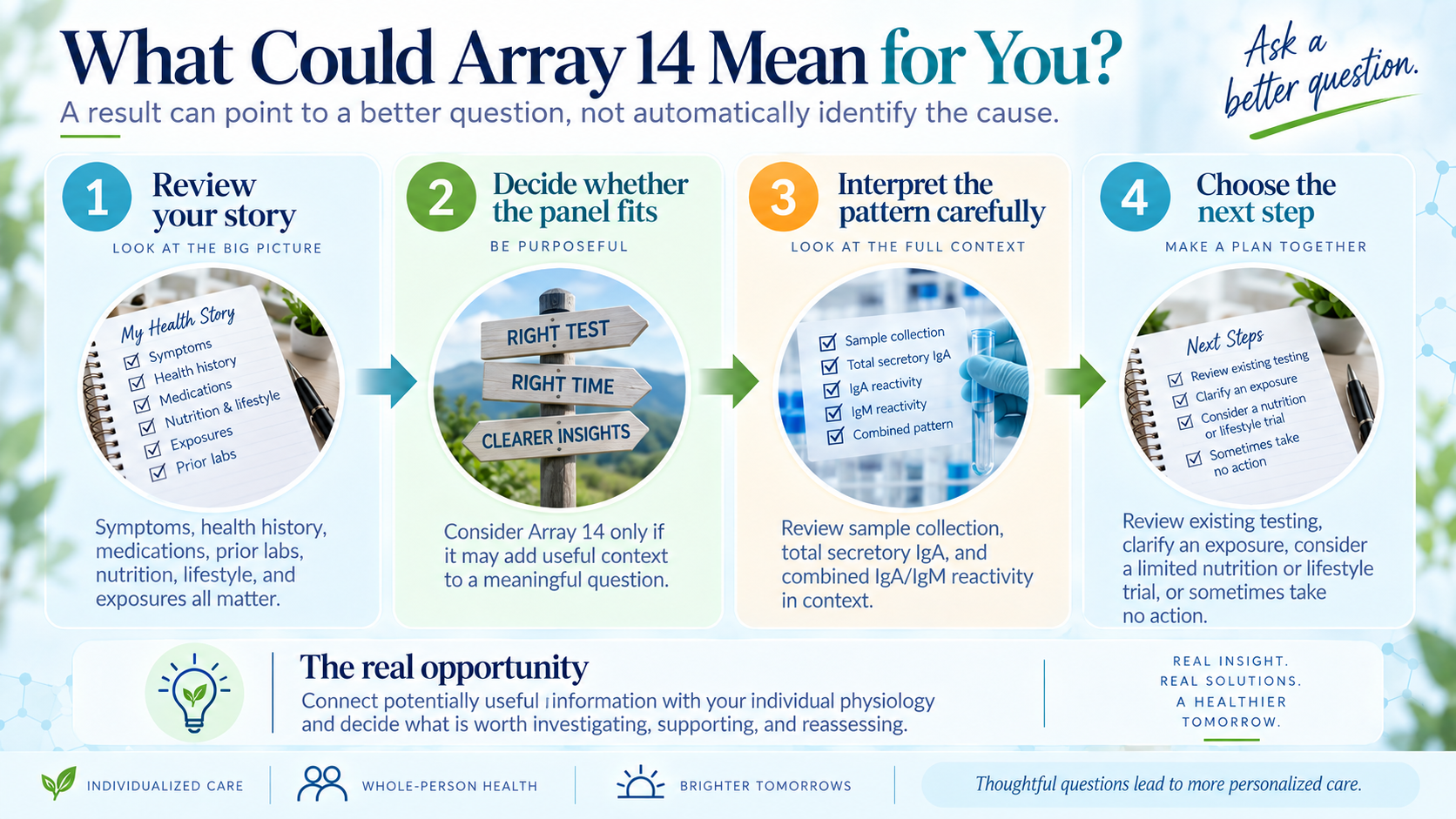
I begin by reviewing your symptoms, health history, medications, existing laboratory results, nutrition, lifestyle, and relevant exposures. When Array 14 fits the questions we are investigating, I look at the total secretory IgA result and patterns of combined IgA/IgM reactivity. Then I connect that information with what we already know about you.
The next step depends on what the whole picture tells us. We might look more closely at your nutrition, clarify an exposure history, review existing medical testing, or develop a focused lifestyle trial with a plan to see how you respond. The value comes from translating useful information into a thoughtful next step that fits your individual physiology and priorities.
The real opportunity: You receive more than a list of highlighted markers. We connect potentially useful immune-reactivity findings with your experience, identify the questions worth pursuing, and build a focused plan around what we learn.
For more context on two common questions, you can read my guides to what may contribute to Hashimoto's disease and a functional medicine approach to psoriasis.
How I Turn Findings Into an Individualized Plan
A diagnosis tells us which condition has been identified. It does not automatically explain what initiated an autoimmune process, what may be contributing to it today, or which factors we can change. Functional medicine offers an opportunity to investigate those questions while working alongside your appropriate medical care.
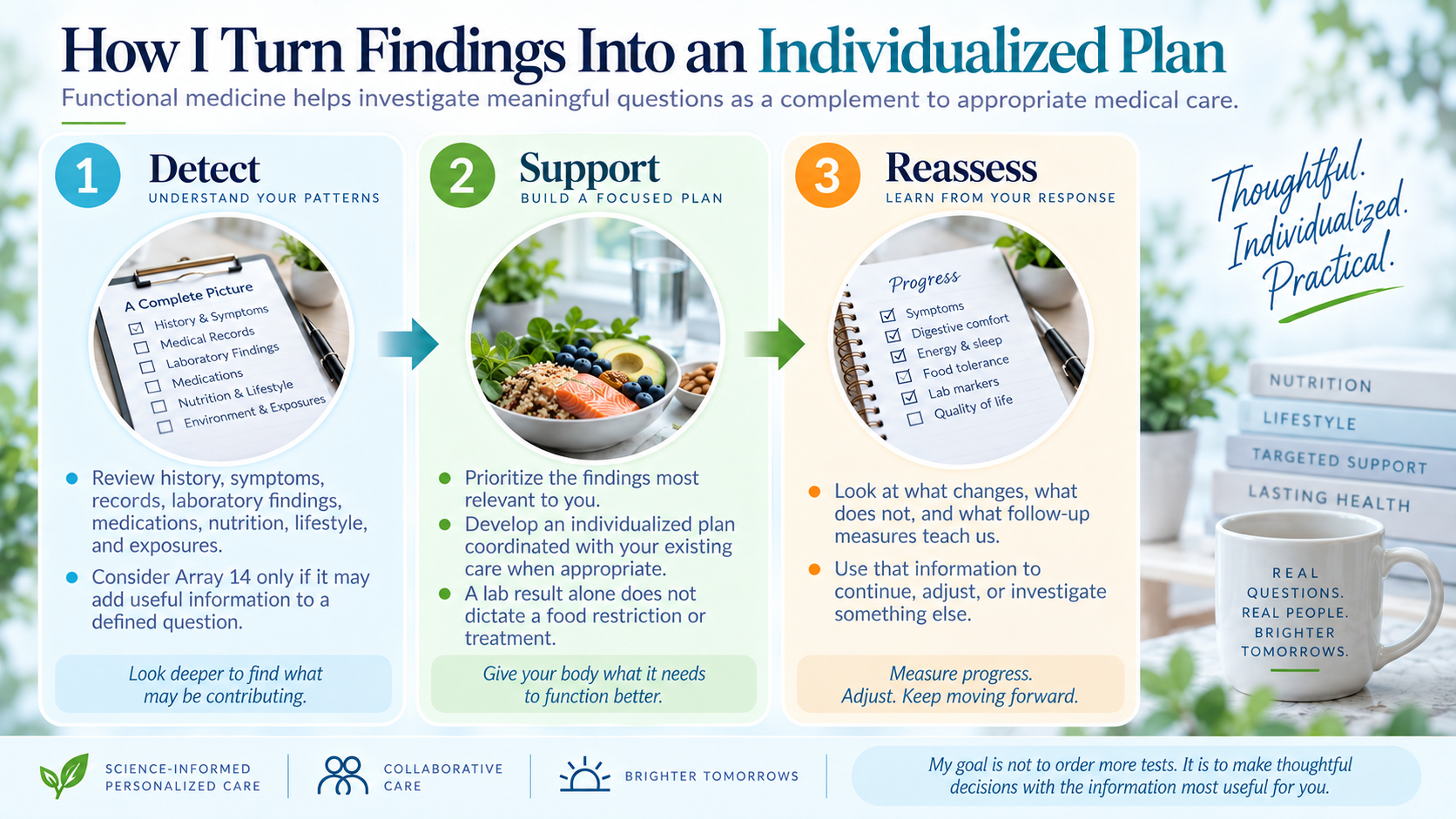
Understand your patterns
I listen to your story and review your symptoms, records, laboratory findings, medications, nutrition, lifestyle, and environmental factors. When Array 14 adds a useful perspective, its findings become another part of our investigation into possible triggers, drivers, and physiological patterns.
Build a focused plan
Together, we prioritize the findings most relevant to your situation and create a focused plan around your individual needs. That may include nutrition, daily habits, or further evaluation, coordinated with the other care you receive.
Learn from your response
We look at what changes, what does not, and what your response teaches us. Your experience and appropriate follow-up measures help us refine the plan and choose the next steps with greater clarity.
My goal is to turn what we discover into meaningful next steps for you. If we decide a dietary investigation is worthwhile, my Hashimoto’s diet guide explains why nutrition decisions should reflect your individual situation rather than a universal list of forbidden foods.
If you would like help exploring what may be contributing to your digestive or autoimmune health challenges, I invite you to apply for care. I personally review each application and, if accepted, send a private link to schedule your appointment.
How to Understand Your Results With Confidence
The most useful way to read Array 14 is to see each antibody result as one piece of your individual immune-health picture. Responses to selected foods, microbial targets, environmental substances, and tissue-associated proteins can raise worthwhile questions. I interpret them in light of your history, symptoms, and other findings, rather than assigning a cause from a single marker.
Some questions need a different kind of measurement. For example, Array 14’s barrier-associated antibody findings do not directly measure intestinal permeability, and its salivary antibody reactivity to calprotectin is not a stool calprotectin measurement. Food allergy, celiac disease, active infection, toxic exposure, autoimmune disease, and neurological injury each require their own appropriate medical evaluation.
My approach: We use the results to sharpen our questions, connect the information with your physiology, and decide which findings can help shape your next step.

Where Array 14 Fits Alongside Other Tests
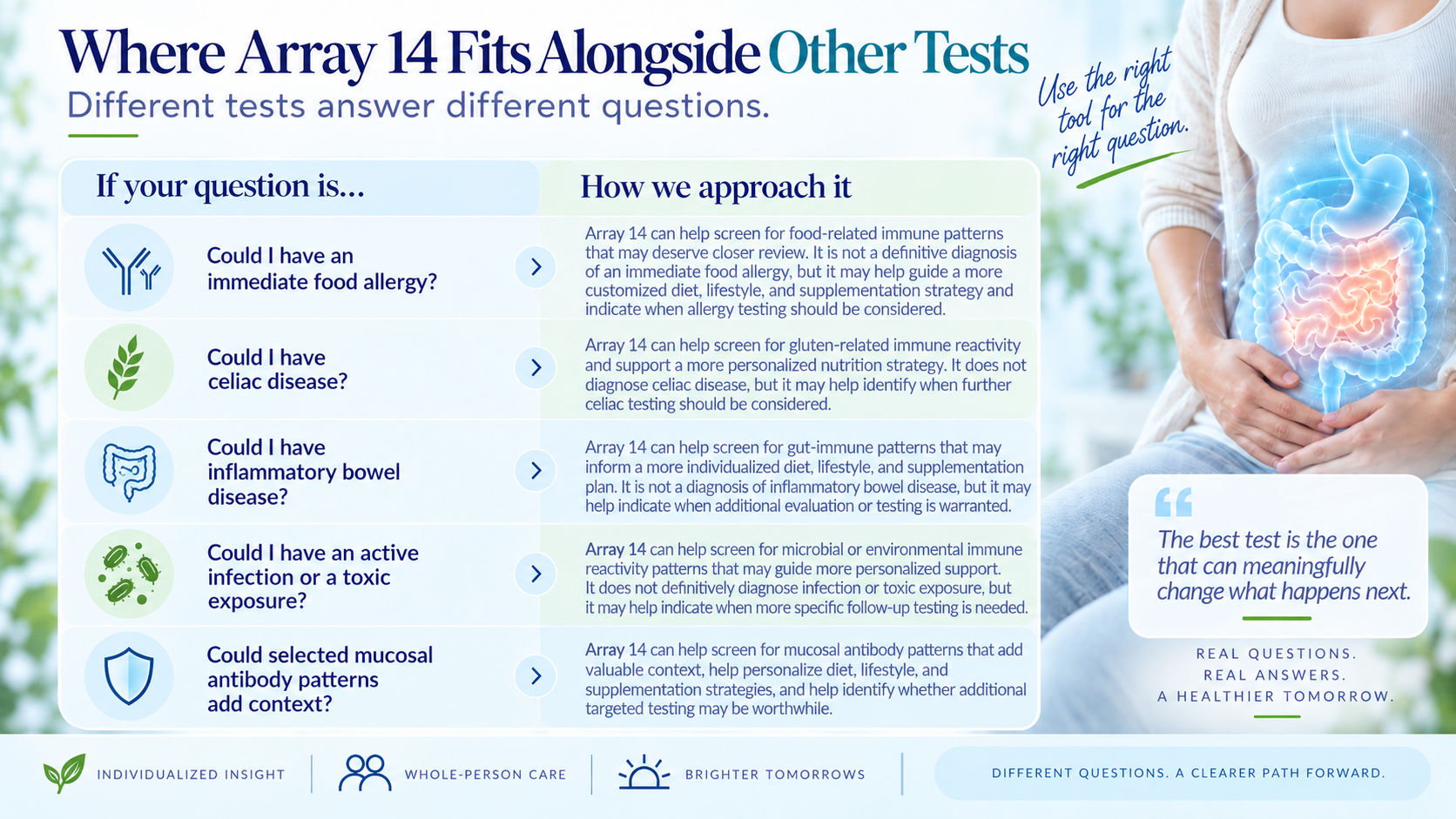
Different assessments give us different kinds of information. Array 14 helps us explore selected salivary immune-reactivity patterns; established medical tests answer specific diagnostic questions. Used thoughtfully, they can contribute different pieces to an individualized investigation.
| If your question is… | How we approach it |
|---|---|
| Could I have an immediate food allergy? | Review the reaction history and seek an appropriate medical allergy evaluation, which may include validated skin or IgE testing. |
| Could I have celiac disease? | Use the standard medical testing pathway while you are still eating gluten. Learn about gluten, Hashimoto's, and celiac disease. |
| Could I have inflammatory bowel disease? | Seek appropriate medical evaluation. A stool calprotectin test, for example, is different from Array 14's salivary antibody reactivity to calprotectin. |
| Could I have an active infection or a toxic exposure? | Consider specific medical or exposure-focused assessment when your history calls for it, rather than interpreting an antibody result as proof. |
| Could selected mucosal antibody patterns add context? | Array 14 may add information about selected salivary antibody patterns that we can connect with your history, symptoms, and other results. |
Frequently Asked Questions
What makes Cyrex Array 14 unique?
Array 14 uses a noninvasive saliva sample to examine combined IgA/IgM antibody reactivity to selected food, microbial, environmental, gut-related, and tissue-associated targets. It also measures total secretory IgA in saliva. Together, the results offer a broader view of selected mucosal immune responses.
What could Array 14 tell me about my immune system?
The test may show patterns of antibody reactivity to selected substances and proteins. I connect those findings with your symptoms, history, and other results to identify questions worth exploring and help shape a focused investigation.
Is Array 14 appropriate for everyone with Hashimoto’s or psoriasis?
The decision is individual. I start with your history, symptoms, records, and existing laboratory findings. If exploring selected mucosal antibody patterns could help answer your questions, Array 14 may be part of our investigation.
Does Array 14 diagnose leaky gut?
Array 14 measures antibody reactivity to selected intestinal barrier-associated targets, which may raise questions about gut-related immune activity. It does not directly measure intestinal permeability, sometimes called leaky gut.
Does Array 14 diagnose food allergies or celiac disease?
Array 14 explores selected salivary antibody patterns rather than diagnosing food allergy, food intolerance, or celiac disease. Those questions have their own medical evaluations. If celiac testing may be needed, speak with your medical clinician before removing gluten because doing so can affect results.
Can Array 14 diagnose an active infection or toxic exposure?
It measures selected antibody responses, not whether an infection is currently active or how much of a chemical or metal is in your body. If your history points to those concerns, we can consider the appropriate specific evaluation.
Does a positive result prove autoimmune disease or nerve damage?
A tissue-associated antibody finding can give us another question to explore, but it does not establish an autoimmune diagnosis, neurological injury, or blood-brain barrier permeability. We connect the finding with your history and appropriate medical assessment.
Should I eliminate every food highlighted on the test?
No. I look at the full picture, including your symptoms, diet, nutritional needs, and other findings. When a focused dietary trial makes sense, we plan it carefully and reassess what you learn from your response.
What happens after I apply for care?
I personally review your Application for Care. If your application is accepted, you receive a private scheduling link. During our work together, we review your history and decide which investigations, including whether Array 14 could contribute useful information, fit your situation.
Ready to Explore What May Be Contributing to Your Health Challenges?
A diagnosis can be the beginning of a more complete conversation about your health. If you are looking for a deeper understanding of possible autoimmune triggers, digestive concerns, and your individual physiology, I would welcome the opportunity to explore those questions with you.
I begin with your history, symptoms, records, existing laboratory results, medications, nutrition, lifestyle, and relevant exposures. From there, we can decide which investigations might add the most useful information and build a focused plan. Cyrex Array 14 is one of the specialized assessments I can consider as part of that process.
Here is how to get started: Submit an Application for Care. I personally review your application to determine whether my approach is a good fit. If it is accepted, you will receive a private link to schedule your appointment.
Sources and Further Reading
- Cyrex Laboratories: Array 14, Mucosal Immune Reactivity Screen. Manufacturer information about the assay, its listed analytes, and suggested applications.
- Cyrex Laboratories: Current Test Arrays. Confirm current availability, sample instructions, and ordering requirements directly with the laboratory before ordering.
- NIDDK: Diagnosis of Celiac Disease. Explains the established medical testing pathway and why gluten should not be removed before evaluation.
- American Academy of Allergy, Asthma & Immunology: Food Allergy. Describes appropriate medical evaluation of suspected food allergy.
- NIDDK: Diagnosis of Crohn’s Disease. An example of established evaluation for inflammatory bowel disease.
- MedlinePlus: Calprotectin Stool Test. Explains what a stool calprotectin measurement evaluates.
- Brandtzaeg: Do salivary antibodies reliably reflect both mucosal and systemic immunity? Review of salivary antibodies and their relationship to immune responses at other mucosal sites.
Cyrex Array 14 is identified by name to describe the test accurately. This independent educational article is not sponsored or endorsed by Cyrex Laboratories.