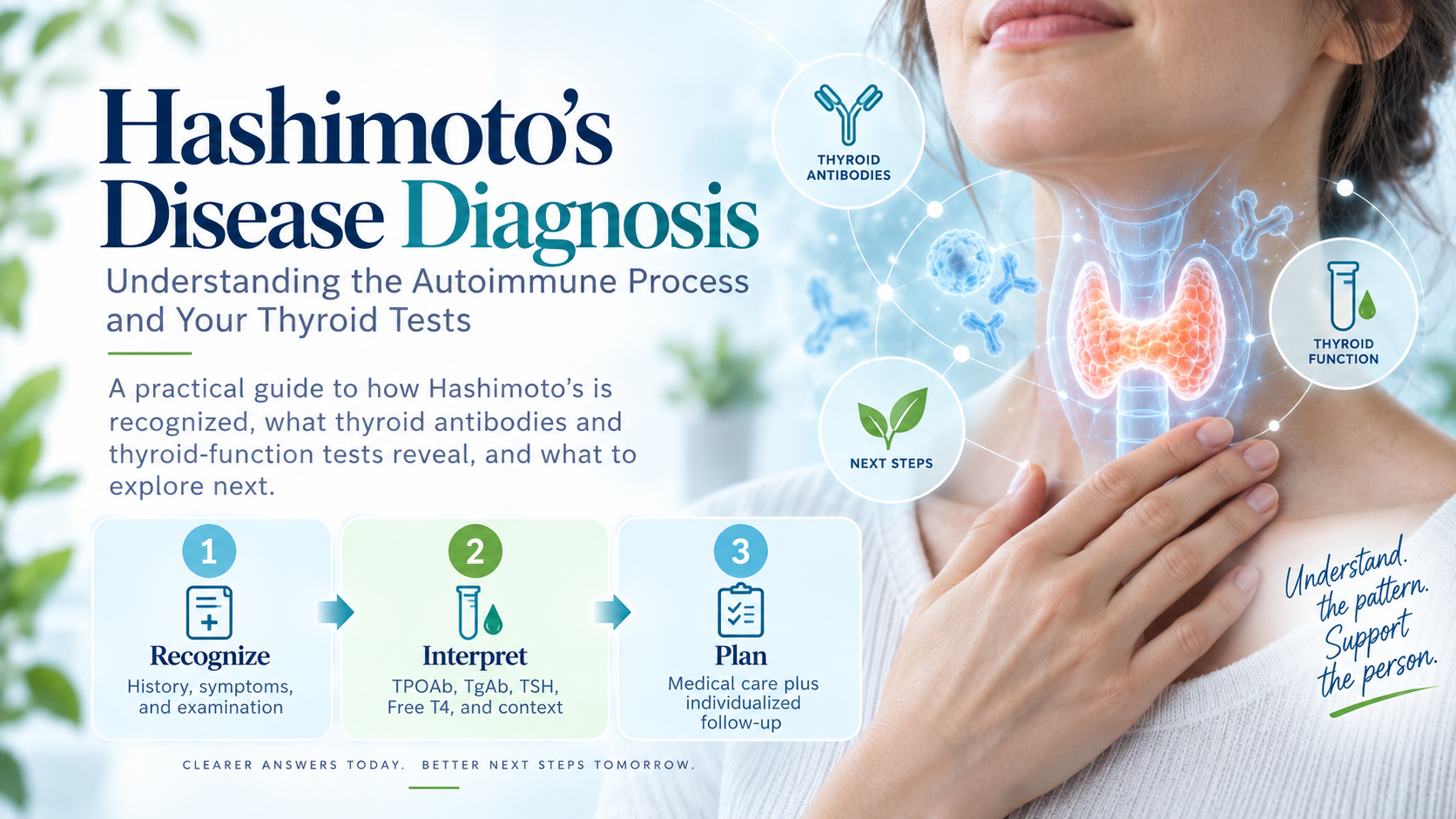
Your Thyroid Diagnosis Is the Beginning of the Investigation
If your thyroid tests came back normal but you still feel unwell, you may be wondering whether something was missed. I would start by asking what was tested. A TSH result tells us something important about thyroid function, but it doesn't tell us whether your immune system is reacting to your thyroid.
Hashimoto's describes an autoimmune process directed at thyroid tissue. Hypothyroidism describes a state in which the body does not have adequate thyroid hormone. They often occur together, but they are not the same diagnosis. You can have evidence of thyroid autoimmunity before the gland loses enough function to change your TSH.
Here is the question I want you to consider: a Hashimoto's diagnosis tells us which disease has been identified. It doesn't automatically tell us what may have triggered the autoimmune process, what might be keeping it active, or which factors we could change.
That's why I look at the autoimmune process, thyroid hormone function, and the rest of your health together. Your history and results help us decide which questions are worth pursuing first.
Why Can a Thyroid Workup Miss the Autoimmune Question?
Thyroid hormone replacement can be essential when your thyroid no longer produces enough hormone. But measuring hormone levels and identifying why the gland may be struggling are different questions.
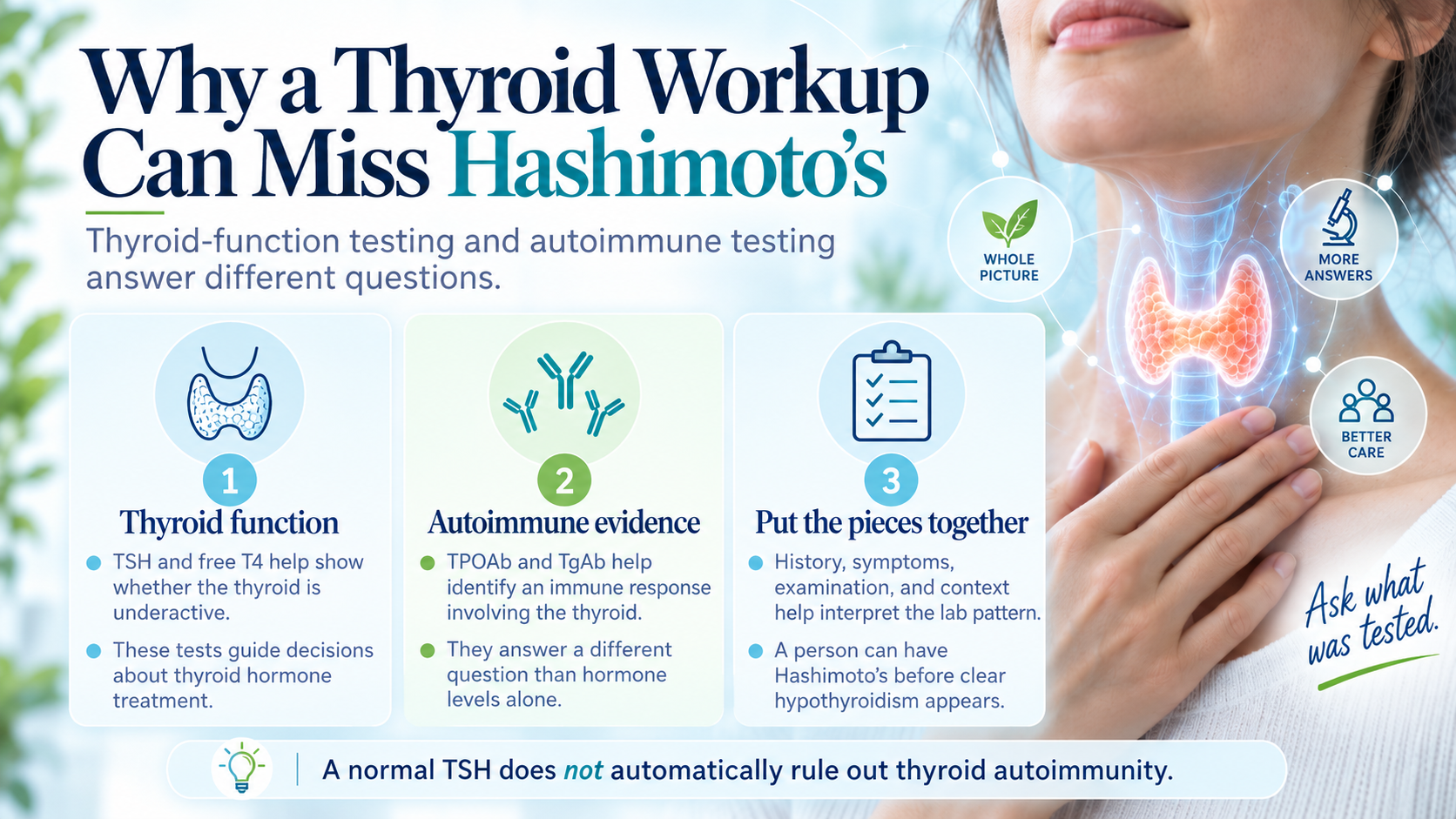
A workup aimed at deciding whether thyroid hormone is needed may start with TSH and free T4. In some situations, identifying Hashimoto's won't change the immediate prescription, so thyroid antibody tests may not be included. Other clinicians do test for antibodies. If you don't know whether you were tested for Hashimoto's, it's worth looking at your actual lab report.
I want to know whether thyroid autoimmunity has been identified, how your thyroid function has changed, and what else in your history might explain the way you feel. That doesn't mean ordering every available test. It means asking better questions and choosing tests when the answers could help us decide what to do next.
How Do We Recognize Hashimoto's, Even When TSH Is Normal?
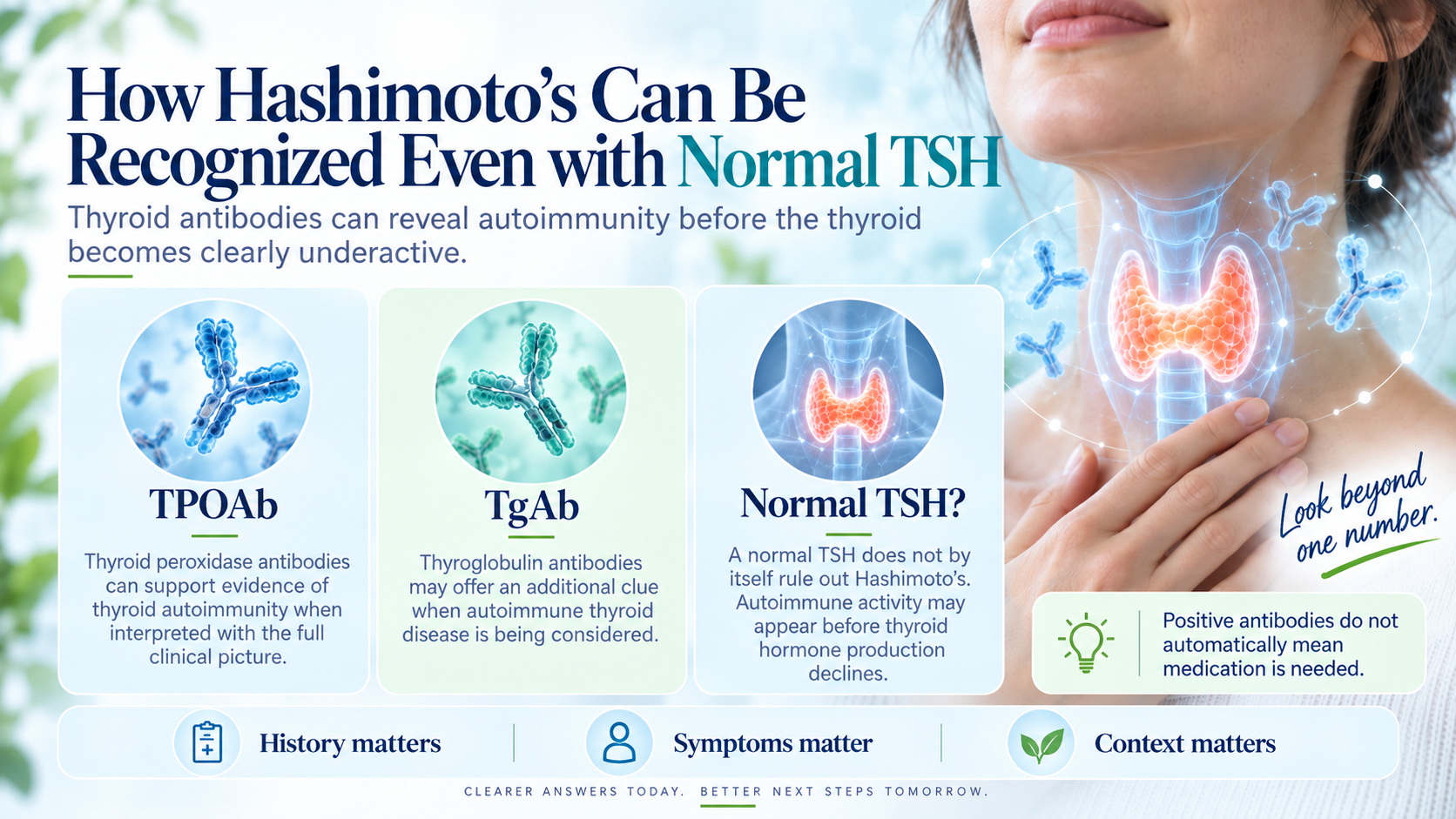
Thyroid peroxidase antibodies (TPOAb) and thyroglobulin antibodies (TgAb) are two distinct clues about an immune response involving thyroid proteins. They are not measures of thyroid hormone production. An elevated result, interpreted with your history and other findings, can support a Hashimoto's diagnosis before hormone deficiency develops.
Thyroid function
TSH and free T4 help describe the gland's current hormone output and your body's feedback signal. These results matter for medical treatment and for following changes over time.
Thyroid autoimmunity
TPOAb and TgAb can help identify the autoimmune process. Their presence does not, by itself, show the amount of thyroid tissue damage, prove the cause, or determine a medication dose.
Normal TSH does not rule out thyroid autoimmunity. However, symptoms plus a normal TSH do not prove Hashimoto's either. Fatigue, hair changes, brain fog, constipation, and weight changes can have multiple causes, so the diagnosis must be supported by appropriate findings.
What if your antibody tests are negative?
Negative TPO antibodies alone do not settle every case. Tg antibodies and the rest of the clinical picture may add information. In selected circumstances, a clinician may use ultrasound to evaluate a suspicious gland or clarify an uncertain picture. An antibody result is a clue, not the entire diagnosis.
For more on what can influence the autoimmune process, see Hashimoto's causes and triggers.
What Happens After the Thyroid Makes Hormone?
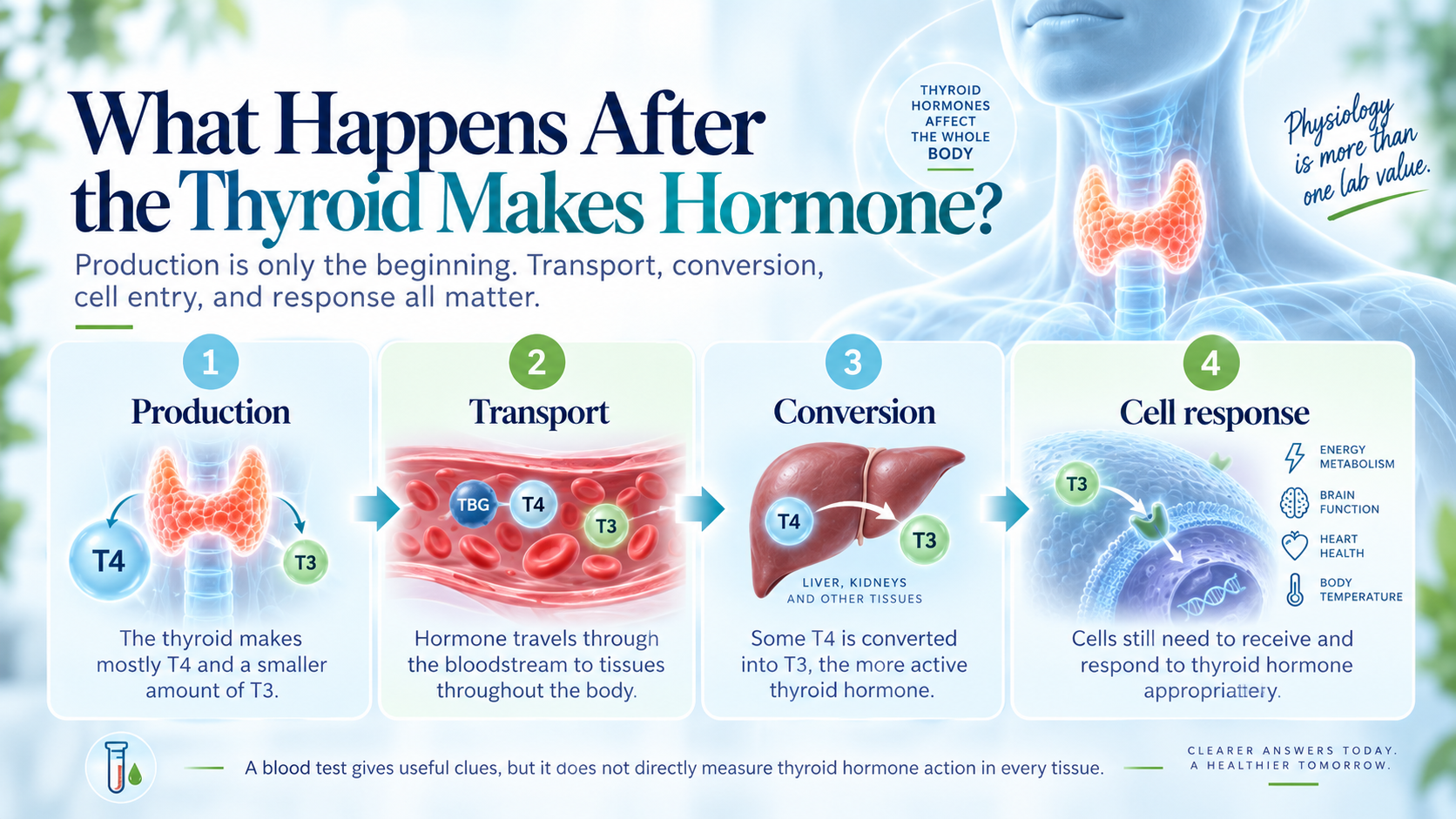
Your thyroid makes mostly T4, but that's not the end of the story. The body transports thyroid hormone, converts some T4 into T3, moves hormone into cells, and responds to it through receptors. If you still don't feel well, these are parts of thyroid physiology worth understanding alongside your overall health.
Should you check T3 or investigate conversion?
Sometimes. If you still feel unwell despite appropriate thyroid treatment, I would review your symptoms, medication, test timing, illness, nutrition, and other possible explanations before deciding whether a T3 measurement would help. A low-normal free T3 result alone cannot tell us how much hormone is being converted inside every tissue or prove that you need T3 medication.
Conversion matters, but there isn't one blood test that shows exactly what is happening in every cell. If treatment changes are being considered, your prescribing clinician needs to be involved.
What Else Could Be Affecting Your Hashimoto's Experience?
I use the Environmentally Induced Autoimmunity model to think about Hashimoto's. Your genes may influence susceptibility, but your health history, exposures, immune regulation, and physiology help us ask what might be contributing to the process in you. We can't identify a personal trigger from the diagnosis alone.

I don't want to hand you a long list of tests or tell everyone to avoid the same foods. I want to find the questions that matter most for you, focus on what we can reasonably change, and see what happens.
Read more about Hashimoto's diet and nutrition and gluten, celiac disease, and Hashimoto's.
If you're curious how I put those pieces together, read how functional medicine approaches Hashimoto's. It explains what the broader investigation can look like before you decide whether working with me makes sense.
What Do Common Hashimoto's Lab Patterns Mean?
These patterns can help you understand why two people with Hashimoto's might have different test results. They're not a way to diagnose yourself. Your history, lab ranges, previous results, medication, and circumstances still matter.
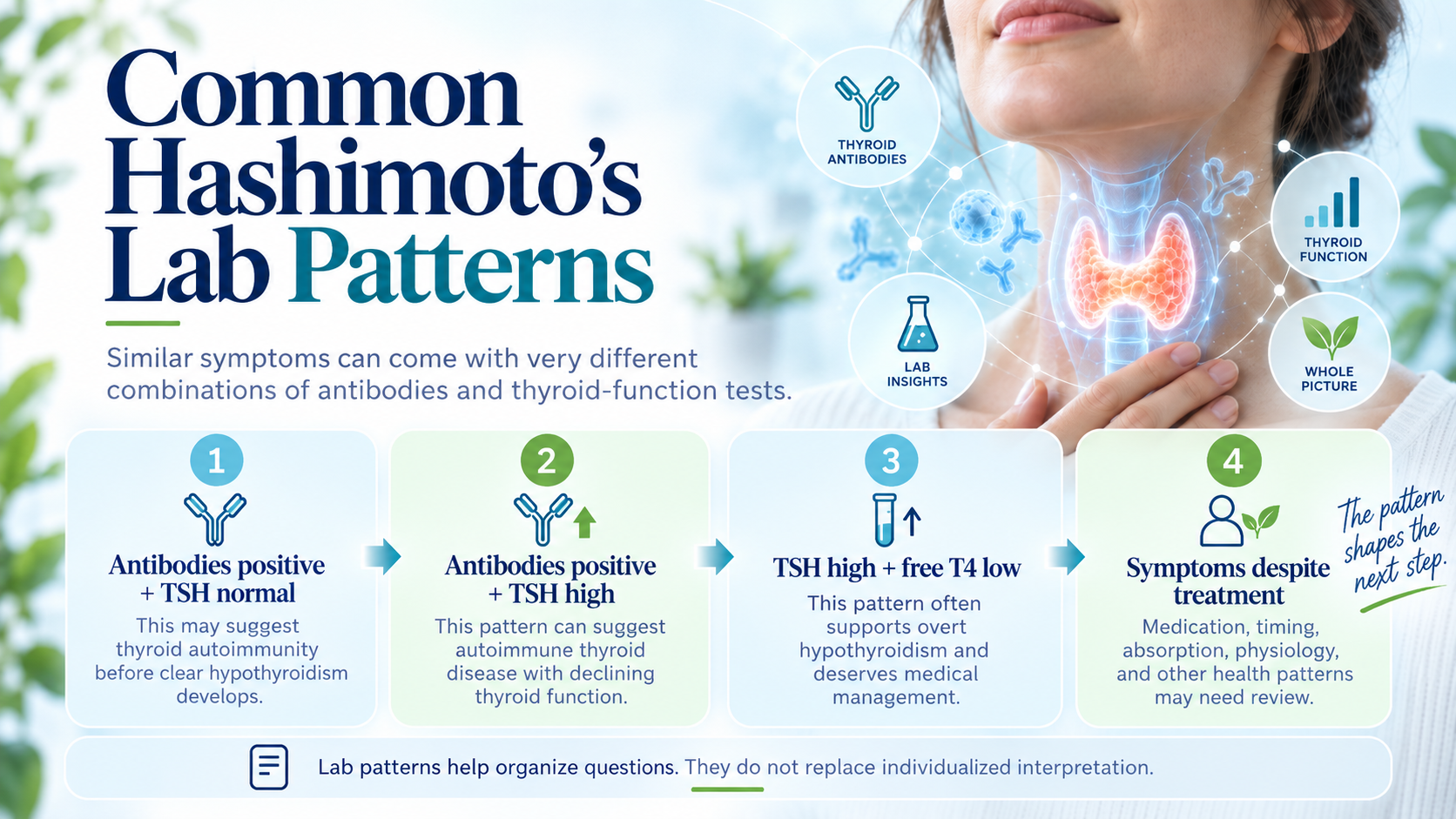
Unexplained combinations, including an unexpectedly low free T4 without elevated TSH, need appropriate medical evaluation rather than assuming that TSH alone tells the whole story.
Should You Follow Thyroid Antibodies Over Time?
Antibodies can help us answer whether thyroid autoimmunity is present. Repeating them later is a different decision: what would a new result help us understand?
Thyroid antibodies can fluctuate, but their levels do not map neatly to symptoms, thyroid tissue damage, or hormone needs. Routine repeat antibody testing is not needed to adjust a thyroid hormone prescription. If we consider repeating antibodies for a specific individualized question, we should agree in advance on what the result would change, interpret it alongside thyroid function and how you feel, and avoid treating a lower number as proof that the disease has been cured.
My reassessment standard: What changed in your symptoms, energy, daily function, thyroid stability, relevant labs, and quality of life? The whole picture matters more than chasing any single antibody value.
When Does Thyroid Imaging Add Information?
Thyroid ultrasound examines the gland's size and structure. It may help evaluate enlargement, a lump or nodule, or an uncertain diagnosis. It can show changes consistent with thyroiditis, including in some people whose hormone tests remain normal. Not everyone with positive antibodies needs an ultrasound.
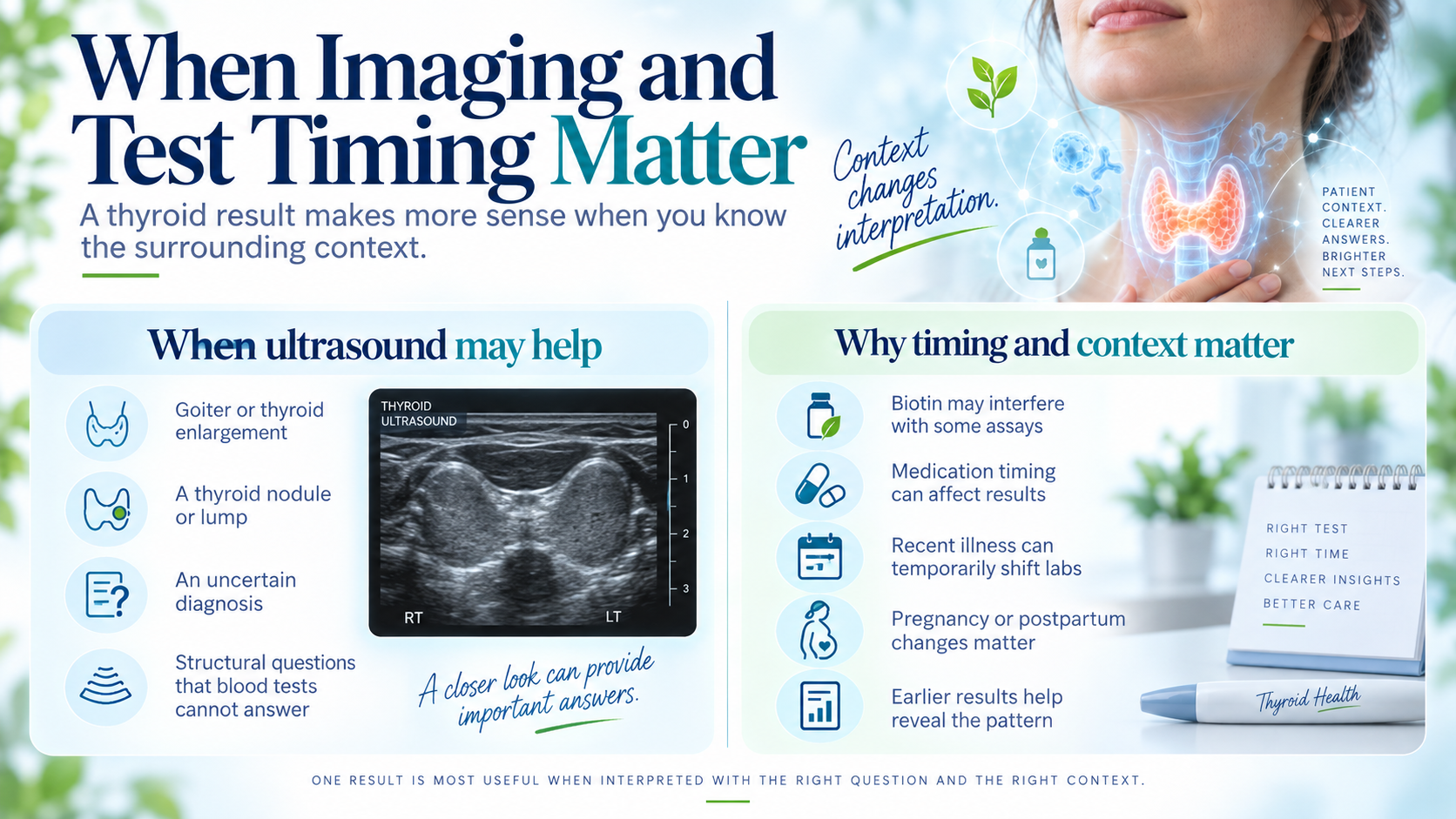
A thyroid biopsy is generally used to investigate a nodule when its imaging features and clinical circumstances warrant sampling. It is not a routine test for confirming Hashimoto's. If you notice a new or rapidly enlarging neck lump, persistent hoarseness, trouble swallowing, or breathing difficulty, seek appropriate medical assessment promptly.
For an expanded discussion, see thyroid imaging and Hashimoto's diagnosis when that guide is available.
Why Do the Timing and Context of Thyroid Tests Matter?
Before interpreting a result, I want to know when it was taken and what was going on in your life. A single result can be misleading when the surrounding context is missing.
- Biotin: Some supplements interfere with thyroid immunoassays. Tell the laboratory and your clinician what you take.
- Thyroid medication: Dose consistency, timing relative to the blood draw, missed doses, formulation changes, and interactions with iron, calcium, food, or other medications can matter.
- Illness and life stage: Acute illness, pregnancy, the postpartum period, and certain medications can change how results should be interpreted.
- Trends: Comparing prior results taken under similar conditions can sometimes answer more than looking at one isolated report.
If the result does not match the clinical picture, the answer is to investigate the discrepancy, not to assume the result is wrong or that every symptom must come from the thyroid.
What Can Functional Medicine Add After a Hashimoto's Diagnosis?
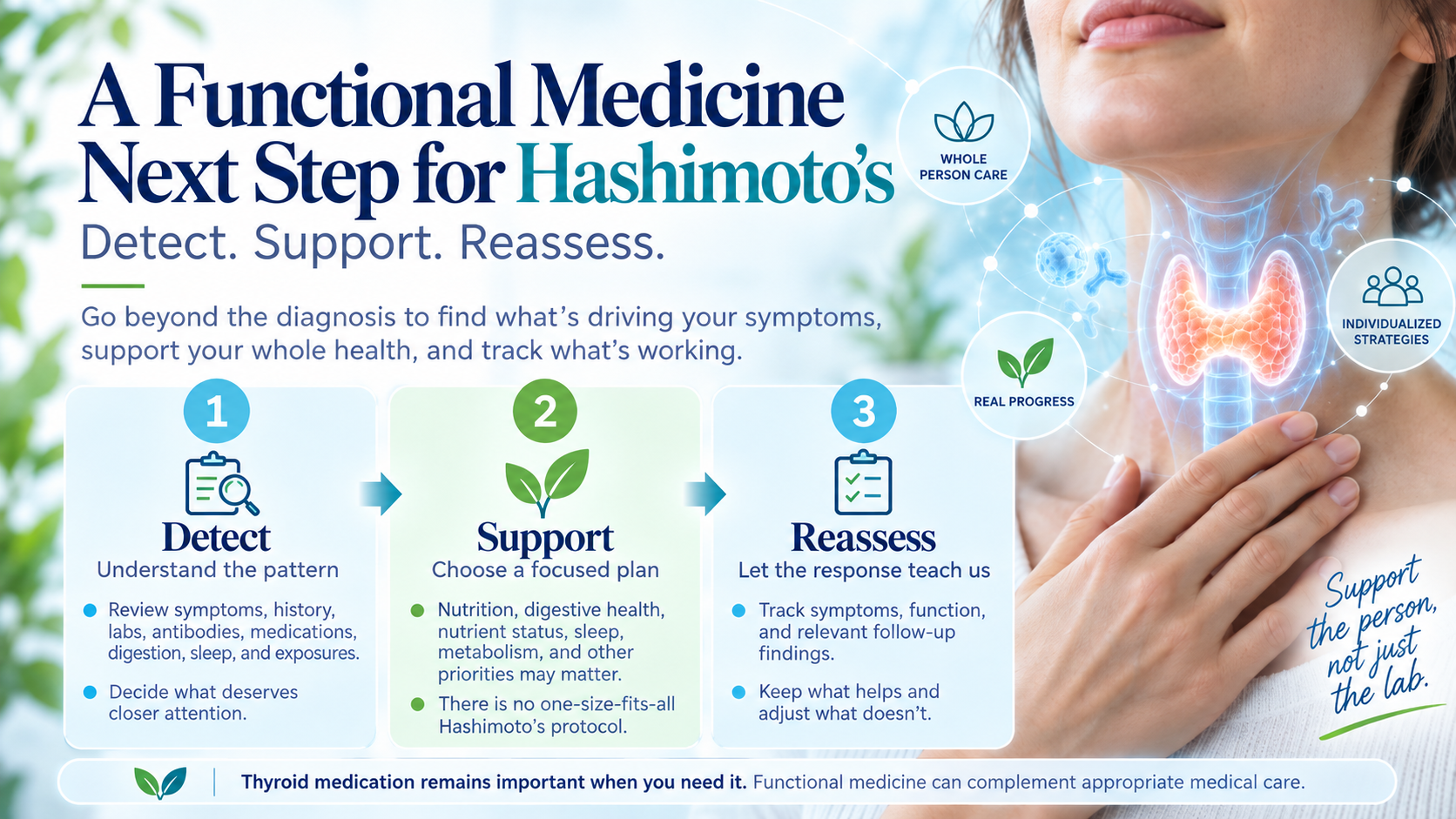
Once you understand your diagnosis, the next question is what to do with that information. My process is DETECT → SUPPORT → REASSESS. We look for the most relevant triggers, drivers, and physiological patterns, make a focused plan, and learn from how you respond. Thyroid medication remains important when you need it; this work can happen alongside your medical care.
Detect
We start with your story, existing labs, antibody and thyroid-function history, symptoms, medications, digestion, nutrition, sleep, stress, and relevant exposures. We decide what needs closer attention before choosing additional testing.
Support
Your plan depends on what we find. Nutrition, nutrient status, digestive problems, sleep, metabolic health, and other priorities may be relevant. There isn't one Hashimoto's protocol that fits everyone.
Reassess
We look at what changed in your symptoms, daily life, and relevant findings. Then we keep what helps and adjust what doesn't. A lower antibody number on its own doesn't tell the whole story.
There is no scientifically established natural cure for Hashimoto's. But there may be meaningful things to investigate and support. Learn more about my functional medicine approach to Hashimoto's and see whether it answers your next questions.
Questions Worth Asking When You Review Your Results
- Were my results checking thyroid function, thyroid autoimmunity, or both?
- Have TPO antibodies and, when appropriate, thyroglobulin antibodies been considered?
- Do earlier results show a stable pattern, or have my symptoms and test results changed?
- Could medication timing, absorption, illness, or other factors affect the numbers?
- If conversion or T3 is a concern, what specific question would further evaluation answer, and what can the test not tell us?
- What in my health history, digestion, nutrition, metabolic health, sleep, or exposures deserves attention?
- What are we going to measure when we reassess?
You can take these questions to your medical clinician, use them to review your own records, or bring them into a functional medicine conversation. You don't have to figure everything out at once.
Frequently Asked Questions About Hashimoto's Diagnosis
Can you have Hashimoto's with normal TSH?
Yes. Thyroid antibodies and other appropriate findings can show thyroid autoimmunity before the thyroid becomes underactive. A normal TSH does not by itself rule out Hashimoto's, and positive antibodies do not automatically mean you need thyroid hormone medication.
Why might a thyroid workup not include Hashimoto's antibody tests?
Some workups focus on thyroid hormone levels because the immediate medical decision is whether hormone replacement is needed. Identifying the autoimmune cause may not change that prescription, but it can answer a different diagnostic question and inform follow-up.
Which antibodies are used to investigate Hashimoto's?
Thyroid peroxidase antibodies (TPOAb) and thyroglobulin antibodies (TgAb) recognize different thyroid proteins. They may help identify thyroid autoimmunity when interpreted with history, examination, thyroid function, and other findings.
Should I check free T3 to see if I have a conversion problem?
Sometimes T3 testing can address a specific clinical question, especially with persistent symptoms on treatment or unexpected results. But a blood T3 value cannot directly measure conversion or hormone action in every tissue, and one result does not prove a conversion disorder.
Can thyroid antibodies show whether the autoimmune disease is improving?
Antibody levels may change, but the number does not reliably measure symptom severity or the amount of thyroid damage. Repeating antibodies should answer a defined question; thyroid function, symptoms, and everyday function remain important to reassess.
Do I need an ultrasound to diagnose Hashimoto's?
Not always. Ultrasound may clarify an uncertain diagnosis or evaluate a goiter or thyroid nodule. A biopsy is typically considered for a nodule that warrants sampling, not simply to confirm Hashimoto's.
What does functional medicine investigate after a Hashimoto's diagnosis?
It reviews the autoimmune process, thyroid physiology, symptom timeline, medications, nutrition, gut health, nutrient status, metabolism, sleep, stress, and relevant exposures. Testing and support are selected for the person rather than prescribed as one universal protocol.
Can you cure Hashimoto's naturally?
There is no scientifically established natural cure for Hashimoto's. An individualized functional medicine plan may help investigate relevant triggers and drivers, support overall physiology, and measure meaningful changes alongside appropriate medical care.
Research and Further Reading
If you want to read further, these sources cover thyroid testing, hormone physiology, and the different explanations researchers are studying for persistent symptoms. Findings from a study still need to be considered in the context of the individual.
- Persistent symptoms in euthyroid Hashimoto’s thyroiditis: current hypotheses and emerging management strategies. Review, 2025.
- Critical approach to hypothyroid patients with persistent symptoms. Review, 2023.
- Thyroid-stimulating hormone and thyroid hormones: a review of current clinical and laboratory status. Thyroid, 2023.
- Hashimoto’s thyroiditis: diagnosis, antibodies, and thyroid-function monitoring. American Thyroid Association.
Wondering What to Explore After Your Hashimoto's Diagnosis?
If this has raised questions about your immune system, thyroid hormone, or symptoms, the next step is to understand how functional medicine connects those pieces. I explain what I look for, how I decide what deserves attention, and what an individualized plan might involve.
Already know you'd like me to review your situation? Learn about applying for care. I'll review your application before sharing any private scheduling information.