First, There Are Two Different Questions to Answer
When someone asks me, “What should I do about Hashimoto's?”, I want to know which part of the picture we're talking about. Your thyroid hormone level matters. So does the fact that an autoimmune process has been identified.
Does your body have enough thyroid hormone?
TSH, free T4, your clinical history, and medical follow-up help answer whether your thyroid is keeping up or whether you need hormone replacement. Replacing a hormone deficiency can be essential to your health.
What may be shaping the autoimmune process and your symptoms?
A Hashimoto's diagnosis does not identify the personal combination of susceptibility, possible triggers, medication issues, nutrition, or other conditions that may matter to you. Those questions call for a more individualized look.
Neither question makes the other unimportant. If you need thyroid hormone, keeping it at an appropriate level is part of supporting your health while you investigate the bigger picture.
What Does Treatment Look Like at Different Stages?
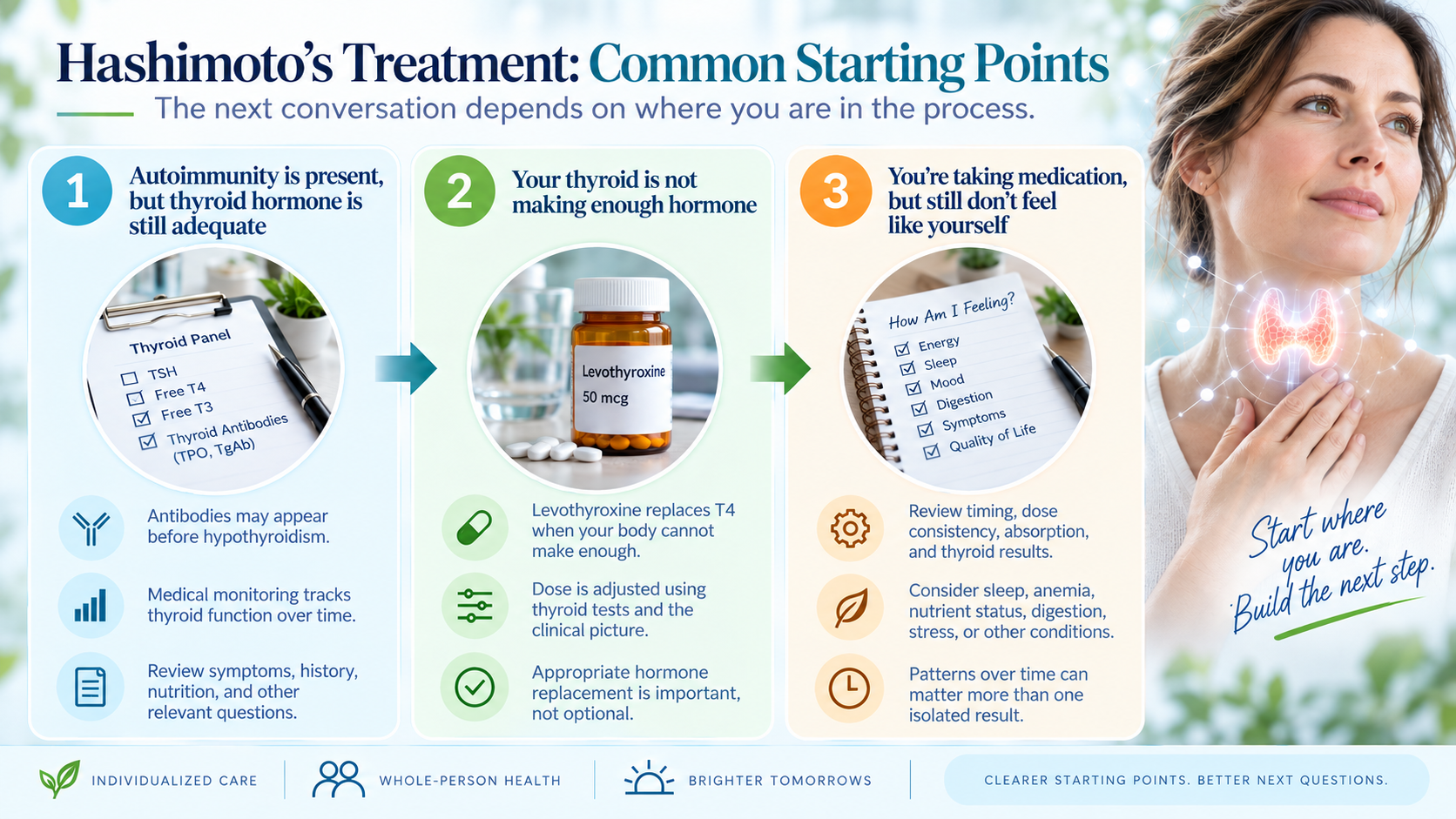
There isn't one starting point for everyone. Here are three common situations. They aren't a way to diagnose yourself, but they can help you recognize which conversation you may need.
Antibodies are present, but thyroid hormone levels are normal
Some people have evidence of thyroid autoimmunity before they develop hypothyroidism. They may not need thyroid hormone yet. Medical monitoring can track changing function while a thoughtful evaluation considers symptoms, history, nutrition, and other relevant questions.
Your thyroid is not making enough hormone
Levothyroxine supplies T4 when your body cannot produce enough. Your prescribing clinician adjusts it using thyroid tests and the clinical picture. When thyroid output is truly insufficient, replacing that hormone is important, not an optional add-on.
You're taking medication, but you don't feel like yourself
First, it's worth reviewing medication timing, dose consistency, absorption, and thyroid results with your prescriber. Then we can ask whether sleep, anemia, nutrient status, digestion, stress, another condition, or hormone physiology may be contributing.
Your thyroid results or symptoms keep changing
Patterns over time can be more informative than one isolated result. Medication changes, pregnancy or postpartum changes, illness, and shifts in thyroid function all deserve context. Sudden or severe symptoms need prompt medical evaluation.
Why Isn't a Hashimoto's Diagnosis the End of the Investigation?
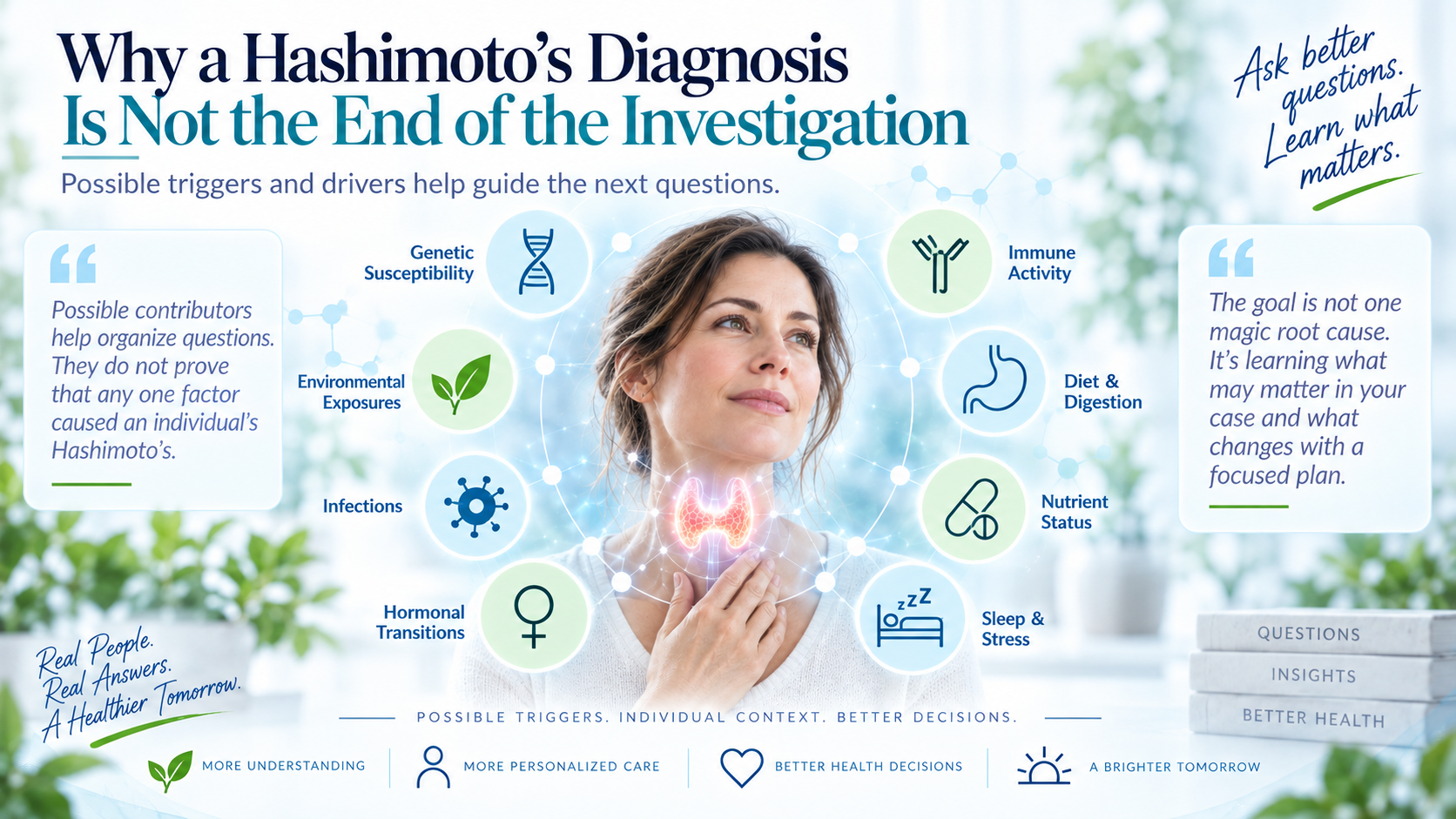
Hashimoto's names the autoimmune disease. It doesn't automatically tell us why your immune system began reacting to the thyroid or which influences may still be relevant. Genetics can help explain susceptibility, but they don't give us a complete personal timeline.
I use an Environmentally Induced Autoimmunity model to organize questions about susceptibility, possible environmental exposures, immune activity, and the body's barrier systems. Depending on your story, we might consider an infection, an important hormonal transition, diet, nutrient status, sleep, stress, or a medication. These are possible contributors to investigate, not a checklist of causes that everyone has.
A positive food antibody, an old infection antibody, or one unusual lab value does not prove the cause of your Hashimoto's. I want the findings to fit your history and help us choose an action we can reasonably assess afterward.
The opportunity isn't finding one magic root cause. It's learning which factors might actually matter in your case, which can be changed safely, and what we learn from your response.
For a closer look at how the diagnosis is established, see how Hashimoto's is diagnosed.
Can Diet, Nutrients, and Everyday Habits Help?
They can be worthwhile parts of a plan, especially when they address something real in your life. But the useful question is not “What diet does everyone with Hashimoto's need?” It's “What do you need support with, and how will we know whether it helped?”
Food and digestion
A nourishing diet can help with overall health, and a specific diagnosis such as celiac disease changes what food choices are medically necessary. If celiac disease is a possibility, discuss testing before removing gluten, because going gluten-free can interfere with testing. Research has not established that everyone with Hashimoto's benefits from gluten avoidance when they do not have celiac disease. If a food trial makes sense for you, we should make it purposeful, nutritionally adequate, and possible to reassess.
Read the Hashimoto's diet guide for a more detailed discussion.
Nutrients and supplements
Iron, vitamin B12, vitamin D, iodine, and selenium are worth understanding when your history or findings give us a reason. That does not mean taking high doses of all of them. Excess iodine can worsen thyroid problems in susceptible people. Selenium research has produced mixed results, and changes in antibody levels have not consistently translated into better quality of life. Supplements can also interact with medicines or lead to excessive intake.
Sleep, stress, and activity
How you sleep, eat, move, and recover can affect your energy and day-to-day function. Those habits can be useful things to support even when we cannot prove they caused the autoimmune disease. I would rather build a realistic plan around your needs than ask you to overhaul your entire life at once.
A good plan has a reason behind each change. What are we trying to improve? What will we track? When will we decide whether to keep going, adjust, or investigate something else?
What If Your TSH Looks Fine but You Still Feel Unwell?
That deserves an actual conversation. Thyroid hormone has to be absorbed, transported, converted in different tissues, and received by cells. T4-to-T3 conversion is real physiology, but a symptom or a single blood test cannot prove that every tissue has a conversion problem. Nor does it automatically mean you need T3 medication.
Sometimes the first clue is simpler: coffee or an iron supplement taken close to levothyroxine, a formulation change, or a digestive condition that affects absorption. Sometimes another problem, such as iron deficiency, poor sleep, or a separate medical condition, has to be addressed on its own terms. A good evaluation doesn't assume every symptom is “just your thyroid,” and it doesn't dismiss the symptom either.
See the detailed guide to thyroid medication, absorption, and T3 questions. Medication decisions belong with your prescribing clinician.
How I Approach Hashimoto's Treatment Questions in Functional Medicine
I start with what has already happened to you, not a universal supplement bundle. You may have years of blood work, changing symptoms, a diet you've already tried, or a medication you don't fully understand. All of that can help us decide what deserves attention now.
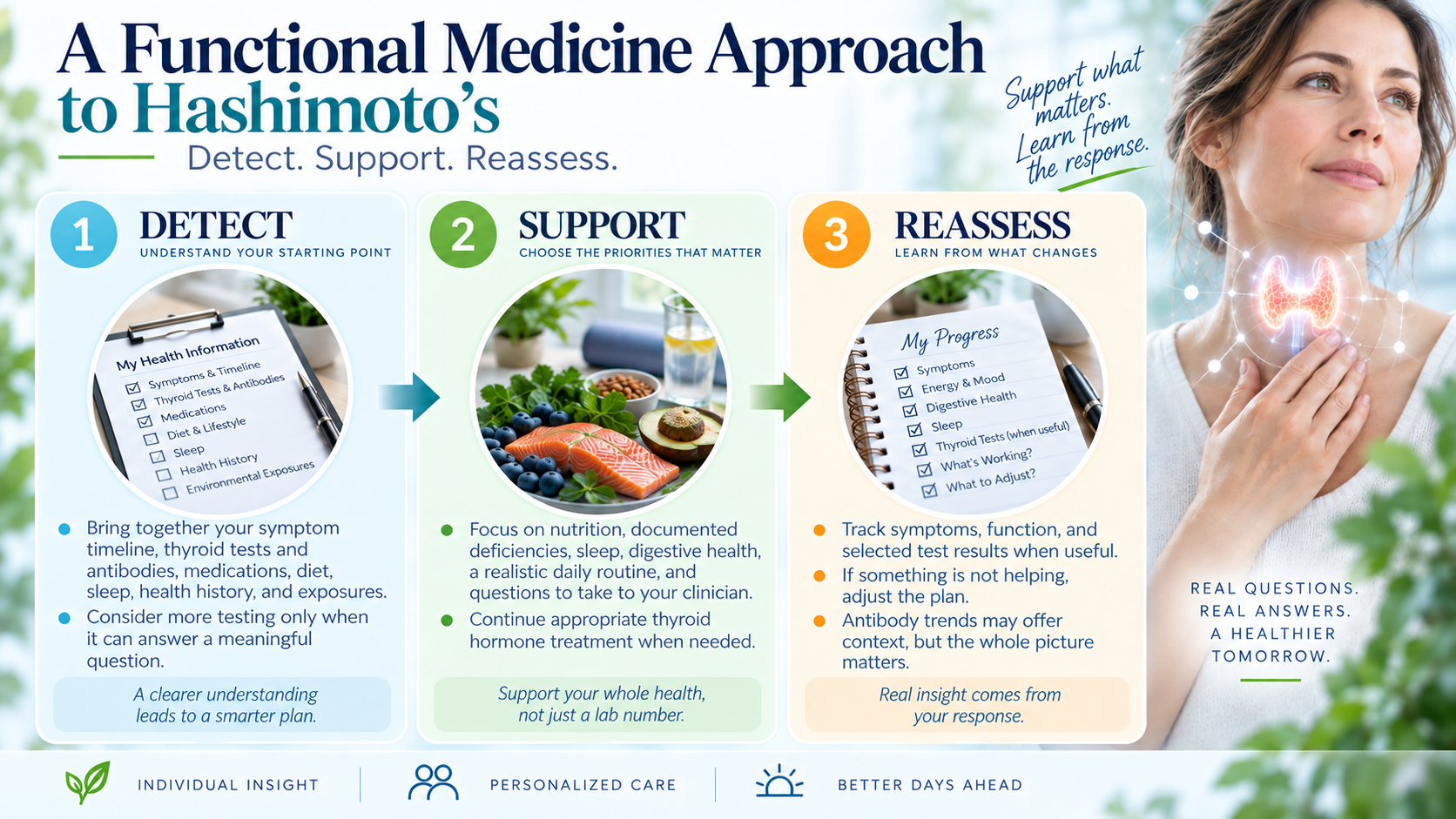
DETECT: understand your starting point
We bring together your symptom timeline, records, thyroid tests and antibodies, medications, diet, sleep, health history, and relevant exposures. We consider more testing only when it can answer a meaningful question. Imaging belongs in the picture if a structural thyroid concern needs evaluation.
SUPPORT: choose the priorities that matter
A plan might focus on better nutrition, a documented deficiency, sleep, digestive health, a realistic daily routine, or questions to take to your medical clinician. Different findings lead to different plans. Appropriate thyroid hormone treatment continues when needed.
REASSESS: learn from what changes
We look at symptoms, function, and selected test results when useful. If something isn't helping, we don't keep doing it simply because it belongs to a popular protocol. Antibody trends may provide context in a specific situation, but a lower number by itself does not prove a cure or explain your everyday function.
Want to see why plans differ between people with the same diagnosis? Read about a bioindividualized approach to Hashimoto's.
Can You Cure Hashimoto's Naturally?
There is no scientifically established natural cure for Hashimoto's disease. That doesn't make your next choices meaningless. Some people can improve symptoms, correct identified deficiencies, support their health, or better understand how their bodies respond to specific changes. Those improvements deserve to be taken seriously without promising that the autoimmune disease has disappeared.
If you already need thyroid hormone because your gland cannot make enough, a diet or supplement should not be presented as a replacement. Keep medical follow-up in place as you explore other questions.
And remember, an antibody result is not a report card on you. Its level does not directly measure all thyroid injury or tell us whether you feel better. We use the whole picture.
Where Should You Go From Here?
If you're newly diagnosed, start with the diagnosis guide. If you want to understand your prescription, read how conventional thyroid treatment works. If you've been wondering why two people with Hashimoto's need different plans, explore the individualized approach.
For the next step in this conversation, I recommend learning how functional medicine approaches Hashimoto's. It brings the diagnosis, triggers, physiology, and your own priorities together so you can decide whether the approach fits what you're looking for.
You can always return to the main Hashimoto's resource center to explore the wider topic.
Frequently Asked Questions About Hashimoto's Disease Treatment
What is the usual treatment for Hashimoto's disease?
If Hashimoto's causes hypothyroidism, a clinician commonly prescribes levothyroxine to replace missing T4 and monitors thyroid function. When thyroid function is still normal, monitoring without hormone medication may be appropriate. Individualized nutrition, lifestyle, and other evaluations can complement medical care.
Is Hashimoto's the same thing as hypothyroidism?
No. Hashimoto's describes an autoimmune disease affecting the thyroid. Hypothyroidism means the body does not have enough thyroid hormone. Hashimoto's may eventually cause hypothyroidism, but the autoimmune process can be present before hormone levels become low.
Can you treat Hashimoto's without thyroid medication?
Some people with Hashimoto's have adequate thyroid function and do not need hormone replacement yet. If your thyroid cannot make enough hormone, medication may be essential. Nutrition, lifestyle, or supplements should not replace necessary prescribed thyroid hormone.
Can functional medicine cure Hashimoto's?
No scientifically established natural cure exists. Functional medicine can provide a structured way to investigate possible triggers, nutritional and physiological issues, and individual responses while you continue appropriate medical care. Improvement in symptoms or a lab marker does not prove a cure.
Should everyone with Hashimoto's stop eating gluten?
No. A gluten-free diet is necessary for celiac disease, but evidence does not show that all people with Hashimoto's without celiac disease benefit from avoiding gluten. Discuss celiac testing before eliminating gluten if celiac disease is suspected, and make dietary changes based on your own needs.
Will selenium or iodine supplements fix Hashimoto's?
No supplement reliably cures Hashimoto's. Excess iodine can make thyroid problems worse in some people, and selenium research has not consistently shown better quality of life. Review your diet, test results, medications, and supplement doses with qualified clinicians before taking high-dose products.
Why do I feel tired if my TSH is normal?
A normal TSH does not explain every symptom. Medication timing or absorption, sleep problems, anemia, nutrition, other conditions, and thyroid hormone physiology may deserve review. A symptom alone does not prove impaired T4-to-T3 conversion.
Should thyroid antibodies be the main way I track treatment?
No. Antibodies can help identify thyroid autoimmunity and may offer context in selected cases, but the number alone does not measure how much thyroid tissue has been damaged or how well you feel. Thyroid function, symptoms, everyday function, and relevant findings matter together.
What should I read next if I want to explore functional medicine for Hashimoto's?
Start with the Functional Medicine for Hashimoto's guide. It explains how Dr. Shook reviews your history, symptoms, possible triggers, thyroid results, and other relevant physiology to build a focused plan and reassess what changes. An Application for Care is available if you later want to explore working together.
Research and Further Reading
These resources support the medical and nutrition facts on this page. The individualized model is explained in the functional medicine guide.
- Hashimoto's disease: diagnosis, hormone replacement, and iodine considerations. National Institute of Diabetes and Digestive and Kidney Diseases.
- Hashimoto's thyroiditis: diagnosis and monitoring. American Thyroid Association.
- Gluten-free diet in non-celiac Hashimoto's thyroiditis. 2025 systematic review and meta-analysis; limited, very uncertain evidence.
- Selenium supplementation and quality of life in autoimmune thyroiditis. 2024 randomized, placebo-controlled trial.
- Selenium supplementation in Hashimoto thyroiditis. 2024 systematic review and meta-analysis.
- Hypothyroidism and thyroid hormone treatment. NIDDK.
Want to Understand What May Be Driving Your Hashimoto's?
Now that you know what thyroid treatment can do, the next guide explains how I investigate possible triggers, your individual physiology, and which factors may be worth changing. You can explore the approach before deciding whether working together makes sense.
Already thinking about working together? Learn about the Application for Care. I review applications before providing a private scheduling link.