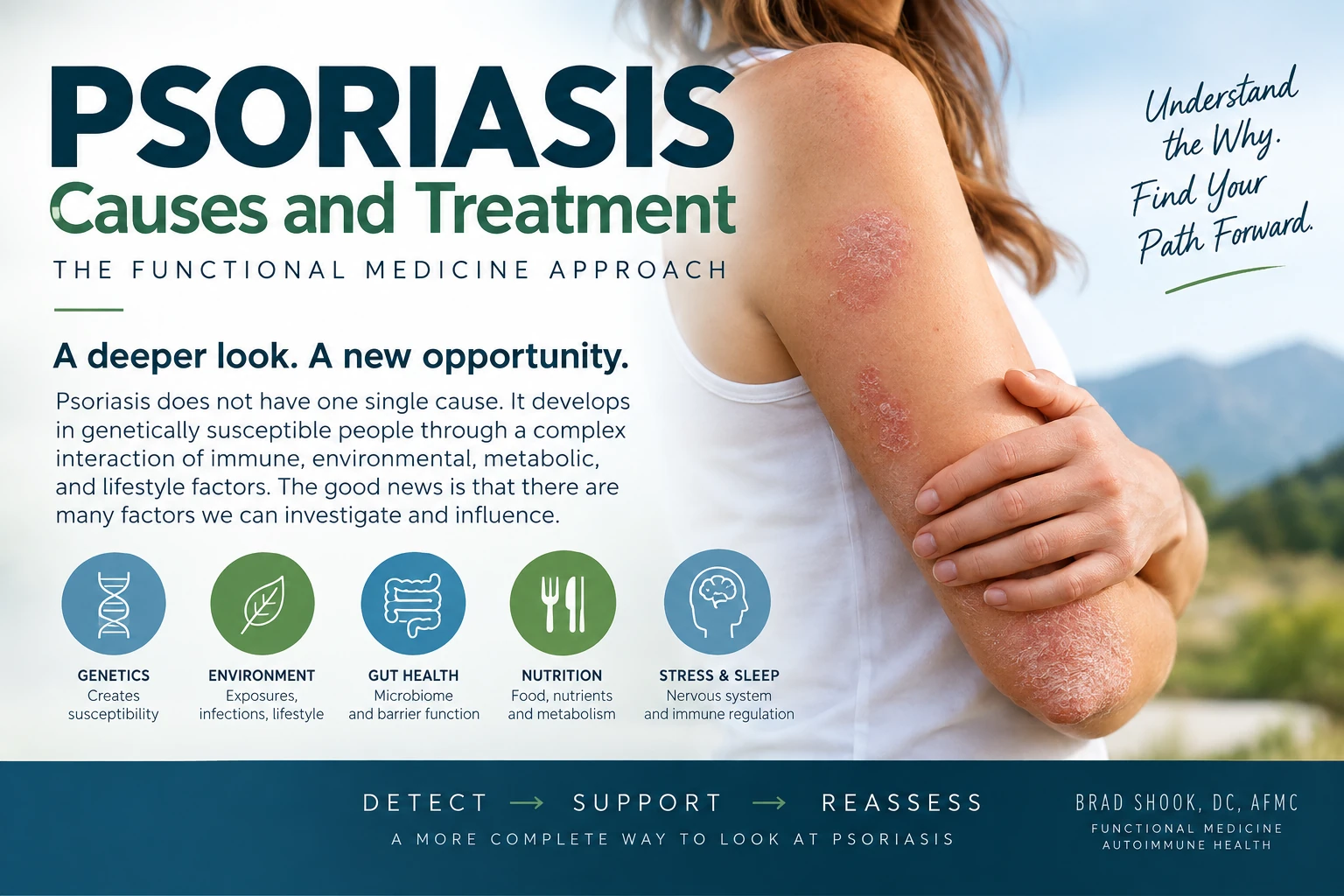
Understanding Psoriasis Causes Means Moving Beyond a Single Root Cause
One of the most common questions I hear is, “What caused my psoriasis?” It is an understandable question, but the answer is rarely simple. Psoriasis is not usually explained by one root cause that applies to every person.
Instead, psoriasis is better understood as an autoimmune and inflammatory process that develops in a susceptible person and may be influenced by multiple triggers, drivers, and patterns in physiology over time.
It creates a new opportunity to ask better questions. What may have triggered the process? What may be helping sustain it? Which factors may be modifiable? Where should we focus first?
Genetics Create Susceptibility, but They Are Not the Whole Story
Genetics matter in psoriasis. Family history increases risk, and researchers have identified multiple immune-related genes associated with the disease. But genetics are not destiny. Many people with genetic susceptibility never develop psoriasis, while others do after a period of changing physiology, exposure, stress, infection, or other environmental influences.
That is an important epiphany. A genetic tendency helps explain vulnerability, but it does not fully explain timing, severity, flare patterns, or why one person improves when another does not.
For deeper context on heredity and immune risk, see the genetics of psoriasis and psoriatic arthritis.
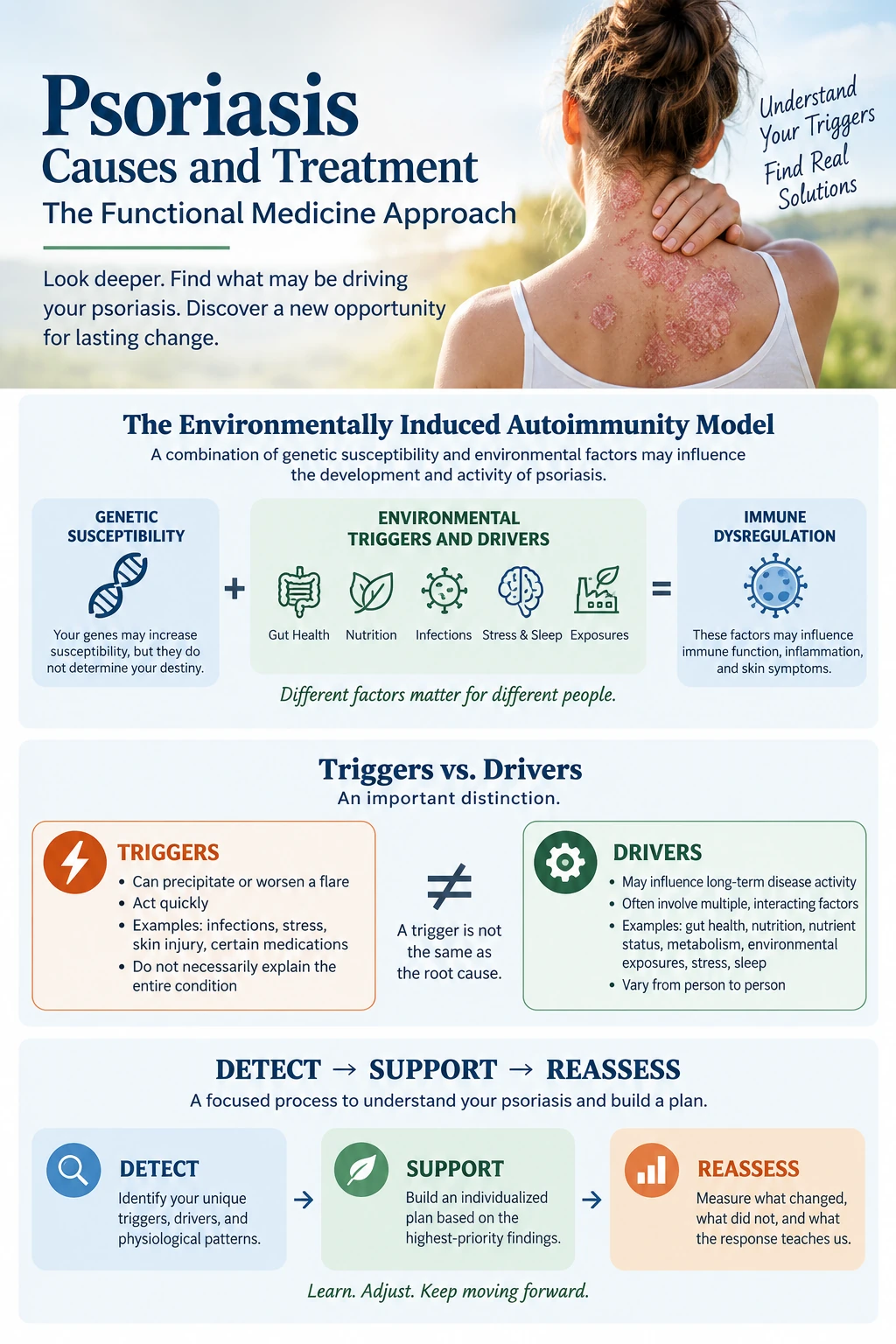
The Environmentally Induced Autoimmunity Model
When I talk about autoimmune disease, I often use the framework of Environmentally Induced Autoimmunity. That does not mean every case has one environmental cause, and it does not mean every person needs the same investigation. It means autoimmune disease can be influenced by an interaction between genetic susceptibility and the environment around the person.
That environment can include infections, medications, food patterns, gut health, sleep, stress, nutrient status, toxic exposures, skin-barrier disruption, metabolic health, and other physiological factors. The useful question is not whether every item on that list matters to everyone. The useful question is which patterns seem most relevant in this person.
Triggers and Drivers Are Not the Same Thing
A trigger is something that provokes or worsens disease activity. A driver is something that may help sustain inflammatory burden or immune dysregulation over time. The two can overlap, but they are not automatically the same.
Common triggers
Infections, stress, skin injury, certain medications, smoking, dry weather, or other events that seem to precede or worsen a flare.
Potential drivers
Patterns involving diet, metabolism, gut health, nutrient status, sleep, chronic stress, exposures, or other physiology that may be contributing to the overall inflammatory picture.
This distinction matters because a list of psoriasis triggers is not the same thing as an explanation for why the disease is active in a particular person.
Known Psoriasis Triggers
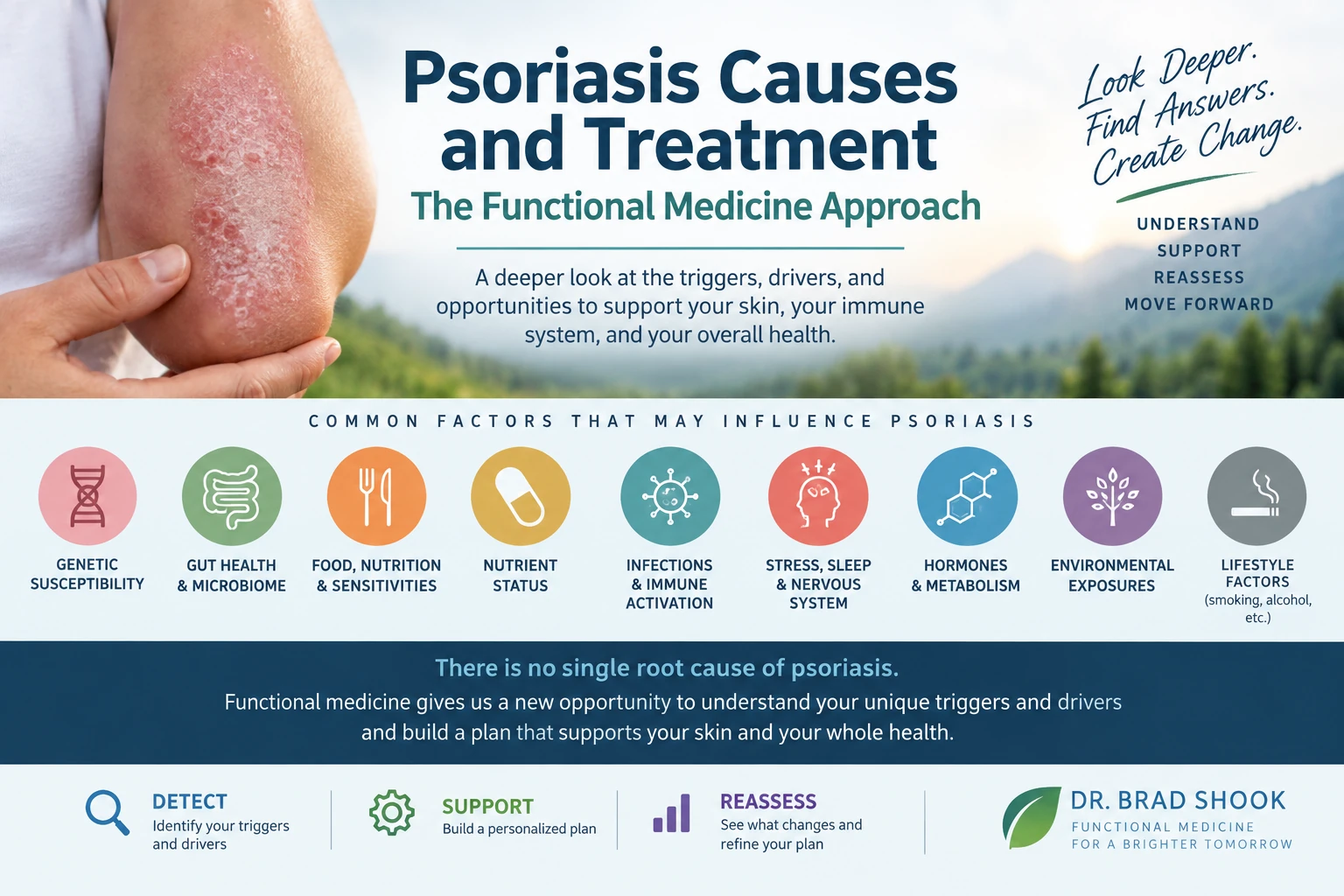
Some flare patterns are well recognized. These do not explain every case, but they often belong in the conversation.
Streptococcal infection can be associated with guttate psoriasis, and other infections may influence immune activity in some people.
Psychological and physiological stress can be relevant to flare patterns.
The Koebner phenomenon describes psoriasis appearing at sites of trauma, irritation, or injury.
Certain medications are known to trigger or worsen psoriasis in some individuals.
Smoking is associated with psoriasis risk and can worsen some forms of disease.
Climate, season, and barrier stress can affect disease expression.
For a broader symptom discussion, see does psoriasis spread? and psoriatic arthritis symptoms, flare-ups, triggers, and treatment.
Gut Health and the Microbiome May Matter, but Not as a Universal Explanation
The older version of this page listed a compromised gut microbiome as an underlying cause of psoriasis. I think the better framing is that gut health may be relevant for some people and deserves thoughtful investigation when the history, symptoms, or response pattern points in that direction.
Functional medicine can look at gastrointestinal symptoms, diet, bowel patterns, medication history, infection history, nutrient status, and other clues to decide whether gut-focused support or testing makes sense. What I want to avoid is telling everyone that gut dysfunction is automatically the cause of their psoriasis.
Food, Nutrition, and Immune Signaling
Food can influence the body in many ways, including immune signaling, barrier function, metabolism, and nutrient status. But there is no single psoriasis diet that works for everyone, and not every person with psoriasis has clinically meaningful food sensitivities or allergies.
I want to be careful here. A personalized nutrition strategy can be incredibly important, but that does not mean every person needs the same eliminations. The point is to look for useful patterns, identify what seems most relevant, and avoid unnecessary restriction when it is not supported by the person's history or response.
Related reading: Hashimoto's and diet, natural support for autoimmune conditions, and can turmeric help with managing psoriasis?.
Nutrient Deficiencies Can Be Relevant
The old page also listed nutrient deficiencies as a possible underlying cause. I would update that to say nutrient status can absolutely be relevant, but it should be evaluated in context. A low nutrient marker does not necessarily explain the entire autoimmune process, yet correcting meaningful deficiencies can still be an important part of supporting the body.
This is one reason I say testing should help us answer better questions. If nutrient status appears relevant, the goal is to detect it, support it intelligently, and reassess the response.
Infections and Immune Activation
Infections can be clinically important in psoriasis, especially when flare timing, symptom patterns, or disease subtype suggest a connection. That does not mean there is always a hidden infection behind psoriasis, but it does mean the topic can be relevant enough to investigate in the right context.
This is a good example of the difference between a trigger and a universal explanation. A strep infection can be highly relevant in one person and irrelevant in another.
Stress, Sleep, and the Nervous System
Chronic stress was one of the factors named on the old page, and I think that remains fair as long as we frame it correctly. Stress can influence inflammation, behavior, sleep quality, recovery, food choices, and overall resilience. Poor sleep can do the same.
Again, I do not want to tell everyone that stress is the cause of their psoriasis. I do want people to appreciate that the nervous system and recovery capacity can be part of the overall picture and deserve attention.
Metabolism, Body Composition, and Broader Health Patterns
Psoriasis is associated with broader health patterns such as obesity, insulin resistance, and cardiovascular risk. That does not mean these patterns explain every case, but it does mean metabolism belongs in the conversation. When a person's physiology is under more strain, the autoimmune process may not be behaving in isolation.
This is one of the reasons psoriasis is more than a skin condition. Supporting overall physiology can matter for the person even beyond the plaques.
Chemicals, Exposures, and the Environment Around the Person
Environmental exposures may also be part of the discussion in select cases. This can include workplace exposures, smoking, secondhand smoke, personal-care products, household chemicals, mold concerns, or other environmental inputs depending on the history.
I would not assume these are always relevant. But when the timing, history, or symptom pattern raises the question, this is part of what a broader functional medicine investigation can explore.
Functional Medicine Opens a New Opportunity for Psoriasis
People are often told what diagnosis they have and what treatment options are available. That can be useful, but it does not always answer the next question: why might this autoimmune process be active in me?
That is where I believe functional medicine is foundational. It gives us a structured way to investigate the person around the diagnosis. We can look at triggers, drivers, immune patterns, barriers, nutrition, metabolism, sleep, stress, gut health, exposures, medications, and other individualized factors that may deserve attention.
This is not about claiming one universal root cause or one protocol for everyone. It is about recognizing that a diagnosis identifies the disease, while functional medicine investigates the conditions that may be influencing how that disease behaves.
DETECT, SUPPORT, REASSESS
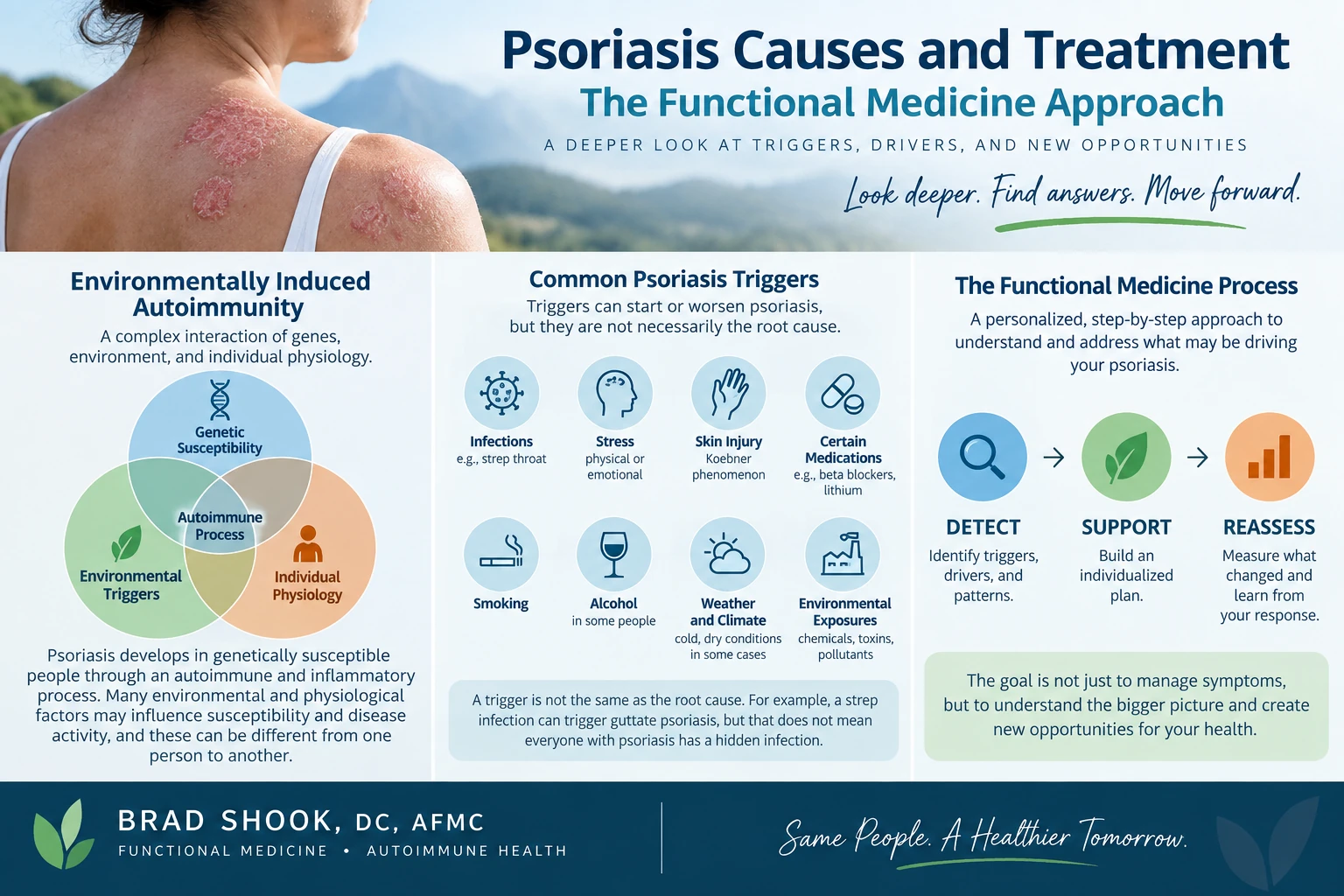
Identify the most meaningful patterns using symptoms, history, records, labs, diet, lifestyle, exposures, medications, and other relevant information.
Build an individualized plan around the highest-priority findings. That may include diet, lifestyle, sleep, stress support, targeted supplements, and other focused strategies.
Measure what changed, what did not, and what that response teaches us about the autoimmune process and the person living with it.
A Personalized Plan for Psoriasis Treatment
The old page was right about one important thing: psoriasis care should be personalized. I would just describe it differently now. Personalization is not a buzzword. It means we do not assume every person needs the same diet, the same supplements, the same testing, or the same explanation for why the disease is active.
Instead, the plan should reflect the person's history, symptoms, current treatment, physiology, goals, and response over time. That is how I think about functional medicine and autoimmune support.
Where Medical Psoriasis Treatment Fits
Functional medicine is not an anti-medication or anti-dermatology position. There are many situations where medical treatment is important, especially when psoriasis is moderate to severe, rapidly worsening, widespread, or associated with psoriatic arthritis.
Topical medications, phototherapy, oral systemic medications, and biologic therapies can all have a place. I do not see these tools and functional medicine as competitors. Functional medicine helps us investigate why the autoimmune process may be active and what may be influencing it. Medical treatment may be used to control active disease and protect health when needed.
To go deeper, see topical and systemic medications for psoriasis, plaque psoriasis medications and functional medicine, and severe psoriasis treatment.
Where to Go Next
Frequently Asked Questions About Psoriasis Causes and Treatment
What causes psoriasis?
Psoriasis does not have one single universal cause. It is a chronic autoimmune and inflammatory disease that develops in genetically susceptible people. Disease activity can be influenced by factors such as infections, stress, skin injury, certain medications, smoking, metabolic health, sleep, nutrition, and other environmental or physiological factors.
Is there a root cause of psoriasis?
I would be careful with the phrase root cause because it often implies one answer that explains every case. In my view, psoriasis is better understood as a multifactor process. The useful question is not, "What is the one cause of psoriasis?" but, "Which triggers, drivers, and physiological patterns may be most relevant in this person?"
What is the difference between a trigger and a driver in psoriasis?
A trigger is something that can provoke or worsen disease activity, such as an infection, a medication, or skin injury. A driver is a broader factor that may help sustain inflammatory burden or immune dysregulation over time. The distinction matters because not every trigger is the whole explanation, and not every driver is obvious from the diagnosis alone.
Can stress cause psoriasis?
Stress can influence psoriasis activity and is a common flare factor for many people, but it should not be treated as the single cause of psoriasis. It is one possible piece of a larger picture.
Can gut health affect psoriasis?
Gut health may be relevant for some people with psoriasis, but it should not be treated as a universal explanation. Functional medicine looks at gut symptoms, history, diet, nutrient status, immune patterns, and other clues to decide whether further investigation is warranted.
Can food trigger psoriasis?
Food may matter for some people, but there is no single psoriasis diet or universal food trigger that explains every case. The useful approach is individualized: look at patterns, symptoms, health history, and response rather than assuming everyone needs the same restrictions.
How does functional medicine treat psoriasis?
In my approach, functional medicine creates a new opportunity to understand the person around the diagnosis. I use it to investigate potential triggers, drivers, and physiological patterns, then build a focused plan using DETECT, SUPPORT, and REASSESS. That can include diet, lifestyle, sleep, stress support, nutrition, gut-health work, targeted supplementation, and other individualized strategies.
Where do medications fit in psoriasis treatment?
Medications can be very important, especially when disease is moderate to severe, rapidly worsening, or associated with psoriatic arthritis. I do not see medical treatment and functional medicine as competitors. Functional medicine investigates why the autoimmune process may be active and what can be changed, while medical treatment may help control active disease and protect health.
Can psoriasis go into remission?
Yes. Psoriasis can wax and wane, and some people experience periods of remission. There is no scientifically established cure, but disease activity can often be controlled more effectively when care is individualized and people learn from how their psoriasis responds over time.
What kind of testing is useful in psoriasis?
Testing should help answer better questions. Depending on the history and symptoms, useful testing may involve nutrient status, metabolic markers, gastrointestinal clues, inflammatory patterns, records review, or other focused assessments. The goal is not to run every test available. The goal is to choose the tests that help guide decisions.
Want Help Investigating What May Be Driving Your Psoriasis?
If you want to explore psoriasis through a functional medicine lens, the goal is not to chase one universal root cause. The goal is to understand the triggers, drivers, and physiological patterns that may be influencing how the autoimmune process behaves in you.
Important Health Information
Seek appropriate medical evaluation for severe, rapidly worsening, infected, painful, or otherwise concerning psoriasis symptoms. If you have psoriasis and also develop prolonged morning stiffness, swollen fingers or toes, heel pain, or joint pain, evaluation for psoriatic arthritis is important.