Natural Autoimmune Support
A diagnosis tells us which autoimmune disease has been identified. It does not automatically tell us what may have helped trigger the autoimmune process, what may still be driving it, or which factors we may be able to change. That is the opportunity of functional medicine.
Brad Shook, DC, AFMC · Functional Medicine · Autoimmune Health

The Diagnosis Names the Disease. The Next Question Is What May Be Driving the Autoimmune Process.
Autoimmune disease does not develop from genetics alone. Research increasingly points to interactions between genetic susceptibility, environmental exposures, immune regulation, and the biology of the specific disease. That gives us a much deeper way to think about what happened between susceptibility and autoimmune expression.
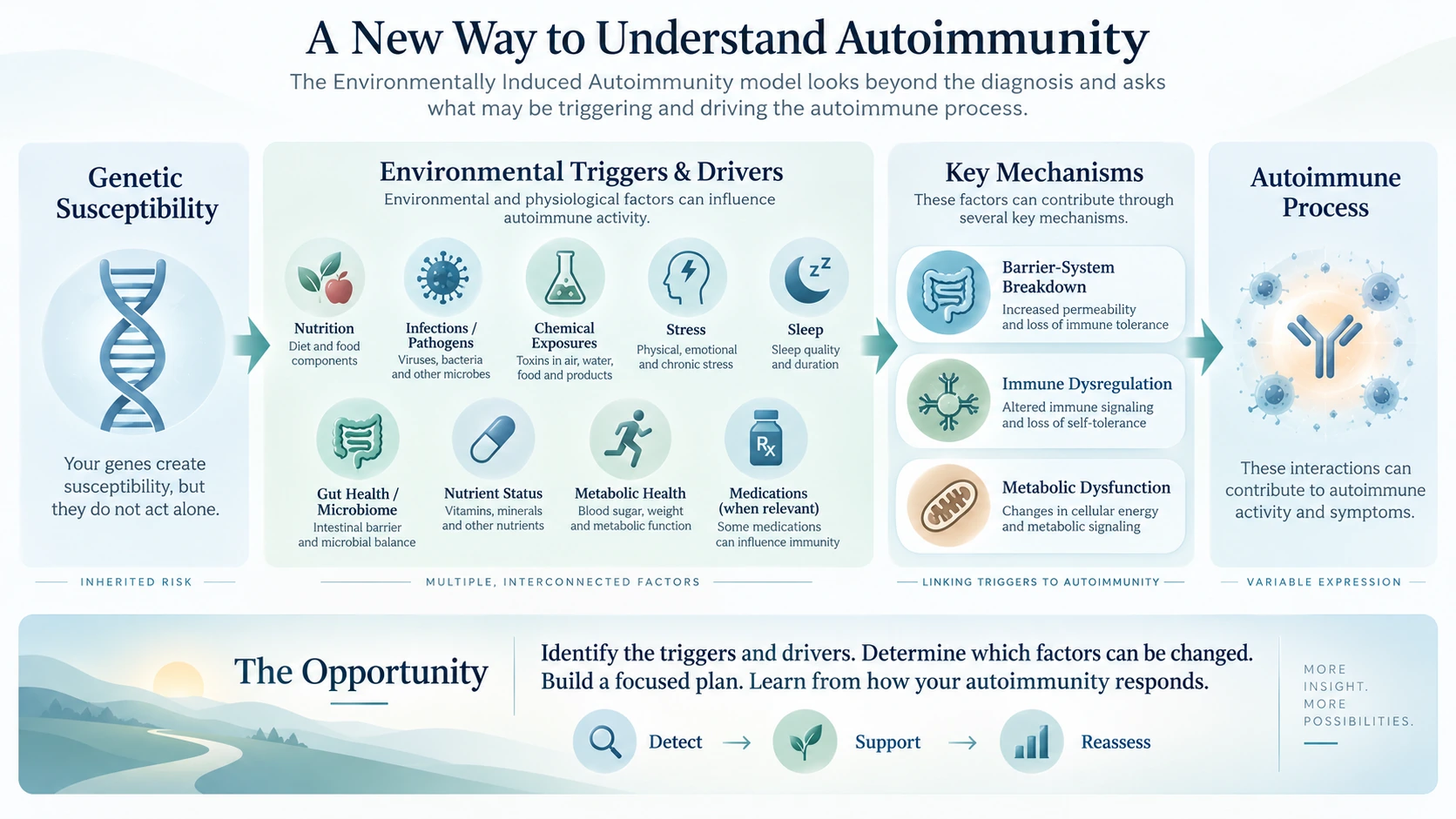
A Clearer Way to Connect the Dots
For me, this is one of the most important advances in how we can think about autoimmunity. The diagnosis remains essential, but now we can also look at the interaction between the person, the environment, and the immune system.
Genetic susceptibility
Your genes can create susceptibility to autoimmune disease. They help explain why autoimmunity clusters in families and why some people are more vulnerable to particular immune reactions.
Environmental triggers & exposures
Infections, smoking, silica, chemicals, medications, hormones, diet-related factors, and other exposures can interact with susceptible biology in disease-specific ways.
Barrier systems
The gut, lungs, skin, and other tissue interfaces are where the immune system continually meets food antigens, microbes, particles, chemicals, and the outside environment.
Immune regulation & tolerance
Autoimmunity develops when immune tolerance to self is lost. Understanding the mechanisms that influence tolerance brings us closer to the biology of the disease process.
How Environmental Triggers Can Influence Autoimmune Biology
A single exposure, infection, or immune reaction does not necessarily explain an autoimmune disease by itself. For many autoimmune diseases, risk reflects interactions among multiple genetic, environmental, and biological influences over time.
What makes the Environmentally Induced Autoimmunity model so useful is that it helps us look at those influences at a more mechanistic level. We can ask how an exposure may affect immune tolerance, inflammatory signaling, tissue barriers, antigen recognition, gene expression, or the microbiome.
Which Factors May Be Important in Your Autoimmune Process?
Once we understand the model, the next step is to look at your history and identify the categories that deserve the most attention. Some factors may have helped trigger the autoimmune process. Others may be contributing to the environment in which it remains active.
Food proteins & immune reactions
Celiac disease gives us a clear example of a specific food antigen, gluten, driving an autoimmune process. In other conditions, diet can influence nutrition, metabolism, gastrointestinal health, and individual immune responses.
Pathogens & infections
Viruses, bacteria, and other infections can influence autoimmunity through mechanisms including molecular mimicry, tissue injury, inflammatory signaling, and persistent immune activation.
Chemicals & environmental exposures
Smoking, crystalline silica, some solvents, air pollution, and other exposures have been associated with autoimmune risk in specific diseases. Your exposure history can add important context.
Gut & barrier health
The gastrointestinal tract is a major immune interface. Digestive symptoms, celiac disease, inflammatory bowel disease, microbiome changes, infections, and nutrient absorption can all be relevant depending on the person.
Nutrition & nutrient status
Nutrients influence immune signaling, antioxidant defense, tissue repair, methylation, energy production, and many other biological pathways. Deficiencies can create clear opportunities for support.
Metabolic health
Blood sugar, insulin resistance, liver function, body composition, and cardiovascular health can influence inflammatory and hormonal physiology and may change what deserves priority.
Stress, sleep & recovery
Your nervous system, hormones, sleep quality, and recovery state influence immune and metabolic signaling and can shape how resilient the system is.
Medications, hormones & life stage
Medication use, pregnancy, menopause, surgery, infections, and other major physiological changes can alter the context in which autoimmune disease develops or behaves.
Testing Gives Us a Deeper View of the Systems Involved
History tells us where to start. Testing can help us see the physiology in more detail and connect patterns that symptoms alone may not reveal.
I begin with the diagnosis, your existing records, and the disease-specific testing that is already part of your medical care. From there, a systems-based functional medicine approach gives us an opportunity to look across several areas of health and understand how they may fit together.
DETECT → SUPPORT → REASSESS
The model helps us understand where to look. This process turns what we learn into an individualized plan.
DETECT
We bring together the diagnosis, symptoms, timeline, family history, records, labs, diet, lifestyle, exposures, medications, gut health, and other relevant information to identify the strongest triggers, drivers, and physiological patterns.
SUPPORT
We build a focused plan around the highest-priority findings. That may involve nutrition, sleep, stress, movement, metabolic health, nutrient status, gastrointestinal support, exposure reduction, and coordination with your existing medical care.
REASSESS
We learn from how your health responds. Symptoms, relevant labs, day-to-day function, and your progress help us refine the plan and become more precise over time.
See How This Approach Applies to Hashimoto's, Psoriasis & Rheumatoid Arthritis
The underlying model can help us organize the investigation, but each autoimmune disease has its own biology, medical risks, testing, and treatment considerations. These resources take the same trigger-and-driver approach and apply it to the questions that matter for each condition.
Hashimoto's Thyroiditis
Explore autoimmune thyroid disease, possible triggers and drivers, diet, testing, symptoms, and functional medicine support.
Explore Hashimoto's →Psoriasis
Explore psoriasis triggers, diet, gut health, testing, related conditions, and functional medicine care.
Explore Psoriasis →Rheumatoid Arthritis
Explore rheumatoid arthritis through a complementary functional medicine lens alongside appropriate rheumatology care.
Explore Rheumatoid Arthritis →My 2015 Natural Autoimmune Support Presentation
I recorded this presentation in 2015 because I was already asking the question that still drives my work today: what is triggering and driving the autoimmune process?
You can hear the early version of this thinking in the presentation. I discuss genetics, immune regulation, food reactions, infections, environmental chemicals, barrier systems, gastrointestinal health, nutrient status, blood sugar, stress, and testing.
My understanding has become more precise over time, especially around immunology and testing, but the central idea has stayed consistent: the diagnosis is important, and there is another layer of opportunity in understanding the triggers, drivers, and physiology around it.
This is the original video that accompanied this page when it was first published.
Gene-Environment Interaction Is a Major Part of Modern Autoimmune Research
The terminology varies across research fields. You will see phrases such as gene-environment interaction, the exposome, environmentally induced autoimmunity, loss of immune tolerance, and systems immunology. These ideas are not identical, but they converge around an important point: autoimmune disease emerges from an interaction between susceptibility and biology across time.
I use Environmentally Induced Autoimmunity because it gives me a practical way to connect that science to the questions people actually want answered: What may have triggered this? What may be driving it now? Which factors may we be able to change?
Autoimmune Disease & Functional Medicine FAQs
What is an autoimmune disease?
An autoimmune disease develops when the immune system loses tolerance to healthy cells, tissues, or organs and begins targeting them. The tissue being targeted and the medical risks differ from one autoimmune disease to another.
What can trigger autoimmune disease?
Autoimmune disease can involve interactions among genetic susceptibility, infections, smoking, environmental exposures, hormones, immune regulation, barrier systems, and other disease-specific factors. The combination can be different from one person and one autoimmune disease to another.
What is Environmentally Induced Autoimmunity?
Environmentally Induced Autoimmunity is the model I use to organize the relationship between genetic susceptibility, environmental triggers and exposures, barrier systems, immune regulation, and autoimmune expression. It helps us ask which factors may be contributing to the process and which factors may be changeable.
Why look for triggers and drivers after I already have a diagnosis?
The diagnosis tells us what disease has been identified. Looking at triggers and drivers asks what may be contributing to the autoimmune process now and which factors may be open to change. That can create additional opportunities for nutrition, lifestyle, metabolic, gastrointestinal, exposure, and other individualized support.
Can advanced testing help with autoimmune disease?
Advanced testing can help us understand the system in more detail when it is selected around your diagnosis, history, symptoms, and existing records. Depending on the case, that may include disease-specific markers, metabolic health, nutrient status, gastrointestinal function, infections, exposures, thyroid physiology, or other areas that can guide the plan.
Does gut health matter in autoimmune disease?
It can. The gut is an important immune and barrier system, and research continues to explore relationships among the microbiome, intestinal barrier biology, immune signaling, and autoimmune disease. Your history and symptoms help determine how important that area may be in your case.
Can functional medicine cure autoimmune disease naturally?
There is no scientifically established natural cure for autoimmune disease as a category. The opportunity with functional medicine is to investigate potentially changeable triggers, drivers, and physiological patterns, support the highest-priority findings, and reassess how your health responds while appropriate medical care continues.
Can I use functional medicine while taking medication for an autoimmune disease?
Yes. Functional medicine can complement appropriate medical care. Medication decisions stay with the prescribing clinician or specialist, while we focus on nutrition, lifestyle, metabolic, gastrointestinal, exposure, and other factors that may be appropriate to support.
How do you approach autoimmune disease with functional medicine?
I use a DETECT, SUPPORT, REASSESS process. First I put together the diagnosis, history, symptoms, records, labs, diet, lifestyle, exposures, medications, and physiology. Then I build a focused plan around the highest-priority findings and reassess what changes.
What happens if I apply for care?
I review the Application for Care before scheduling. If I believe my approach may be a good fit for what you are dealing with, I send you the private next step to schedule.
If This Helps You See Autoimmunity Differently, the Next Step Is to Look at Your Case
You may already know the name of your autoimmune disease. The next opportunity is to understand which triggers, drivers, and physiological patterns appear most important in your story.
Tell me what has been diagnosed, what you are still struggling with, what you have already tried, and what you hope to understand or improve. I review every Application for Care before scheduling. If I believe my approach may be a good fit, I will send you the private next step.