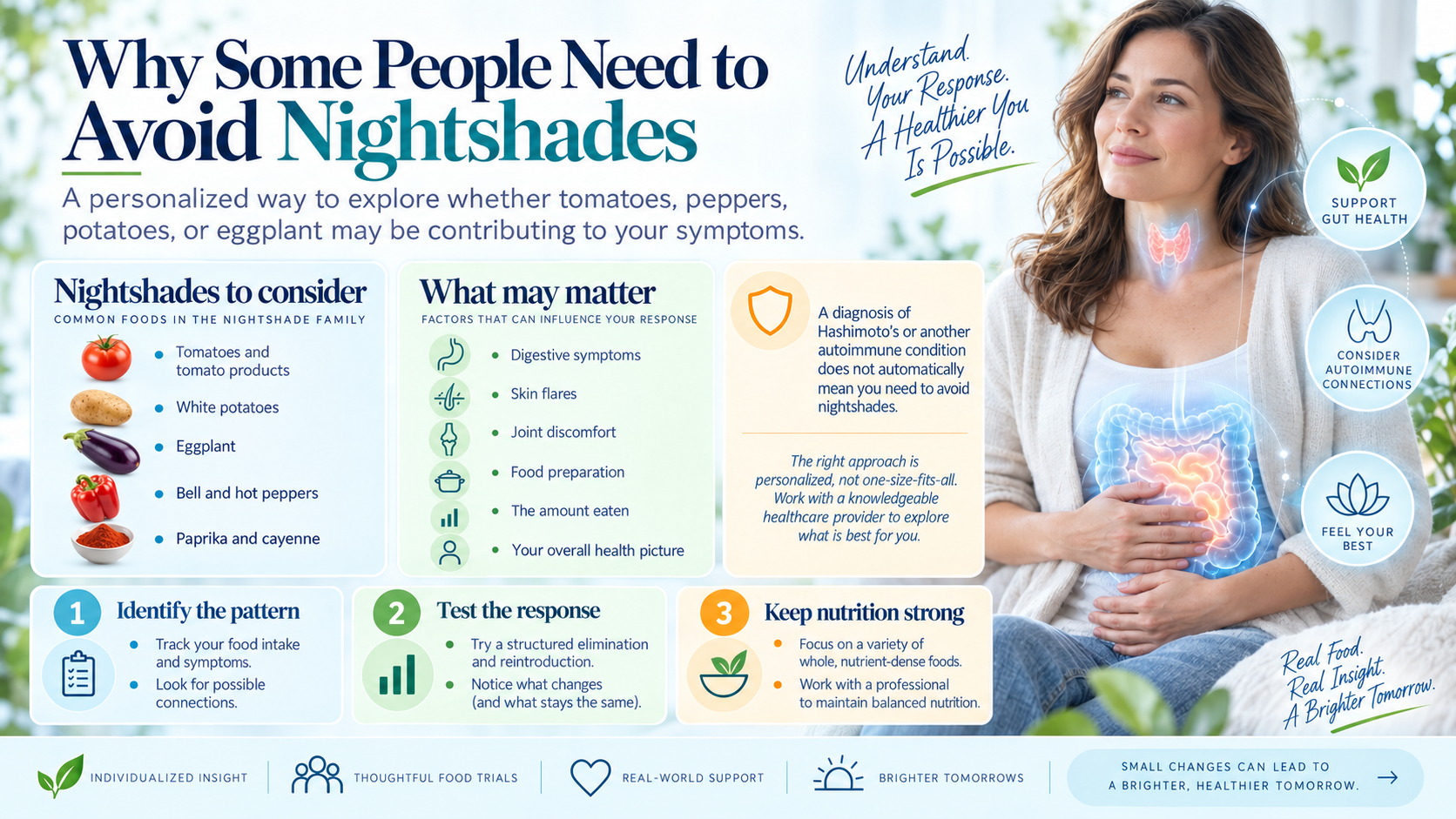
What Are Nightshades? Foods and Spices to Know
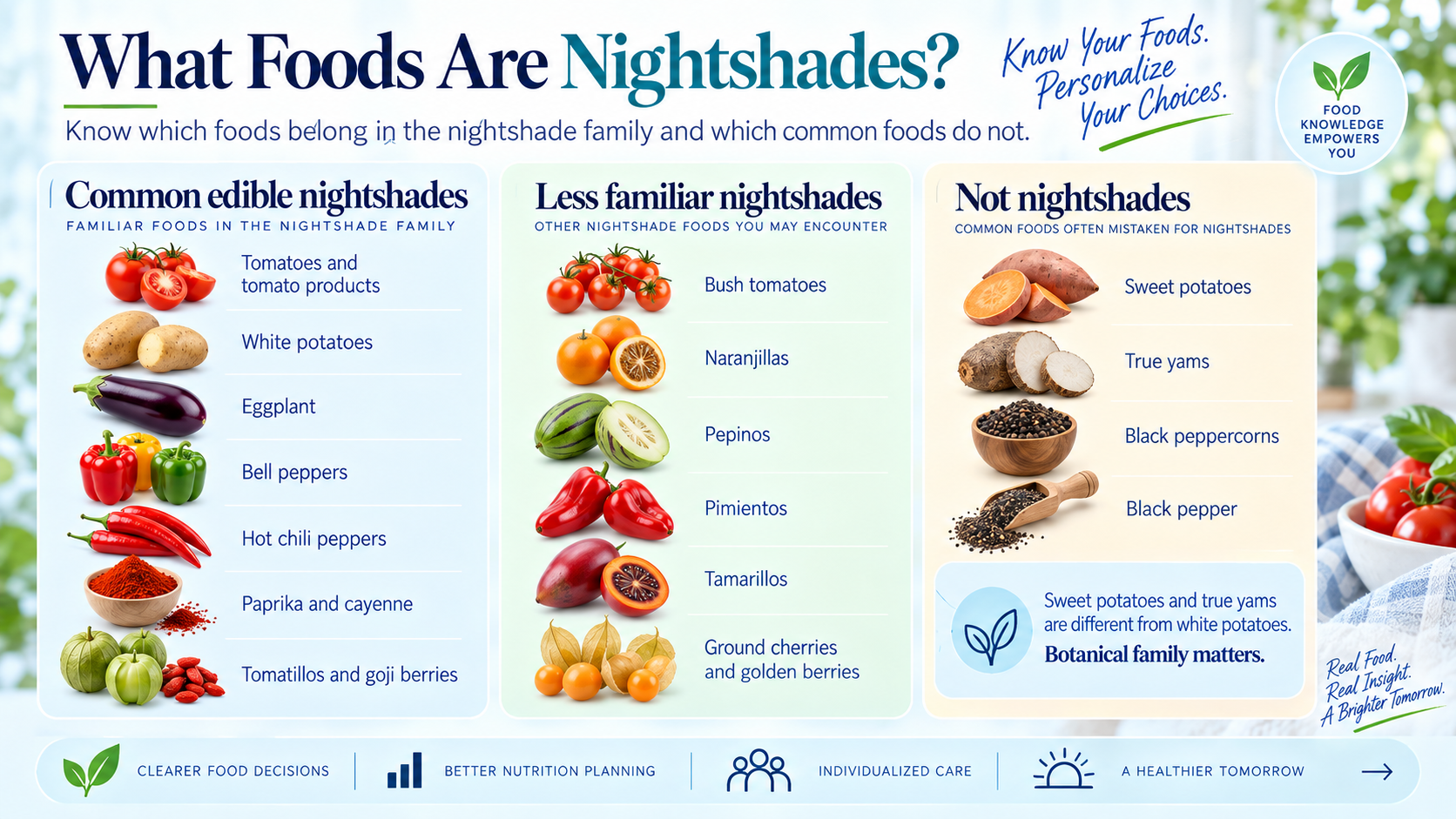
Nightshades are plants in the Solanaceae family. Many are familiar, nutrient-rich foods that people eat every day. Others are less common, and some related wild plants are poisonous. That does not make edible tomatoes or potatoes inherently dangerous.
Common edible nightshades
- Tomatoes, including tomato sauce and paste
- White, red, yellow, and purple potatoes
- Eggplant
- Bell peppers and hot chili peppers
- Tomatillos and goji berries
- Paprika, cayenne, and crushed red pepper
Less familiar nightshades
- Bush tomatoes
- Naranjillas (lulo)
- Pepinos (pepino melons)
- Pimientos
- Tamarillos (tree tomatoes)
- Ground cherries and golden berries
Not nightshades: sweet potatoes, true yams, black peppercorns, and black pepper. Sweet potatoes belong to the morning glory family; true yams belong to a different family, Dioscoreaceae. Both are distinct from white potatoes. See the botanical reference below.
Tomatoes and peppers can contribute vitamin C and plant pigments, while potatoes contribute potassium, carbohydrate, and other nutrients. Before removing foods, I want to understand what they contribute to your diet and how we would replace them if a trial makes sense.
Why Nightshades Come Up in Autoimmune and Leaky Gut Diets
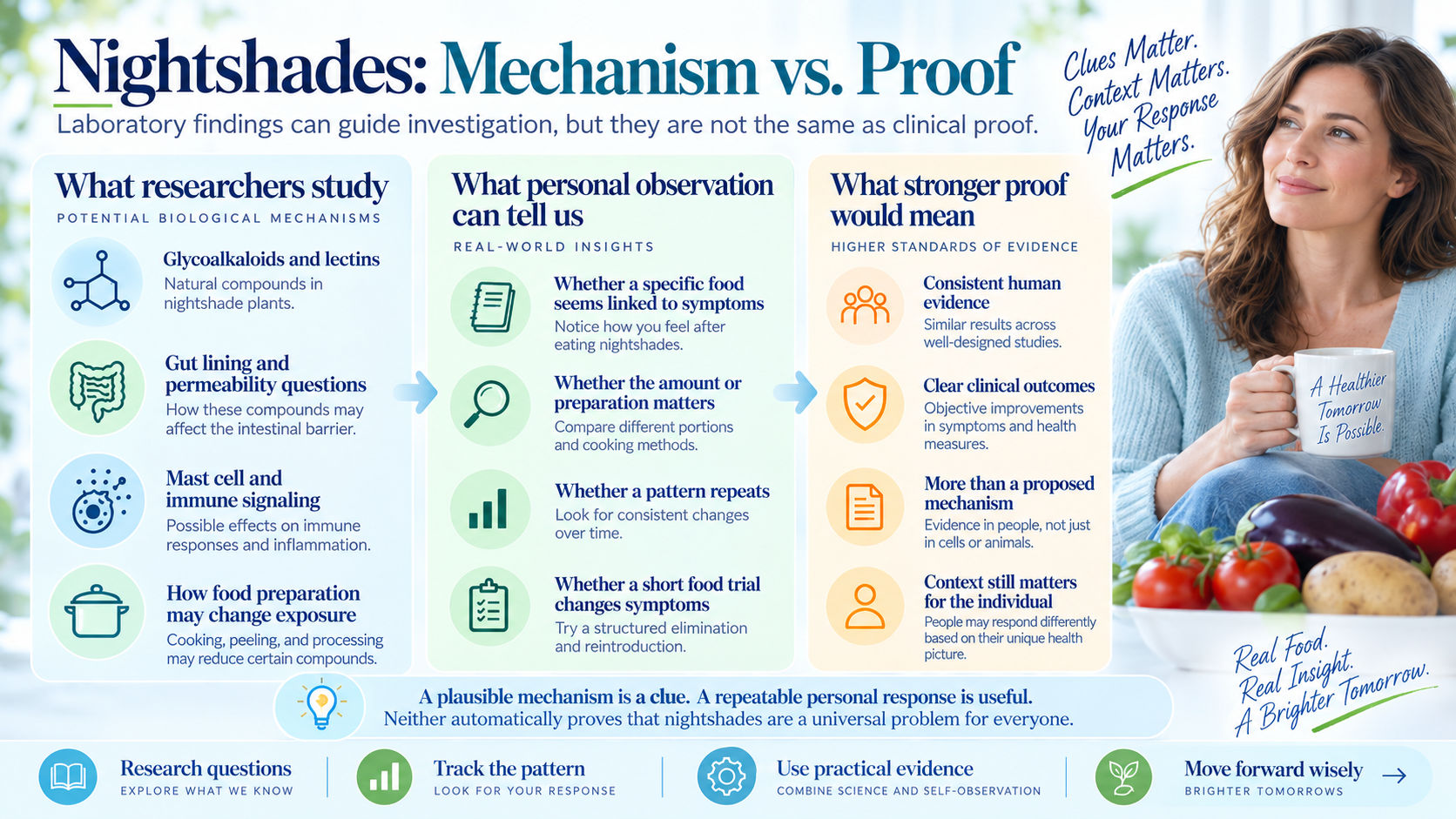
There is a reason nightshades appear on some autoimmune food lists. Tomatoes, potatoes, eggplant, and peppers contain different natural compounds that researchers have studied for their effects on cells, the gut lining, and immune signaling. Two of the main questions involve alkaloids and lectins. They are not the same thing, and they do not affect everyone in the same way.
Research on nightshade compounds gives us some useful leads, especially when digestive symptoms seem connected to food. A 2023 review of nightshades and gastrointestinal conditions discusses possible effects of glycoalkaloids on the intestinal lining and mast cells, while noting that the human evidence is still limited. I take those findings seriously as questions to investigate, not as a reason to tell everyone with an autoimmune diagnosis to stop eating tomatoes.
Here's what I want you to know: a food can be worth looking into even when we do not know exactly why you react to it. The most useful information comes from putting your symptoms, health history, food preparation, and, when appropriate, relevant testing together.
Saponins and the natural defenses in tomatoes
Plants make substances that help protect them from insects and microbes. Saponins are one broad group of compounds with soap-like properties in some experimental settings. Tomatoes also contain steroidal glycoalkaloids, including alpha-tomatine, that researchers study because they can interact with cell membranes. These compounds are related in their chemistry and effects, but calling every tomato glycoalkaloid a saponin would oversimplify the subject. Research on tomato glycoalkaloids describes how their amounts differ with the part of the plant, ripeness, and processing.
That is a helpful reason to ask whether you respond differently to a ripe tomato, a green tomato, or a cooked sauce. It is not evidence that normal servings of ripe tomatoes routinely damage everyone's gut or cause autoimmune disease.
Lectins in nightshades: what makes them interesting?
Lectins are proteins that bind to specific sugars on the surfaces of cells and other molecules. They are found in many foods, including some nightshades, beans, grains, nuts, and seeds. Different lectins have different properties. The fact that two foods contain lectins does not mean your body will respond to them in the same way.
One area of research looks at how certain lectins bind to carbohydrates and how some can cause cells or other particles to clump together. This is called agglutination. Researchers also study whether antibodies made against certain lectins can bind to proteins in human tissue, a possible form of cross-reactivity.
For example, a 2020 laboratory study found that antibodies directed against selected lectins also bound to some human tissue proteins, including thyroid peroxidase (TPO), under laboratory conditions. That is interesting when we're asking questions about autoimmune thyroid disease. The study did not show that eating tomatoes or potatoes damages the thyroid, that a blood-test result predicts a Hashimoto's flare, or that a lectin-free diet treats Hashimoto's.
This distinction matters because lectins are a large family. The clearest established food-safety concern involves certain raw or undercooked beans, not ordinary servings of all lectin-containing vegetables. A 2026 food-safety assessment explains how the type of lectin and the way a food is prepared can change its activity.
Could raw and cooked nightshades affect you differently?
Yes, it's possible. Cooking changes the structure of some food proteins and can change the activity or availability of certain plant compounds. The effect depends on the particular food and compound. That is one reason a fresh tomato, tomato paste, and a spicy tomato sauce are not identical exposures.
If you feel fine after cooked tomatoes but uncomfortable after raw ones, I would want to know that. The same goes for plain baked potatoes compared with fries, or sweet bell peppers compared with very hot chilies. We can use those differences to ask a more specific question instead of removing an entire food family unnecessarily. Cooking is not a guarantee that every possible reaction disappears, and it does not make a known food allergy safe.
Capsaicin: why hot peppers may feel different
Capsaicin is the compound that gives chili peppers their heat. It activates the nerve receptors that sense heat and burning. If hot salsa gives you a burning mouth, reflux, or digestive discomfort, capsaicin may be part of the explanation. That sensation alone does not mean you are having an autoimmune flare.
I would ask whether you react to the same pepper in a smaller amount, whether sweet peppers bother you, and what else was in the meal. Those details tell us much more than simply checking off “nightshades” on a list.
Glycoalkaloids in potatoes: a separate food-safety question
Potatoes contain natural glycoalkaloids, mainly alpha-solanine and alpha-chaconine. Levels can rise with damage, sprouting, and certain storage conditions. High exposure can cause nausea, vomiting, or diarrhea. That is an acute food-safety concern, not proof that ordinary potatoes cause chronic autoimmunity. Read the food-safety assessment.
Discard potatoes that are extensively green, heavily sprouted, damaged, or bitter. If a properly stored, normally prepared potato still seems to bother you, we can investigate that separate question.
Do You Need to Avoid Nightshades if You Have Hashimoto's?
Not simply because you have Hashimoto's. Your diagnosis tells us that an autoimmune process is affecting the thyroid. It does not tell us whether tomatoes, potatoes, or any other food are contributing to your symptoms.
What interests me is the opportunity to learn more about your situation. Maybe you feel noticeably better when you leave a particular food out, then feel worse when you bring it back. Maybe the pattern turns out to involve spicy food and reflux rather than the thyroid itself. Or maybe nightshades have nothing to do with how you feel. Each answer helps us decide where to focus.
Lectin research adds another question worth understanding: some antibodies against selected lectins can bind to thyroid-related proteins in a laboratory. We do not yet have clinical evidence showing that this makes nightshades a cause of Hashimoto's or that eliminating them protects thyroid tissue. I would not use that research alone to put you on a restrictive diet.
I also want to consider thyroid function, medication timing, digestive health, nutrient status, sleep, and other findings that fit your history. You can read more in my Hashimoto's guide, my article on what may cause or contribute to Hashimoto's, and my Hashimoto's diet guide. Keep taking prescribed thyroid medication unless the clinician managing it advises a change.
What About Psoriasis, Joint Pain, and Arthritis?
If you have psoriasis, psoriatic arthritis, or ongoing joint pain, it makes sense to wonder whether certain foods are part of your symptom pattern. Some people notice changes in their skin, digestion, or joint comfort after changing what they eat. I want to understand those observations without assuming a food has caused an autoimmune flare.
Research has not established that removing all nightshades treats psoriasis or prevents arthritis flares. The Arthritis Foundation discusses nightshades as a personal food question rather than a universal arthritis trigger. A rheumatoid arthritis guideline considers nutrition alongside established treatment, but it does not specifically demonstrate a benefit from avoiding nightshades in psoriasis or Hashimoto's.
For psoriasis, I would look at the whole health history and what seems to be changing over time. My functional medicine psoriasis guide explains that approach. If a joint is newly swollen, painful, or stiff for a prolonged period, have it evaluated promptly. Food experiments should not delay appropriate care for inflammatory arthritis.
When Is It Worth Looking More Closely at Nightshades?
I would pay attention if you have noticed a similar reaction more than once. Perhaps hot peppers repeatedly cause burning or reflux. Perhaps one particular potato dish seems to bother your digestion. Or perhaps you have noticed a change in skin or joint symptoms when you remove and then eat a food again. Those patterns give us a place to start.
I would also want to look at everything else in the meal. Tomato sauce often includes onions, garlic, and a large amount of acid. Fries come with cooking oil and different portion sizes. Chili can contain beans, dairy, and several spices. Even the way a food is cooked may change what you are exposed to.
What you can do today: note the food, how it was prepared, the amount you ate, what happened, and when it happened. Those few details can make our next conversation much more useful.
Can a Food Sensitivity Test Tell You if Nightshades Are a Problem?
No single test can give us that answer by itself. There are different kinds of food reactions, and the right next step depends on what you are experiencing.
If you develop hives, swelling, wheezing, or an immediate severe reaction, that calls for an allergy evaluation. Food-specific IgE testing and supervised food challenges may be appropriate through an allergy professional. Do not try a suspected severe-allergy food challenge on your own.
Some specialty panels measure IgG or IgA antibodies to selected food proteins, or to particular parts of those proteins. Some also distinguish cooked from raw preparations. Those measurements can raise questions about immune recognition, but a positive result does not establish that the food is harmful to you, that it caused your autoimmune disease, or that avoiding it will improve your symptoms. Professional allergy organizations do not recommend food IgG panels to diagnose food allergy or intolerance. Learn why the distinction matters.
There is another reason I do not want to rely on a test alone: an uncomfortable response to a compound such as capsaicin may involve nerve receptors rather than the antibody that a food panel measures. Your symptoms, clinical history, appropriate medical evaluation, and a carefully chosen food trial often tell us more when considered together.
My goal is to choose the right question before choosing a test. We may find that a focused diet-and-symptom record is the most useful starting point. In other circumstances, your history may point toward specific, better-established medical tests or a discussion of selected additional testing and its limitations.
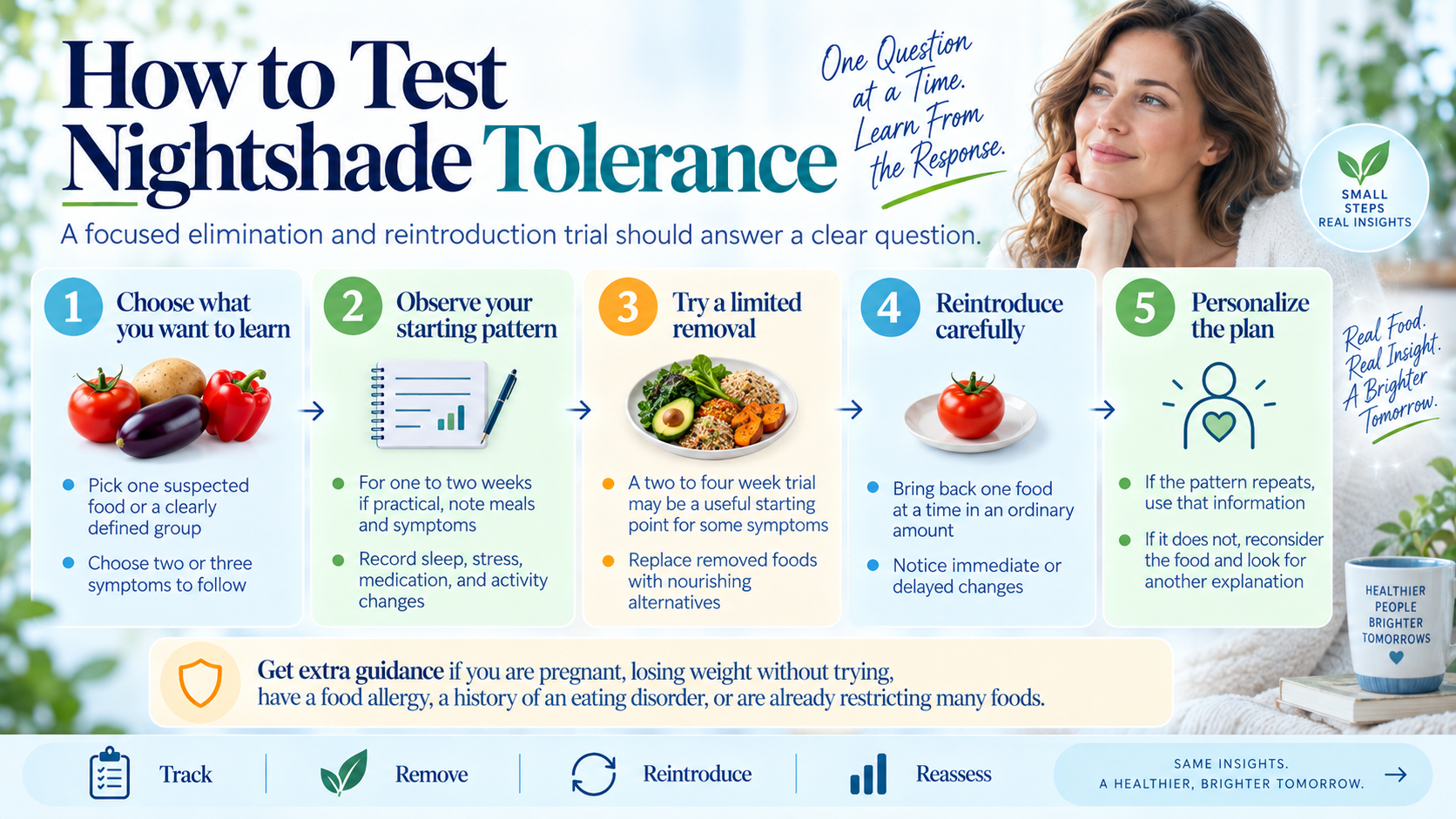
How to Test Nightshade Tolerance and Learn From the Results
If a nightshade trial makes sense for you, I want it to answer a clear question while keeping you well nourished. We can adjust the plan to your symptoms, diet, and medical needs rather than use the same timetable for everyone.
Choose what you want to learn
Choose one suspected food, or a clearly defined group if the history points that way. Pick two or three symptoms you can follow, such as reflux, bowel changes, joint discomfort, or skin symptoms.
Observe your starting pattern
For about one to two weeks, if practical, note what you normally eat and how you feel. Record other changes that could matter, including medication, sleep, stress, and activity.
Try a limited, nutritionally complete removal when appropriate
A trial of roughly two to four weeks may be a reasonable starting point for some symptoms, but there is no universal duration, especially for skin and joint changes. Replace the foods you remove with nourishing alternatives.
Reintroduce carefully
When it is safe, bring back one food at a time in an ordinary amount. Note any immediate or delayed response and whether it happens again. Never reintroduce a food that caused a serious allergic reaction without specialist guidance.
Use the response to personalize your plan
If the pattern repeats, we can decide whether one food, portion, or preparation needs attention. If it does not, we can consider bringing the food back and look for another explanation.
Extra guidance is especially important if you are pregnant, have a history of an eating disorder, are losing weight without trying, have a known food allergy, or are already restricting many foods. A food trial should not replace recommended testing or prescribed treatment.
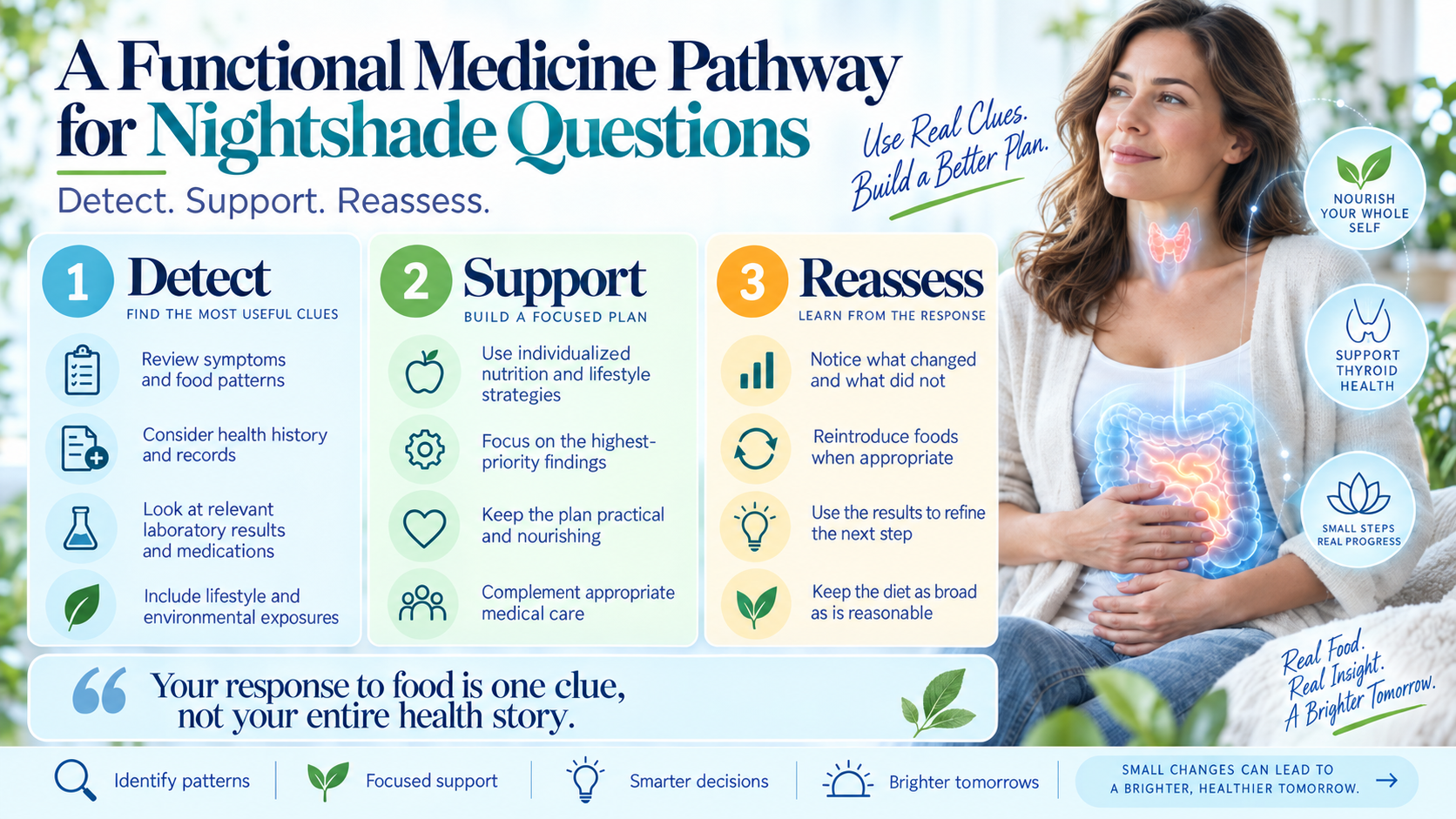
The Functional Medicine Opportunity: Detect, Support, Reassess
A diagnosis tells us which disease has been identified. It does not automatically tell us what set the autoimmune process in motion, what may be affecting it now, or which factors we can change. That's the opportunity I want to explore with you. Your response to food is one clue, not your entire health story.
Find the most useful clues
Review symptoms, food patterns, health history, records, relevant laboratory results, medications, lifestyle, and exposures. Decide which questions actually need investigation.
Build a focused plan
Address the highest-priority findings with an individualized nutrition and lifestyle strategy that fits your needs and complements your medical care.
Learn from the response
Look at what changed, what did not, and what that teaches us. Reintroduce foods when appropriate and adjust the plan using the information we gained.
If nightshades matter to you, we can use that information to make your plan more specific. If they do not, we can keep nutritious foods in your diet and turn our attention to the questions that are still unanswered. You can also explore my Hashimoto's diet guide and article on gluten, Hashimoto's, and celiac disease. Gluten is a separate question, and it deserves its own careful assessment.
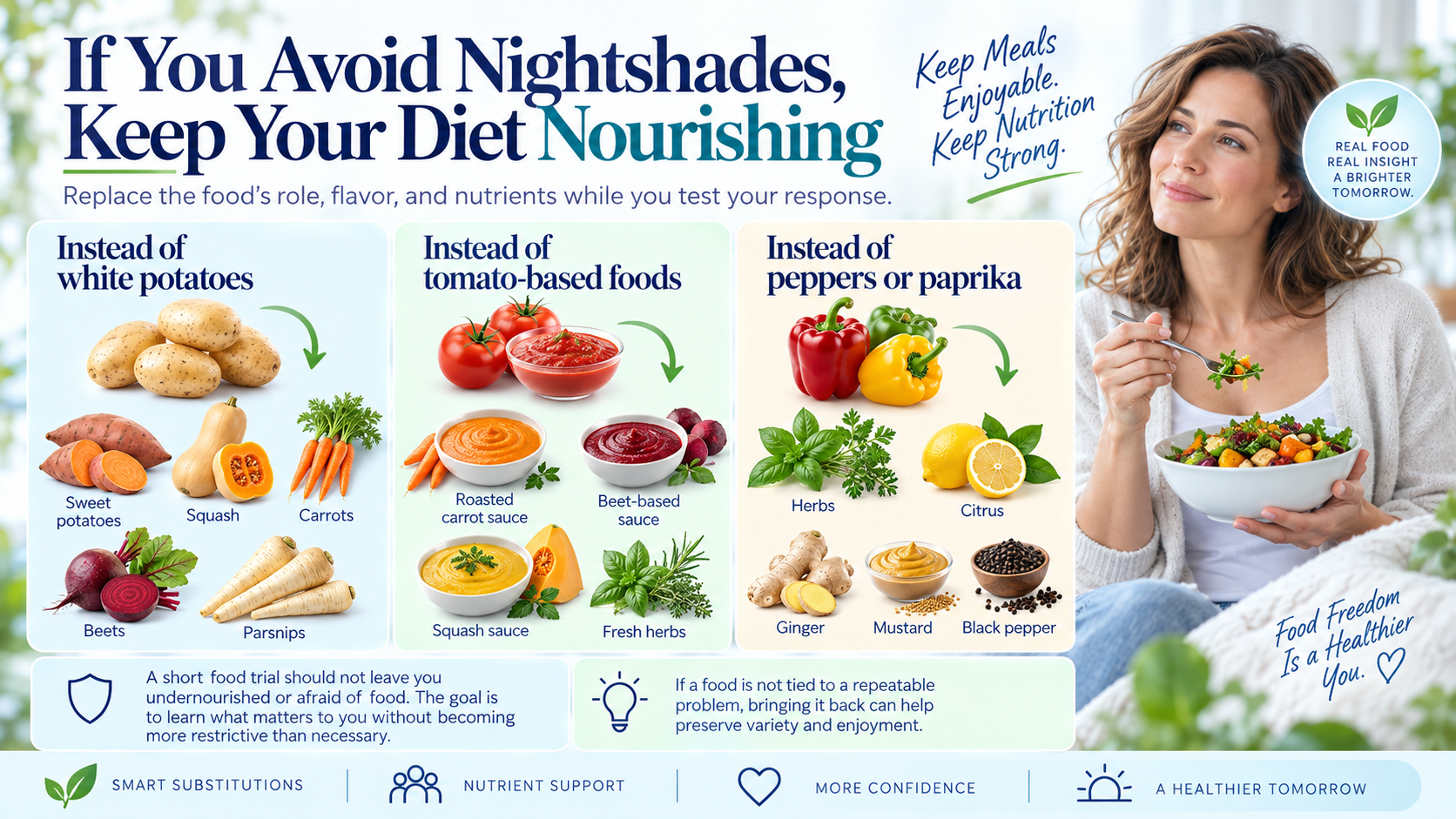
If You Need to Avoid a Nightshade, Keep Your Diet Nourishing
A short trial should not leave you without satisfying meals. If you are testing white potatoes, try sweet potatoes, squash, carrots, beets, or parsnips. If tomatoes are the question, a roasted carrot, beet, or squash sauce may provide a similar role in a meal. Herbs, citrus, ginger, mustard, and black pepper can add flavor when you are testing hot peppers or paprika.
Choose substitutes around your own allergies, tolerances, energy needs, and preferences. If a food is not associated with a repeatable problem, returning it to your diet can help preserve variety and enjoyment.
Wondering Which Foods and Other Factors May Be Affecting Your Autoimmune Health?
If you have Hashimoto's, psoriasis, or another autoimmune condition, you may have more questions than answers about what to eat and why you feel the way you do. You do not have to sort through every food list on your own.
When we work together, I review your history, symptoms, relevant records and testing, nutrition, and daily life. We look for possible triggers and drivers, build a focused plan around what we find, and reassess so we can learn from your response.
I review applications first. If your application is accepted, you will receive a private scheduling link.
Frequently Asked Questions About Nightshades
What foods are nightshades?
Common edible nightshades include tomatoes, white potatoes, eggplant, bell and hot peppers, tomatillos, goji berries, and pepper-based spices such as paprika and cayenne.
Why do some people avoid nightshades with autoimmune disease?
Nightshades contain natural compounds, including glycoalkaloids and some lectins, that researchers study for possible effects on digestive and immune pathways. A personal food response may be worth investigating, but an autoimmune diagnosis does not establish that nightshades are a trigger.
Do nightshades cause inflammation?
Certain nightshade compounds have biological effects in laboratory and animal research. That does not establish that normal servings cause inflammation in everyone. If you notice a consistent symptom pattern, the specific food and your broader health deserve a closer look.
Do I have to avoid nightshades if I have Hashimoto’s?
No. Hashimoto’s alone does not mean you need to eliminate nightshades. If you suspect a repeatable response to one of these foods, you can explore it as part of an individualized plan while continuing appropriate thyroid care.
Do lectins in tomatoes or potatoes attack the thyroid?
Laboratory research has found that antibodies to some lectins can bind to certain human tissue proteins, including thyroid peroxidase. It has not shown that eating tomatoes or potatoes damages the thyroid or that removing nightshades treats Hashimoto’s.
Are raw nightshades different from cooked nightshades?
They can be. Cooking changes some food proteins and plant compounds, and meal ingredients also differ. A response to raw tomato does not automatically mean cooked tomato or every other nightshade will cause the same problem.
Can a food sensitivity blood test prove that nightshades are causing my symptoms?
No. Food IgG or IgA results alone cannot prove that a food caused symptoms or autoimmune disease. Food IgG testing is not recommended to diagnose food allergy or intolerance. A clinician can help choose appropriate evaluation based on the type of reaction.
Can nightshades cause leaky gut?
Some nightshade compounds affect intestinal tissue in experimental research, and scientists are studying their possible role in digestive symptoms. There is not enough human evidence to conclude that usual servings cause clinically important intestinal permeability in a particular person.
Can nightshades make psoriasis or arthritis worse?
Some people report personal food-related symptom changes, but evidence has not established that avoiding all nightshades treats psoriasis or prevents arthritis flares. New or persistent swollen joints need medical evaluation.
Are sweet potatoes and yams nightshades?
No. Sweet potatoes and true yams are not nightshades, and they belong to different botanical families from each other.
How long should I try avoiding nightshades?
A focused trial of about two to four weeks may be a useful starting point for certain symptoms, but timing varies. Track your symptoms and plan a safe reintroduction rather than assuming permanent avoidance is needed.
Should I avoid every nightshade if one bothers me?
Not necessarily. The response may involve one food, amount, ripeness, spice intensity, preparation, or another ingredient in the meal. The goal is to learn what matters to you without making your diet more restrictive than necessary.
When should I seek medical care rather than try an elimination diet?
Seek prompt evaluation for blood in stool, unexplained weight loss, persistent fever, severe abdominal pain, new swollen joints, or progressive weakness. Trouble breathing or throat swelling after eating requires emergency care.
Sources and Further Reading
I use the research below to frame specific questions about nightshade compounds, food responses, thyroid health, and food safety. Research on a mechanism is not the same as a clinical trial showing that avoiding a food treats autoimmune disease.
- Nightshade vegetables and digestive symptoms: a 2023 review. Reviews proposed gut-related mechanisms and the limited human evidence.
- Reaction of lectin-specific antibodies with human tissue. 2020 laboratory study of antibody binding and possible cross-reactivity; not a nightshade-elimination treatment trial.
- European Food Safety Authority: plant lectins in food. 2026 assessment distinguishing food types, preparation, and established acute risks.
- Tomato glycoalkaloids: role in the plant and in the diet. Research review on alpha-tomatine, composition, ripeness, and processing.
- European Food Safety Authority: glycoalkaloids in potatoes. Food-safety assessment of acute exposure and potato preparation.
- American Academy of Allergy, Asthma & Immunology: food IgG testing. Why food IgG tests are not established to diagnose food allergy or intolerance.
- Arthritis Foundation: The Ultimate Arthritis Diet. Discusses diet and why nightshades are not a universal arthritis trigger.
- American College of Rheumatology: integrative interventions for rheumatoid arthritis. Guideline for rheumatoid arthritis alongside medical treatment, not proof for nightshade avoidance.
- American Thyroid Association: Hashimoto's thyroiditis. Thyroid evaluation, monitoring, and treatment.
- University of Illinois Extension: sweet potatoes and yams. Botanical distinctions among these foods.