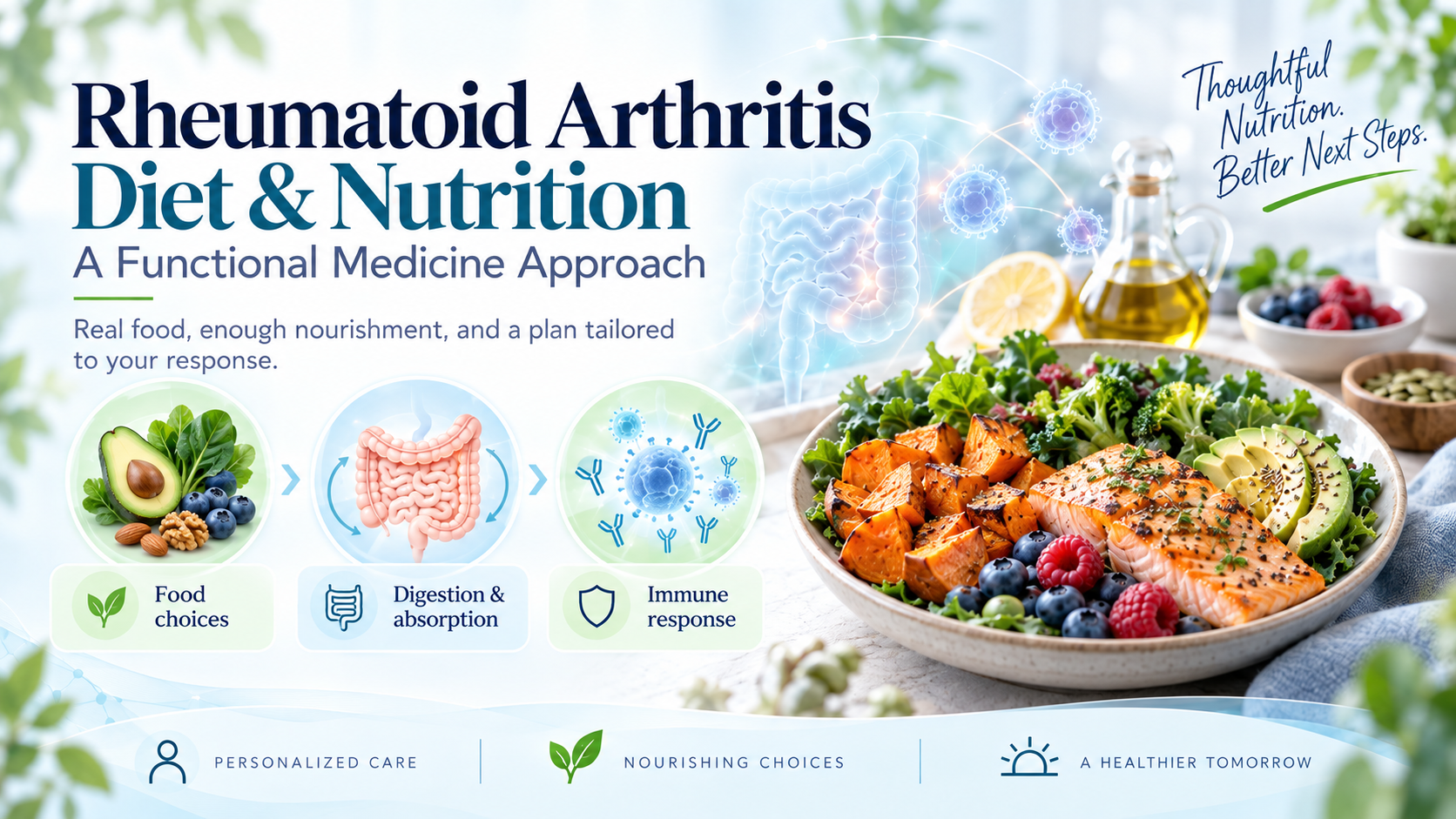
Could a functional medicine approach to your RA diet make a difference?
If you have rheumatoid arthritis, it is worth looking closely at the foods you eat and how your body responds to them. I want to understand whether food-related reactions could be contributing to your symptoms, and which changes may help reduce that burden.
I use the Environmentally Induced Autoimmunity model to organize your history, investigate potential triggers and drivers of the autoimmune process, and help you plan a strategy. Food is a critical part of that investigation. Your digestion, symptoms, sleep, chemical exposures, vitamin and mineral status, and the health of your intestinal barrier all help us decide where to focus.
We look at the foods themselves, their components, and what happens when you eat them. When a food reaction is suspected, the next step may be a targeted elimination or a broader autoimmune paleo trial. Either way, the diet needs to provide enough protein, vegetables, fruit, and other nourishing foods while we evaluate your response.
DETECT
Review your food history, symptoms, digestion, and existing findings. Consider whether additional testing could help guide food selection or investigate a nutrient or digestive concern.
SUPPORT
Choose a targeted elimination or an AIP approach. Plan what you will eat, address relevant digestive and nutrient needs, and make the changes manageable.
REASSESS
Compare your response with where you started. Review symptoms, food intake, and relevant findings, then decide what to reintroduce or adjust.
Read more about how I use this process in functional medicine for rheumatoid arthritis.
ra-diet-detect-support-reassess.png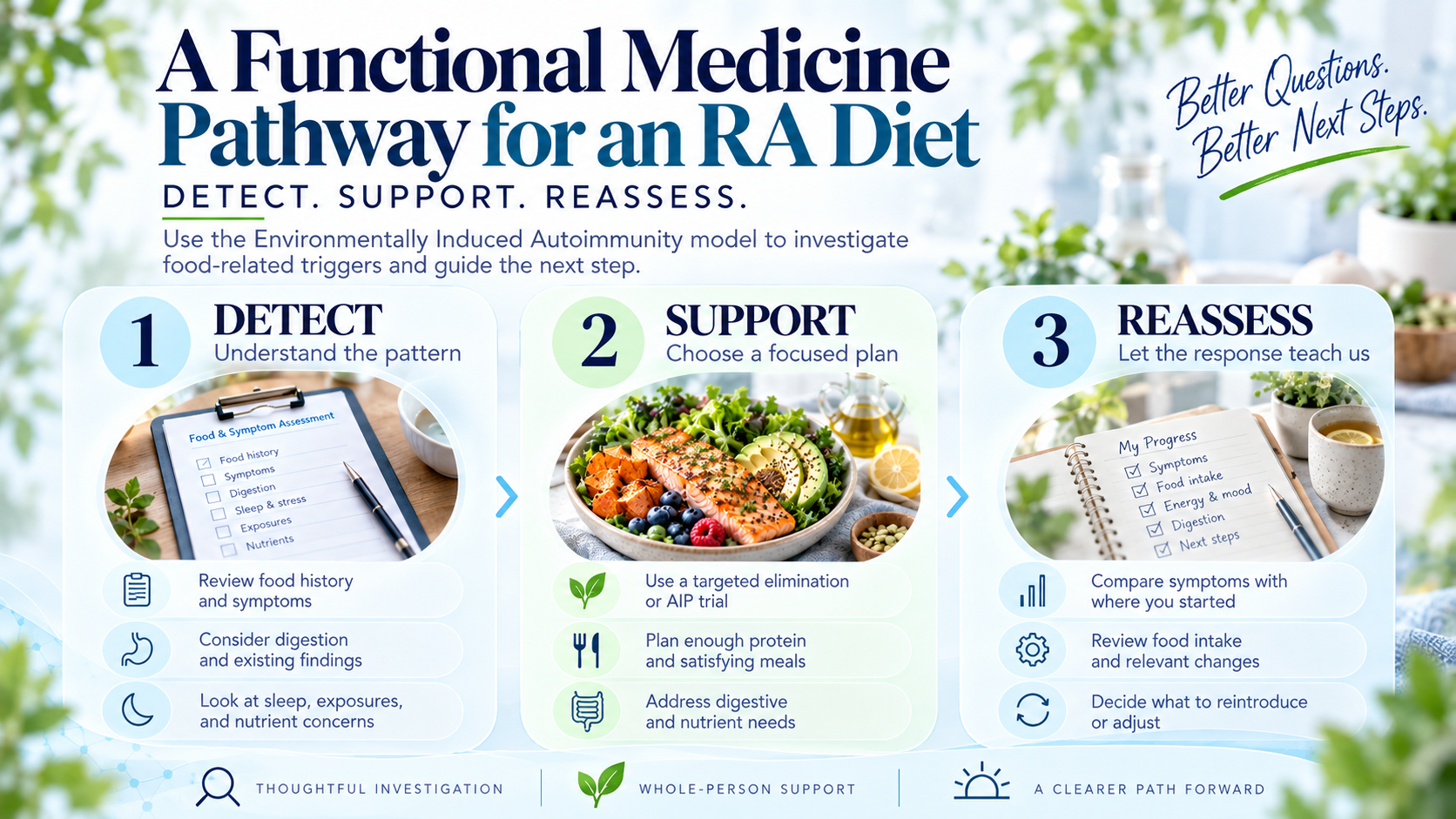
I created a 12-week rheumatoid arthritis supplement, nutrition, and lifestyle protocol that brings the foundational pieces together in one structured plan you can review and follow on your own.
How food, digestion, and your immune system connect
Digestion breaks food down into smaller components that your body can absorb and use. The small intestine absorbs most of those nutrients. Eating a nutrient-rich diet and absorbing those nutrients are related, but they are not the same thing. [1]
Your intestinal lining separates the contents of your gut from the tissue beneath it. Immune cells sit in and beneath that lining, where they help respond to what is encountered. Healthy immune tolerance allows the body to accept food without treating it as a threat.
This is why I consider digestion and the intestinal barrier when evaluating possible food-related immune reactions. We may need to look beyond a food list and ask why certain meals are difficult, whether a digestive condition is present, or whether your intake is meeting your needs.
Researchers have found changes in intestinal permeability in people with RA. Experimental work also connects barrier disruption with arthritis, although much of the evidence about changing the barrier to improve arthritis comes from animal studies. This is a useful area of investigation, not a way to assume that everyone with RA has the same gut problem. [2]
Explore the functional medicine gut health guide for more detail. If IBS is part of your history, the IBS support guide addresses a different set of digestive considerations.
ra-diet-digestion-conversation.png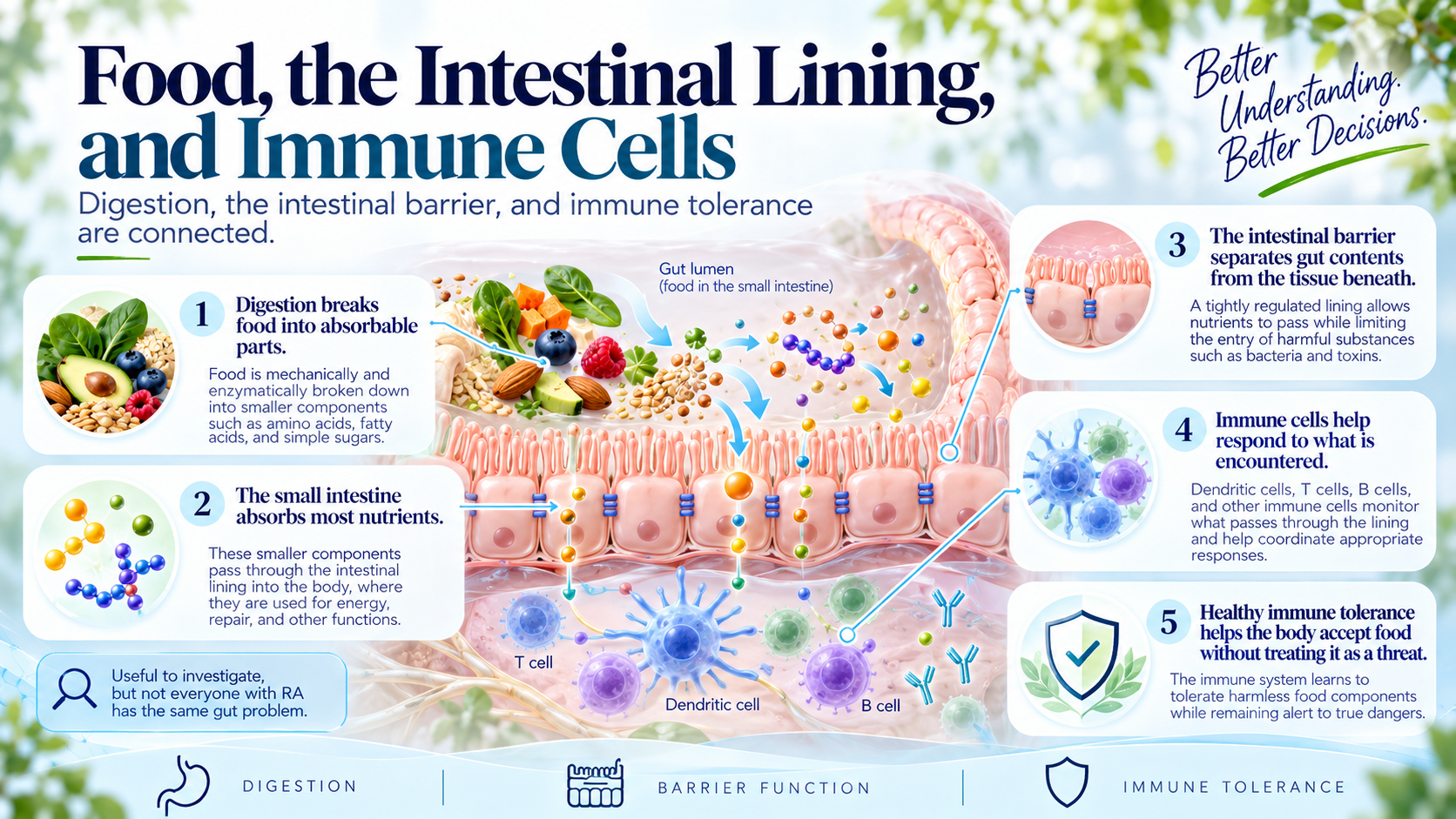
What do I mean by a food-related immune reaction?
Food supplies the protein, energy, vitamins, and minerals your body needs. Some food components can also act as antigens, meaning the immune system can recognize them. Recognition is normal; the question is whether there is an unwanted reaction in your case.
Celiac disease is one clear example of an immune response to a food component: gluten triggers a response that damages the small intestine. Other reactions involve different mechanisms. Trouble digesting lactose, for example, is different from an immune reaction to a milk protein. [3]
When I talk about a lower-antigenicity diet, I mean an approach intended to reduce exposure to foods we suspect may be provoking a reaction. We use the history, relevant findings, and response to elimination and reintroduction to make the plan more specific to you.
Food proteins, lectins, and phytates are different questions
Looking at food proteins does not mean protein is bad. Getting enough protein remains part of the plan. We are looking at particular foods and reactions, not trying to avoid protein as a nutrient.
Lectins and phytates sometimes come up in this discussion, but they do not all act in the same way. Some lectins can cause digestive problems when foods are improperly prepared; phytates can reduce absorption of certain minerals. Soaking, fermentation, and cooking can change their effects. Their presence in a food does not, on its own, tell us that the food is driving RA. [4]
That distinction helps us ask a better question: is this a concern about immune reactivity, digestion, preparation, or nutrient absorption? The answer affects what we do next.
Why I often use autoimmune paleo for an RA diet trial
In my practice, I often recommend the autoimmune paleo diet, also called the Autoimmune Protocol or AIP, when we want to evaluate possible food-related triggers. It gives us a structured way to temporarily remove a broader group of foods while building meals around nutrient-dense choices.
A Mediterranean-style diet is a good place for a lot of people to start. I may choose AIP when I want a more focused elimination trial. The reason is the question we are trying to investigate: how does this person respond when those foods are removed, and what happens when we add foods back?
Core AIP
The elimination phase removes grains, dairy, eggs, legumes, nuts, seeds, and nightshades, along with alcohol and many highly processed foods. The next phase is a planned reintroduction. [5]
Modified AIP
A less restrictive version keeps options such as rice, most legumes, seeds, and ghee. It may make the trial more manageable when cost, food preferences, or the demands of a stricter plan are concerns. [5]
We choose the version deliberately. A food allowed by a protocol may still be unsuitable for someone with a specific allergy or other established reaction. And removing more foods is not automatically a better plan.
My preference for AIP is a clinical choice for conducting an elimination trial. Research has not established that AIP is superior to a Mediterranean diet for RA. There is encouraging early RA-specific research, which I explain below.
What do you eat during an AIP trial?
The first thing I want to know is what you will eat once the foods being evaluated are removed. A plan that leaves you hungry, short on protein, or eating the same two foods needs work.
| Meal component | Examples | What we consider |
|---|---|---|
| Protein | Fish, poultry, meat, or shellfish you tolerate | Your preferences, appetite, and any established allergies |
| Vegetables | Broccoli, leafy greens, carrots, squash, cucumber | Variety, preparation, and digestive comfort |
| Starchy vegetables | Sweet potatoes, plantains, winter squash | Enough energy for your needs |
| Fruit | Berries, apples, pears, citrus | Foods you enjoy and tolerate |
| Fats | Olive oil and avocado | Ways to make meals satisfying and easier to prepare |
These are examples, not a complete prescription. The food list changes if we use Modified AIP or a targeted elimination. We also review nutrients that may become harder to obtain when a food group is removed, including calcium when dairy is excluded.
ra-diet-food-foundations.png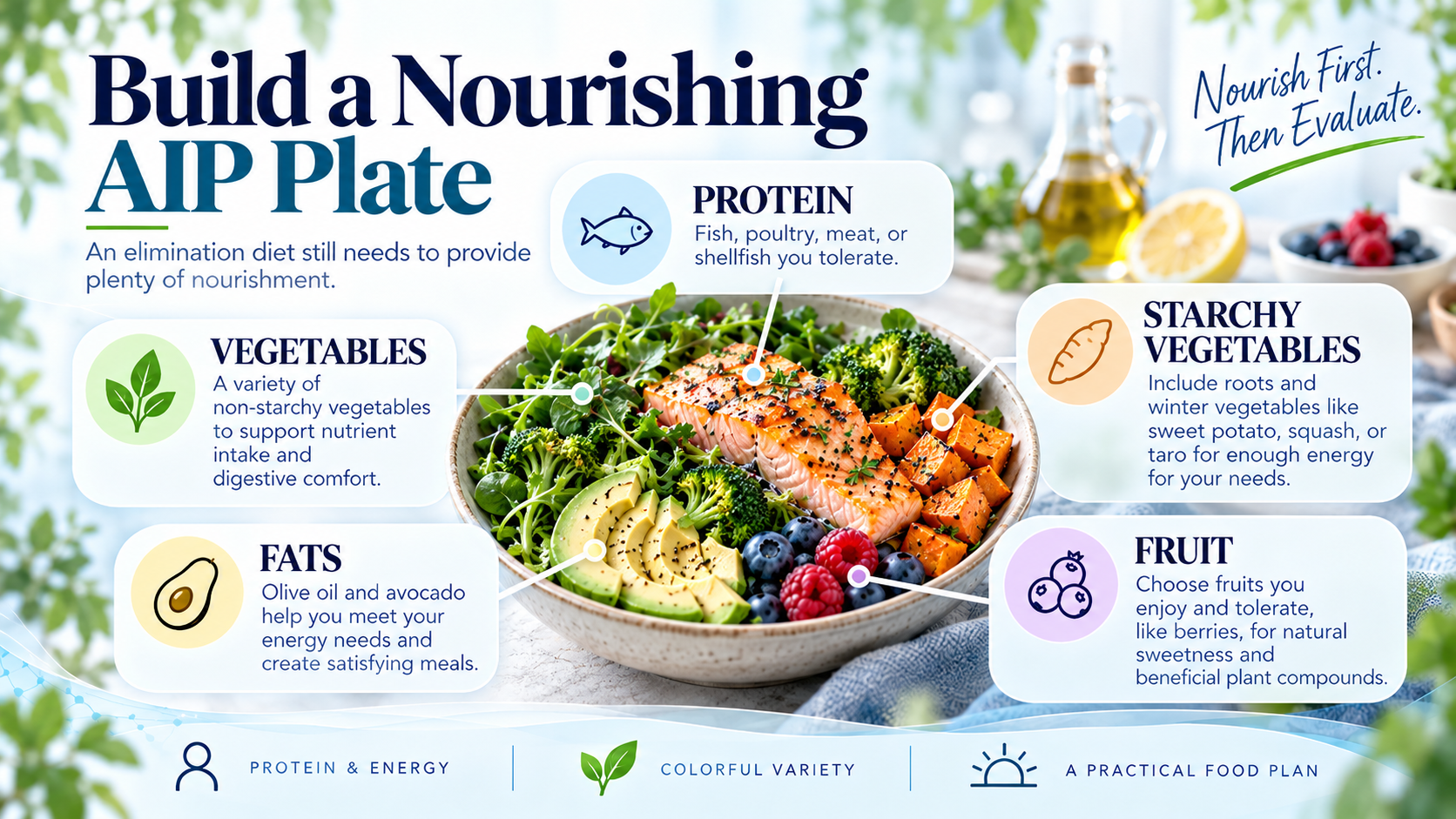
How we choose an elimination diet and evaluate the response
Sometimes there is a specific food to investigate. Other times the pattern is less clear, and a broader elimination trial is more useful. I use food allergy or sensitivity testing when appropriate in my practice, together with your history and the changes we observe during the trial.
A targeted elimination
Focus on selected foods based on the history and relevant findings. Plan substitutions before removing them so the diet still meets your needs.
A broader AIP trial
Temporarily remove several food groups using an agreed protocol. Track the response, then work through a planned reintroduction rather than keeping every exclusion indefinitely.
- Document where you are starting. Record your usual meals, symptoms, digestion, and recent changes.
- Choose the foods and the replacements. Be clear about which version of the diet you are following and how you will get enough food.
- Set a review date. Agree on what you will track and when we will evaluate it.
- Reintroduce when appropriate. Add foods back in a planned sequence and look for a repeatable response.
- Use what we learn. Keep useful changes, reconsider unnecessary restrictions, and investigate questions that remain.
If celiac disease is a possibility, arrange the evaluation before removing gluten because dietary changes can affect test accuracy. A known or suspected serious food allergy also changes the reintroduction plan; that food should not be challenged at home. [3]
Testing questions are covered in the functional medicine testing guide. For your existing RA results, see RA testing and lab review.
ra-diet-personal-food-trial.png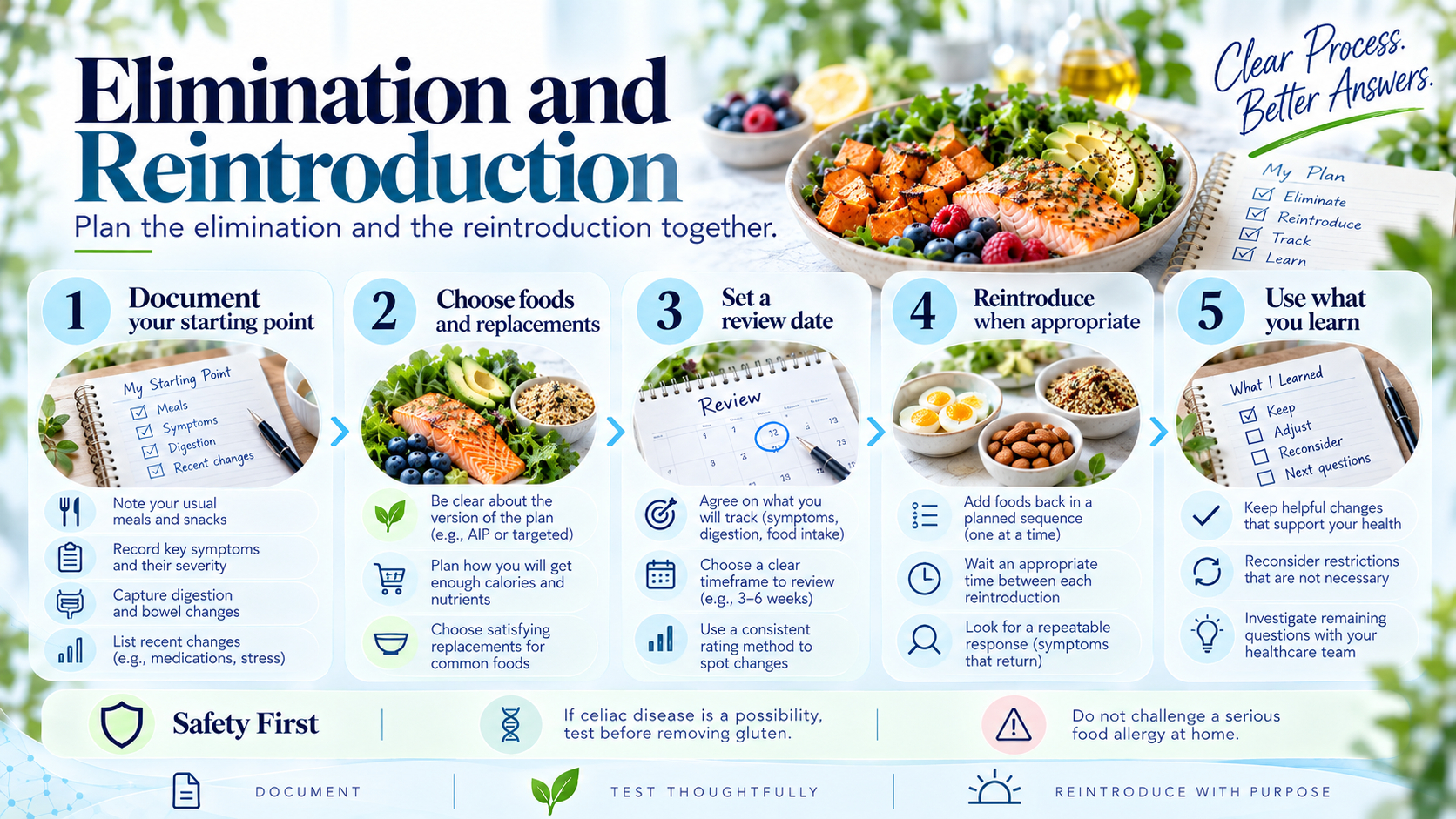
A lower-antigenicity approach still has to nourish you
We need to consider both sides of the diet: what may be provoking a reaction and what your body needs to function well. Removing foods without replacing their nutritional contribution can leave important gaps.
I review your food intake, digestive history, vitamin and mineral findings, and current supplements. If there is evidence of a deficiency or an absorption problem, that deserves a specific plan.
| Area | What we look at |
|---|---|
| Protein and energy | Are you eating enough, maintaining an appropriate weight, and finding meals you can tolerate? |
| Iron and B12 | Do your intake, symptoms, or existing findings suggest a need for further evaluation? |
| Vitamin D and calcium | What do your intake and bone-health needs indicate? Vitamin D helps the body absorb calcium. [6] |
| Omega-3 intake | Do you eat fish, and is a supplement appropriate? RA supplement studies have mixed results, so the decision needs context. [7] |
Bring the names and doses of your supplements. We can review what each one is intended to do before adding more.
My 12-week rheumatoid arthritis protocol combines nine supplement products with nutrition options, movement, sleep, stress support, goal-setting resources, and a clear checkpoint to reevaluate how you are doing.
ra-diet-nutrient-review.png
Simple meals that fit an AIP trial
These Core AIP-style examples show how to put a meal together. Adjust ingredients for your allergies, preferences, and individual plan.
A savory breakfast
Plain turkey patties with sautéed greens, roasted sweet potato, and berries. Check seasonings against your food list.
A chicken and vegetable bowl
Chicken, roasted squash, cucumber, and avocado over greens, with olive oil and lemon.
A simple fish meal
Salmon with broccoli and sweet potato. Use herbs and seasonings that fit your plan.
With Modified AIP, a meal might also include rice or a tolerated legume. Keep the versions clear so you are following one agreed plan instead of mixing rules from several lists.
Plan for days when your hands hurt or your energy is low
Frozen vegetables, pre-cut produce, batch-cooked protein, and a few meals in the freezer can make a real difference to how manageable the diet feels. Start with meals you are willing to eat repeatedly. We can add variety as you get comfortable with the plan.
If an elimination diet leaves you weak, persistently hungry, losing weight unintentionally, or increasingly anxious about food, bring that up promptly. Feeling worse is a reason to review the plan, not simply make it stricter.
ra-diet-easy-meals.png
What changes are we looking for?
Before changing the diet, I want us to agree on what we are following. That might include morning stiffness, joint comfort, energy, digestive symptoms, or an activity that has become difficult.
Keep a short, useful record
- Which foods you removed or reintroduced, and when.
- The symptoms we agreed to track.
- Changes in digestion, appetite, energy, and weight.
- Other changes, including sleep, illness, medication, or supplements.
If something improves, we look at whether the improvement is consistent and what happens during reintroduction. If nothing changes, we reconsider the hypothesis and the plan. A dietary trial should give us information we can use.
A symptom diary helps us track patterns; it is not a direct measurement of immune tolerance. Relevant lab findings and examinations add a different kind of information.
If you are trying to understand a change in symptoms, the RA flare guide may also help.
ra-diet-reassess-progress.png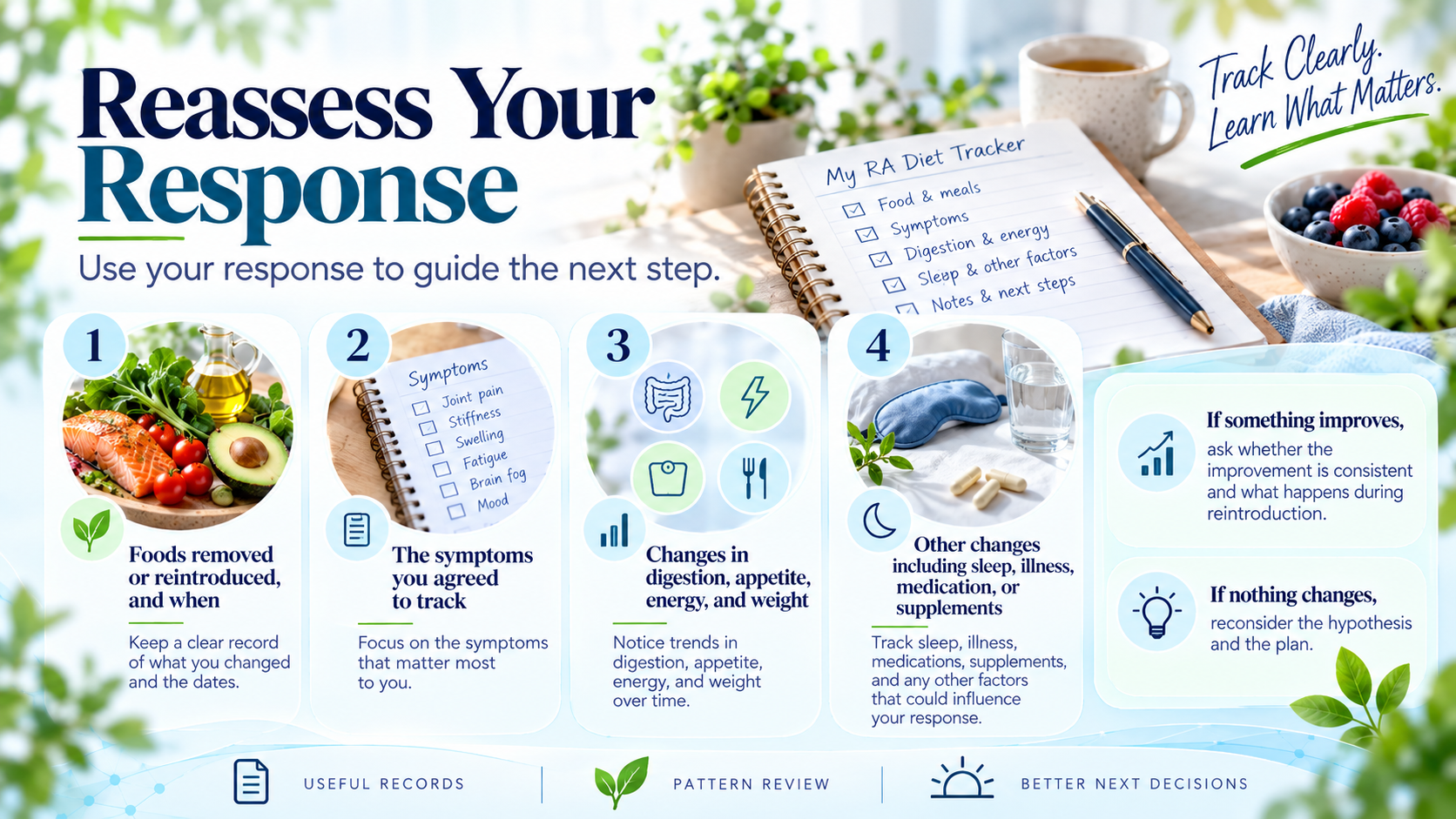
What does the research say about AIP and RA?
An encouraging pilot study
Nine adults with RA completed four weeks of their usual diet followed by eight weeks of AIP. Patient-reported symptoms and disease-impact scores improved overall, with improvements in seven of the nine participants. [8]
The study was small, unblinded, and had no separate randomized control group. It could not establish which removed foods mattered or whether immune reactivity changed. Some participants experienced digestive problems or unintended weight loss. It supports further research and careful individual follow-up.
A useful option with a broader evidence base
The American College of Rheumatology conditionally recommends a Mediterranean-style diet. That does not make it the only dietary approach worth discussing. In my practice, the choice depends on whether we are improving the overall eating pattern or conducting a more specific elimination trial. [9]
AIP is a clinical approach I use to investigate possible food-related contributors. I explain what we are trying, why we are trying it, and how we will decide whether it is helping.
Let’s look at your diet in the context of your autoimmune health
Start with your history and your questions
If you want to explore whether food-related reactions, digestion, or nutrient status deserve closer attention in your case, start with the Application for Care.
I review your information personally. If I believe my approach is a good fit, I will send you a private scheduling link.
Brad Shook, DC, AFMC · Hickory, North Carolina · Remote consultations for appropriate clients nationally
Common questions about an RA elimination diet
What is a good starting point for a rheumatoid arthritis diet?
A Mediterranean-style diet is a good place for many people to start. In my practice, I often use autoimmune paleo or AIP when the goal is to investigate possible food-related reactions through elimination and reintroduction.
Why does Dr. Shook use autoimmune paleo for RA?
I use AIP as a structured elimination approach when we want to evaluate possible food-related triggers. We temporarily remove selected food groups, maintain a nourishing diet, and use your response to guide reintroduction and the next steps.
What does lower antigenicity mean?
I use this term to describe a dietary approach intended to reduce exposure to foods suspected of provoking an immune reaction. The food choices depend on your history, relevant findings, and response to the trial.
What is the difference between Core AIP and Modified AIP?
Core AIP removes a broader range of foods during elimination. Modified AIP keeps options such as rice, most legumes, seeds, and ghee. We choose an approach based on the purpose of the trial and your individual needs.
Does looking at food proteins mean I should eat less protein?
No. Getting enough protein remains important. The question is whether particular foods are a problem for you, not whether protein as a nutrient should be avoided.
Do you use food allergy or sensitivity testing?
I use testing when appropriate as part of a broader evaluation. Your history, relevant results, and response to dietary changes help guide the selection of foods and the plan for reassessment.
How long will I need to stay on an elimination diet?
We agree on a review date before starting. The duration depends on the reason for the trial, your nutritional needs, and your response. Reintroduction is part of the plan; the elimination phase is not meant to become an indefinite list of restrictions.
Should I remove gluten before testing for celiac disease?
Discuss testing first if celiac disease is suspected. Removing gluten can make the tests less accurate and complicate the evaluation.
Can I work with Dr. Shook remotely?
Remote functional medicine consultations are available for appropriate clients nationally through my Hickory, North Carolina practice. Start with the Application for Care; I review your information before offering a private scheduling link.
Sources and further reading
- NIDDK. Your digestive system and how it works.
- Matei and colleagues. Intestinal barrier dysfunction and arthritis pathology. Med (2021).
- NIDDK. Diagnosis of celiac disease.
- Harvard T.H. Chan School of Public Health, The Nutrition Source. Antinutrients and food preparation.
- Autoimmune Wellness. Core and Modified AIP protocol definitions (2026).
- NIH Office of Dietary Supplements. Vitamin D fact sheet.
- NIH Office of Dietary Supplements. Omega-3 fatty acids fact sheet.
- McNeill and colleagues. Autoimmune Protocol diet in adults with rheumatoid arthritis: pilot feasibility study (2026).
- American College of Rheumatology. Guideline for exercise, rehabilitation, diet, and additional integrative interventions in RA (2023).
Updated October 2, 2026. This page describes my functional medicine approach and the research relevant to it.
Dietary changes are not a proven cure for RA or a replacement for prescribed treatment. Keep medication changes with your prescriber, and seek prompt evaluation for new or worsening joint swelling.