There Probably Is Not One Perfect Psoriasis Diet
People with psoriasis are often given two extreme messages. One says diet has nothing to do with psoriasis. The other says there is one hidden food trigger or one perfect elimination diet that everyone needs.
I do not think either extreme is useful.
Psoriasis is an autoimmune and inflammatory disease. A diagnosis tells us what disease has been identified, but it does not automatically tell us which dietary, metabolic, gastrointestinal, environmental, or lifestyle factors may be influencing disease activity in a particular person.
Start with a strong nutritional foundation, then use history, symptoms, testing when appropriate, and response over time to decide whether a more targeted dietary strategy is worthwhile.
This diet guide belongs inside the larger framework described in Psoriasis Causes and Treatment: The Functional Medicine Approach and Gut Health and Psoriasis.
Diet Is Becoming a More Serious Part of the Psoriasis Conversation
The evidence is not perfect, but it is getting better. A 2025 systematic review of psoriasis dietary studies concluded that Mediterranean-style, calorie-restricted, and appropriately selected gluten-free approaches, along with fiber, prebiotics, probiotics, and omega-3 fatty acids, may be associated with better psoriasis outcomes. The authors also emphasized that higher-quality evidence is still needed.
That is the right level of confidence. Diet matters enough to investigate, but not enough to justify pretending one rigid diet has been proven for everyone.
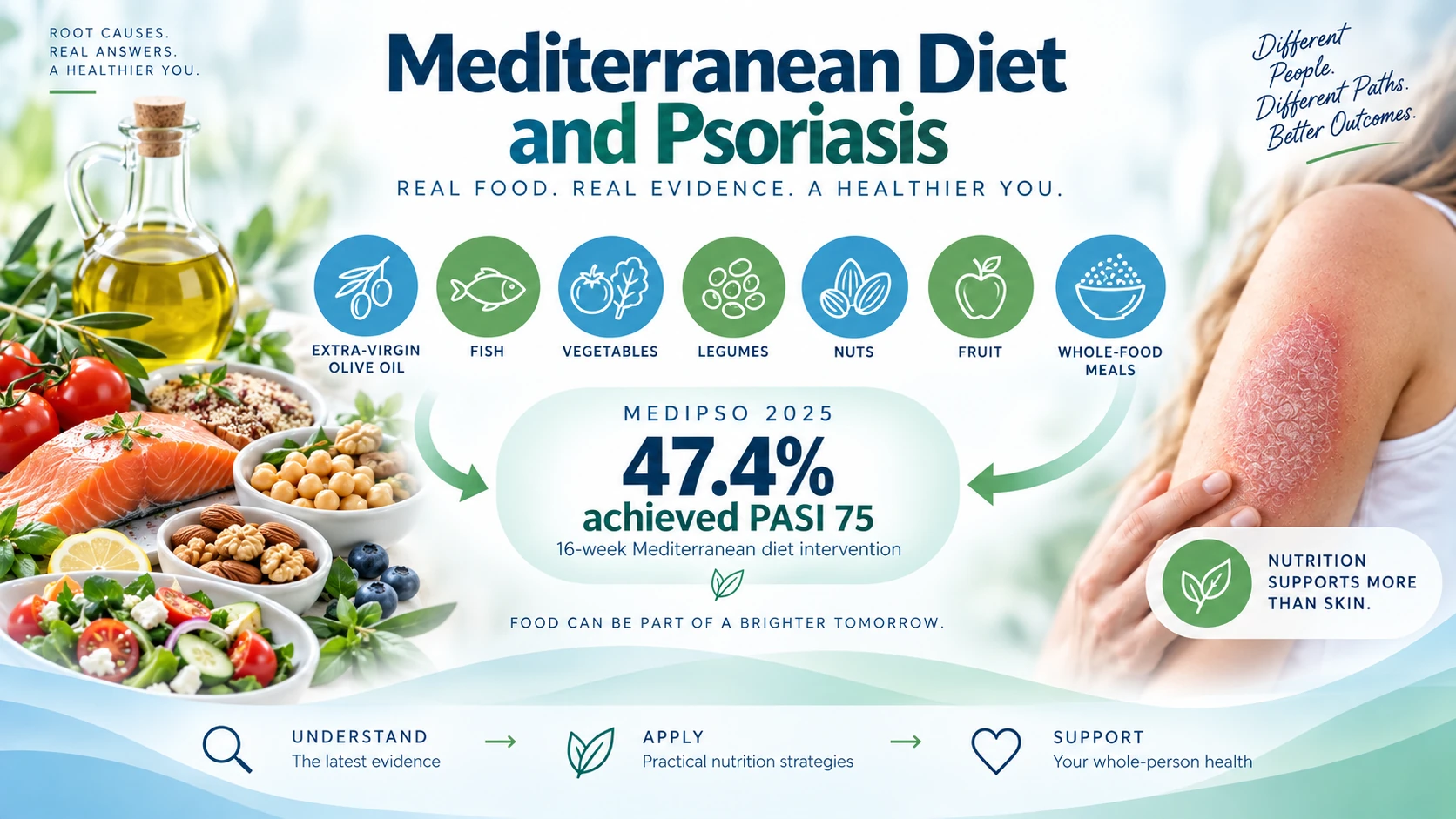
In the 2025 MEDIPSO randomized clinical trial, 9 of 19 adults assigned to a 16-week dietitian-guided Mediterranean diet achieved a 75% reduction in PASI, compared with 0 of 19 in the control group. Participants continued stable topical therapy, so the study tested diet as an additional strategy rather than as a replacement for treatment.
Whole Foods First: The Simplest Place to Begin
Before I start removing long lists of foods, I usually want to know what is replacing them.
A diet can be technically gluten-free, dairy-free, or Paleo and still be built around packaged foods, sweeteners, refined starches, snack products, and convenience foods. That is not the same thing as eating real food.
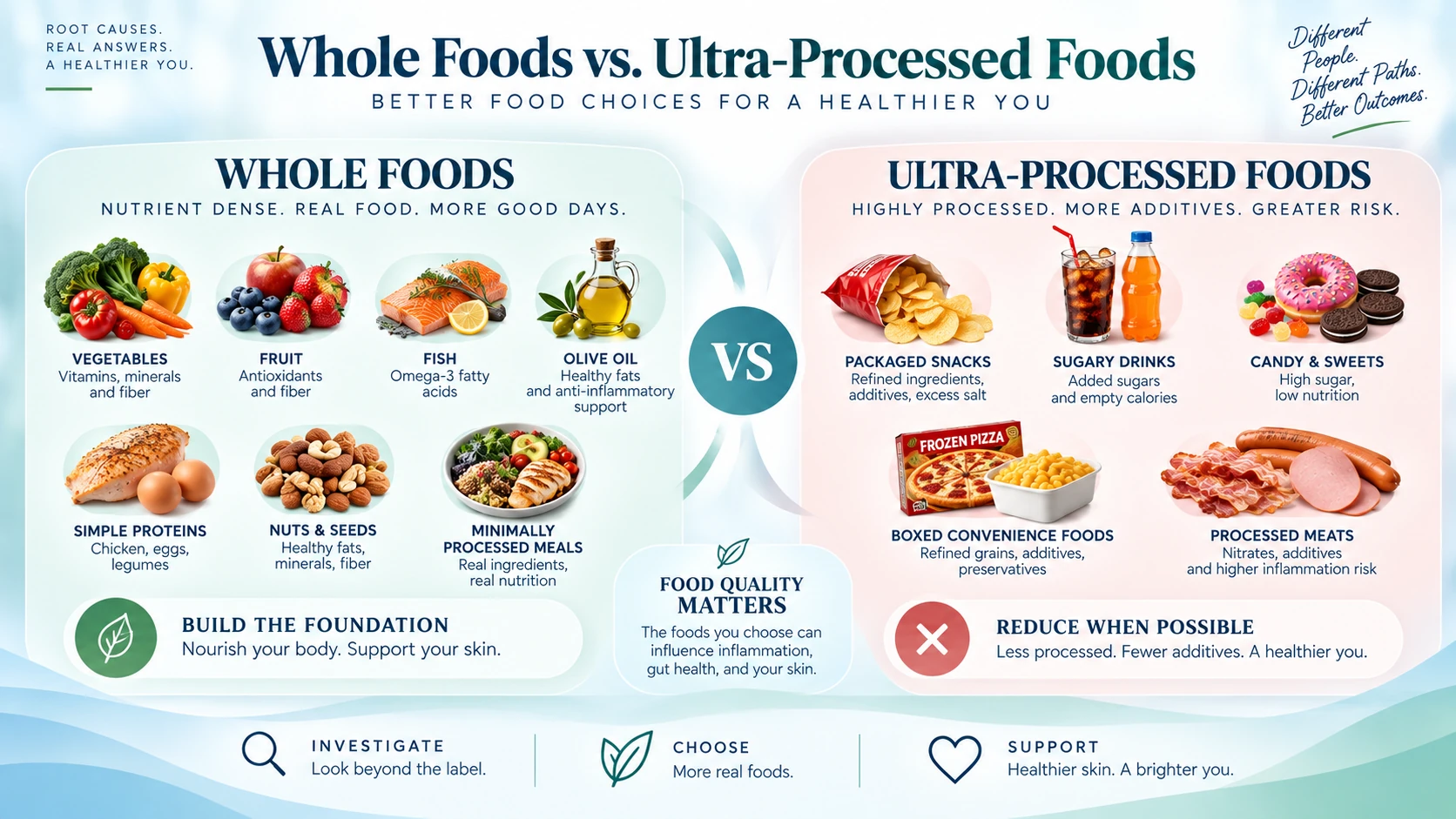
A 2025 prospective UK Biobank study involving more than 121,000 adults found that higher intake of ultra-processed foods was associated with a greater risk of developing psoriasis. In a substitution model, replacing 20% of ultra-processed food intake with unprocessed or minimally processed foods was associated with an 18% lower psoriasis risk.
That study looked at future risk rather than treatment of established psoriasis, so I would not claim that removing packaged foods will automatically clear someone's skin. But it strongly supports the direction I have used clinically for years: make whole, minimally processed food the foundation.
What Foods Are Good for Psoriasis?
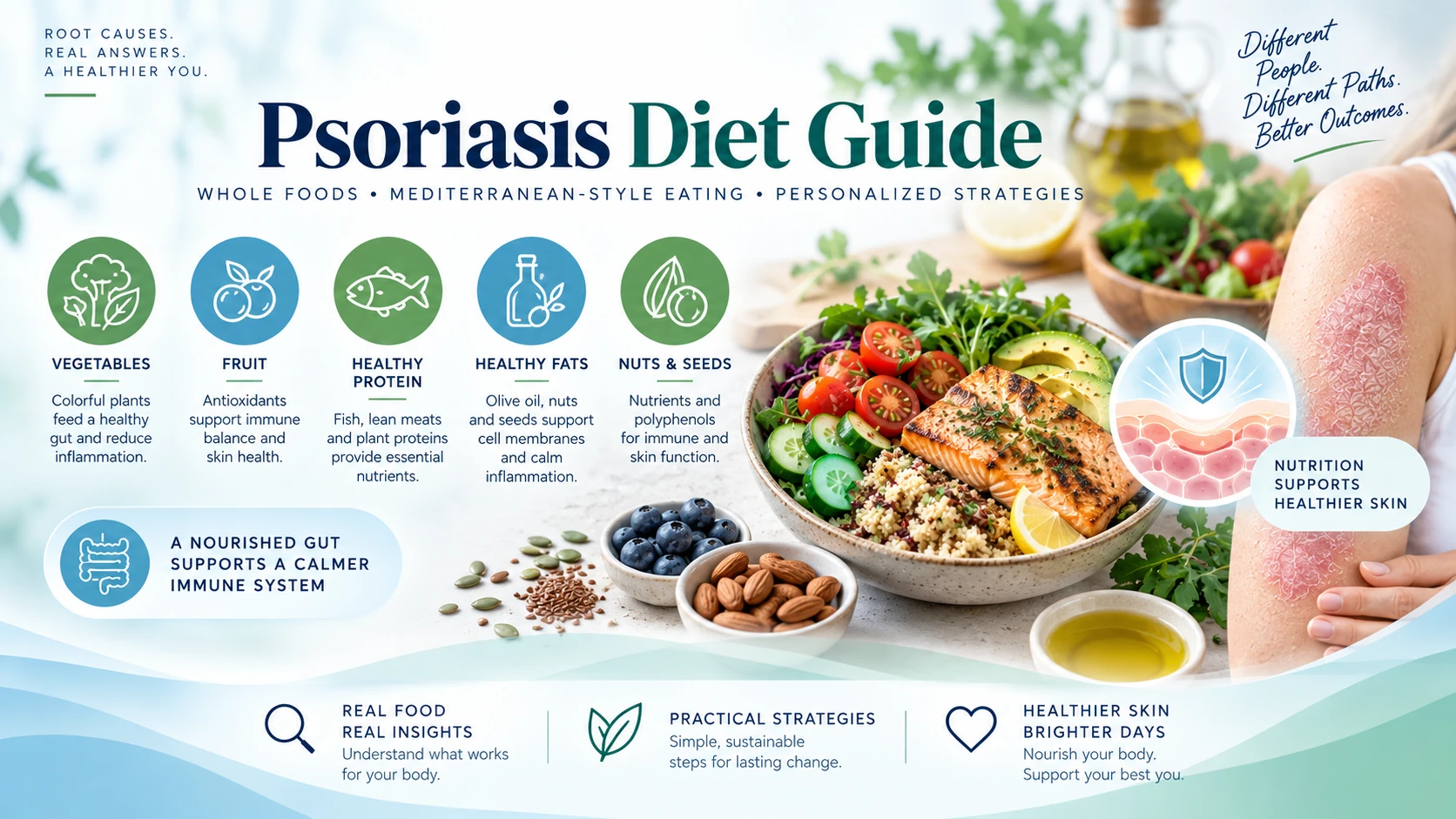
If someone asks me where to start before we know anything else about them, I would build the plate around foods that improve overall diet quality and cardiometabolic health.
Vegetables and fruit
Use a broad variety of colors and types. These foods provide fiber, polyphenols, vitamins, minerals, and other compounds that support metabolic and gut health.
Fish and omega-3-rich foods
Fatty fish such as salmon, sardines, trout, and mackerel fit well within a Mediterranean-style pattern.
Healthy fats
Extra-virgin olive oil, avocado, nuts, and seeds can provide a more favorable fat profile when they fit the individual's plan and tolerance.
Quality protein
Fish, poultry, eggs if tolerated, lean meats, and other minimally processed protein sources can help preserve muscle and make meals more satisfying.
Fiber-rich plant foods
Legumes, vegetables, fruit, nuts, seeds, and whole grains can support microbial diversity and metabolic health when tolerated and when they fit the dietary strategy being used.
Simple meals you can repeat
The best diet on paper is useless if it is too complicated to follow. A small number of reliable meals can make consistency much easier.
What Foods Should You Avoid With Psoriasis?
I would not begin with a universal forbidden-food list. I would start with the categories that are most defensible and then personalize from there.
Reasonable first reductions
- Ultra-processed foods
- Excess added sugar
- Frequent refined snack foods
- Processed meats
- Excess alcohol
- Foods that repeatedly and clearly cause symptoms for the individual
Do not assume everyone must eliminate
- Gluten
- Dairy
- Nightshades
- Eggs
- Nuts and seeds
- Legumes or grains
Those foods may be removed temporarily in a structured elimination trial when there is a reason. That is very different from declaring them universal psoriasis triggers.
Why the Mediterranean Diet Is So Interesting for Psoriasis
The Mediterranean diet is less about one magic food and more about the overall pattern: vegetables, fruit, legumes, nuts, seeds, whole grains, fish, extra-virgin olive oil, minimally processed foods, and relatively little ultra-processed food.
That pattern makes sense for psoriasis for several reasons. It can improve diet quality, cardiometabolic health, fiber intake, fatty-acid balance, and polyphenol exposure. Those are all relevant because psoriasis is not just a skin disease. It is associated with increased cardiometabolic risk and systemic inflammation.
The MEDIPSO trial gives us something we did not have before: randomized clinical evidence that a Mediterranean intervention can improve psoriasis severity in at least some adults with mild to moderate disease.
I still would not tell every person with psoriasis, “You must eat Mediterranean forever.” I would say the evidence now gives us a strong whole-food foundation from which to personalize.
Weight, Insulin Resistance, and Psoriasis
When someone has overweight, obesity, insulin resistance, fatty liver risk, or other metabolic concerns, diet has another important job. It can improve the broader physiology surrounding the autoimmune disease.
A 2026 systematic review and meta-analysis of 13 randomized trials involving 1,145 adults found that weight-loss interventions improved psoriasis severity. The National Psoriasis Foundation has also long recommended dietary weight reduction for people with psoriasis who have overweight or obesity.
This should never become a message of blame. Psoriasis is not caused simply by body weight. The point is that adipose tissue, insulin resistance, cardiovascular risk, and systemic inflammation can interact with psoriasis, so metabolic health is worth addressing when relevant.
Diet Can Change the Gut Environment, but the Gut Is Not One Universal Root Cause
Diet is one of the strongest day-to-day influences on the gut microbiome. Fiber, plant diversity, fermented foods, protein intake, fat quality, alcohol, and ultra-processed foods can all change the gut environment.
That matters because newer psoriasis research continues to identify relationships between the gut microbiome, microbial metabolites, intestinal barrier function, immune signaling, and psoriasis. But those studies do not show that every person has the same dysbiosis or that “healing leaky gut” is a proven universal psoriasis treatment.
That is why I keep returning to the same principle: investigate the person, not an internet theory.
For a deeper review of this research, read Gut Health and Psoriasis: Understanding the Gut-Skin Connection.
Should You Go Gluten-Free for Psoriasis?
Not automatically.
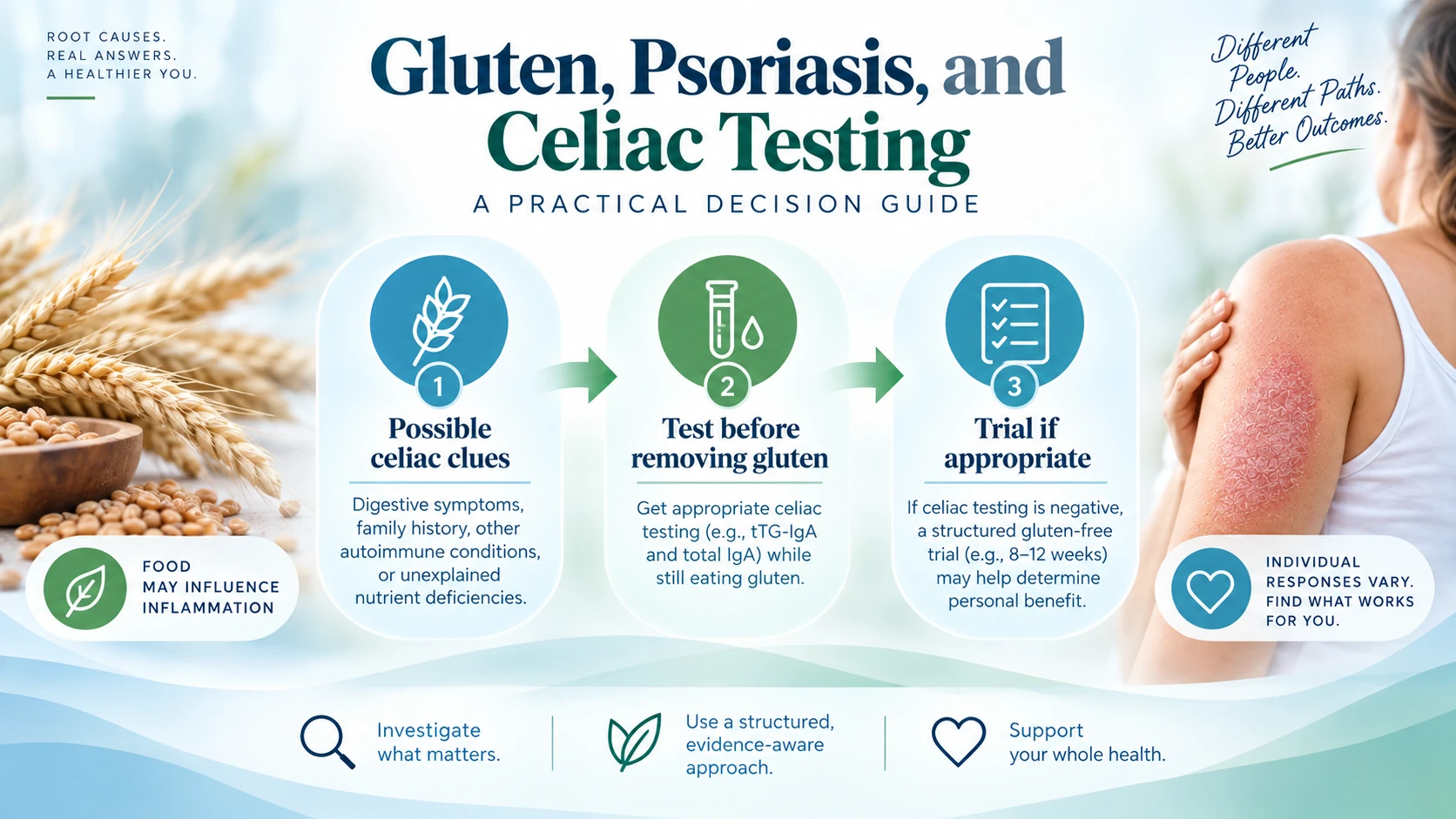
Psoriasis and celiac disease occur together more often than chance alone would predict, and some people with psoriasis who have celiac disease or positive gluten-related serology improve on a gluten-free diet. That is why the National Psoriasis Foundation's systematic review recommended a gluten-free diet most clearly for people who test positive for serologic markers of gluten sensitivity.
If celiac disease is a possibility, testing should generally be considered before removing gluten because going gluten-free can make celiac testing less informative.
What About Dairy, Nightshades, Eggs, Lectins, and Other Foods?
These are some of the most common foods people are told to remove. They are also where dietary advice can become unnecessarily restrictive.
I have seen clients who appear to respond to specific food removals. I have also seen people arrive after months of avoiding an enormous list of foods with no clear idea which restrictions were helping, which were unnecessary, or how to reintroduce anything.
My preference is to use food elimination as an experiment with a purpose. If we remove something, we should know why we are removing it, what we are watching, and how we will decide whether it deserves to stay out.
Where the Autoimmune Protocol Diet May Fit
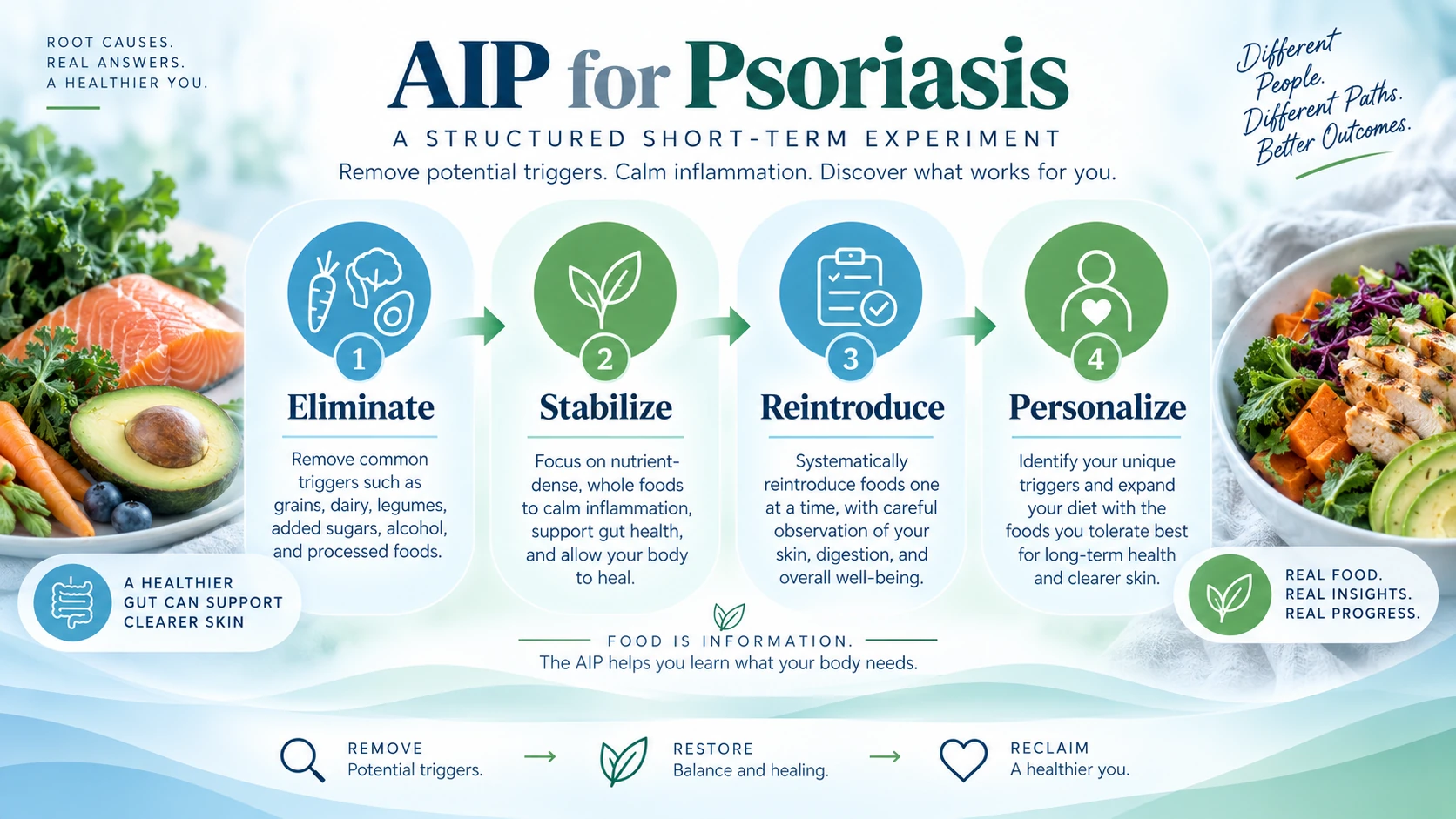
The Autoimmune Protocol, usually called AIP, is a structured elimination and reintroduction framework. It temporarily removes several food categories and then uses systematic reintroduction to help identify foods that may or may not be well tolerated.
A 2025 review of AIP describes it as a personalized elimination strategy used across autoimmune conditions. However, psoriasis-specific trial evidence remains limited. That distinction matters.
I have used autoimmune-Paleo-style frameworks clinically because they can create structure, simplify food choices, and make it easier to observe patterns. I do not think everyone with psoriasis needs to live on a strict AIP diet forever.
Why I Often Use Slow-Cooker Whole-Food Meals
One of the most practical ways I have found to help people follow a whole-food or autoimmune-Paleo-style plan is to simplify meals around a slow cooker or Crock-Pot. It reduces preparation time, makes batch cooking easy, and helps replace packaged convenience foods with meals built from recognizable ingredients.
I want to be precise about what I am claiming. I am not aware of psoriasis research showing that slow cooking itself treats psoriasis. The advantage is behavioral and practical. It can make the kind of whole-food dietary pattern we want much easier to sustain.
A simple slow-cooker meal might combine a tolerated protein, vegetables, herbs, broth or another simple liquid base, and a healthy fat added appropriately. That gives someone a repeatable template without giving away an entire individualized program or requiring complicated recipes.
Clinically, I have found this especially useful when a client is doing a temporary elimination framework because the number of food decisions is already high. Simpler preparation can improve consistency, and consistency gives us better information when we reassess.

Omega-3s, Vitamin D, Probiotics, Curcumin, and Other Supplements
Supplements get a lot of attention because they are easier to market than a dietary pattern. Some have promising data, including omega-3 fats, probiotics, vitamin D in selected situations, and curcumin. But reviews continue to find mixed results and limited certainty across products and doses.
That does not mean supplements are useless. It means they should follow the question we are trying to answer. If someone has a true nutrient deficiency, correcting it makes sense. If a probiotic is being considered because there is a specific gastrointestinal reason, that is different from automatically handing every person the same bottle.
I would rather build a strong food foundation first and use supplements selectively.
If you want to see how I combine that dietary foundation with a structured supplementation plan, review my 12-week psoriasis supplement protocol. It brings the supplement, diet, and lifestyle pieces together in one place.
How I Build a Psoriasis Diet Without Making It Needlessly Complicated
Before changing anything, identify what the person actually eats, how often they eat ultra-processed foods, how much protein and fiber they get, and whether digestive or metabolic issues are present.
Move toward whole, minimally processed foods and a Mediterranean-style pattern where appropriate.
Celiac risk, gastrointestinal symptoms, metabolic disease, allergies, clear food-response patterns, medications, and nutrient concerns can all change the plan.
If a more restrictive trial is justified, define what is being removed, how long the experiment will run, and what will be reassessed.
The purpose of an elimination diet is usually to learn, not to accumulate permanent restrictions.
DETECT, SUPPORT, REASSESS
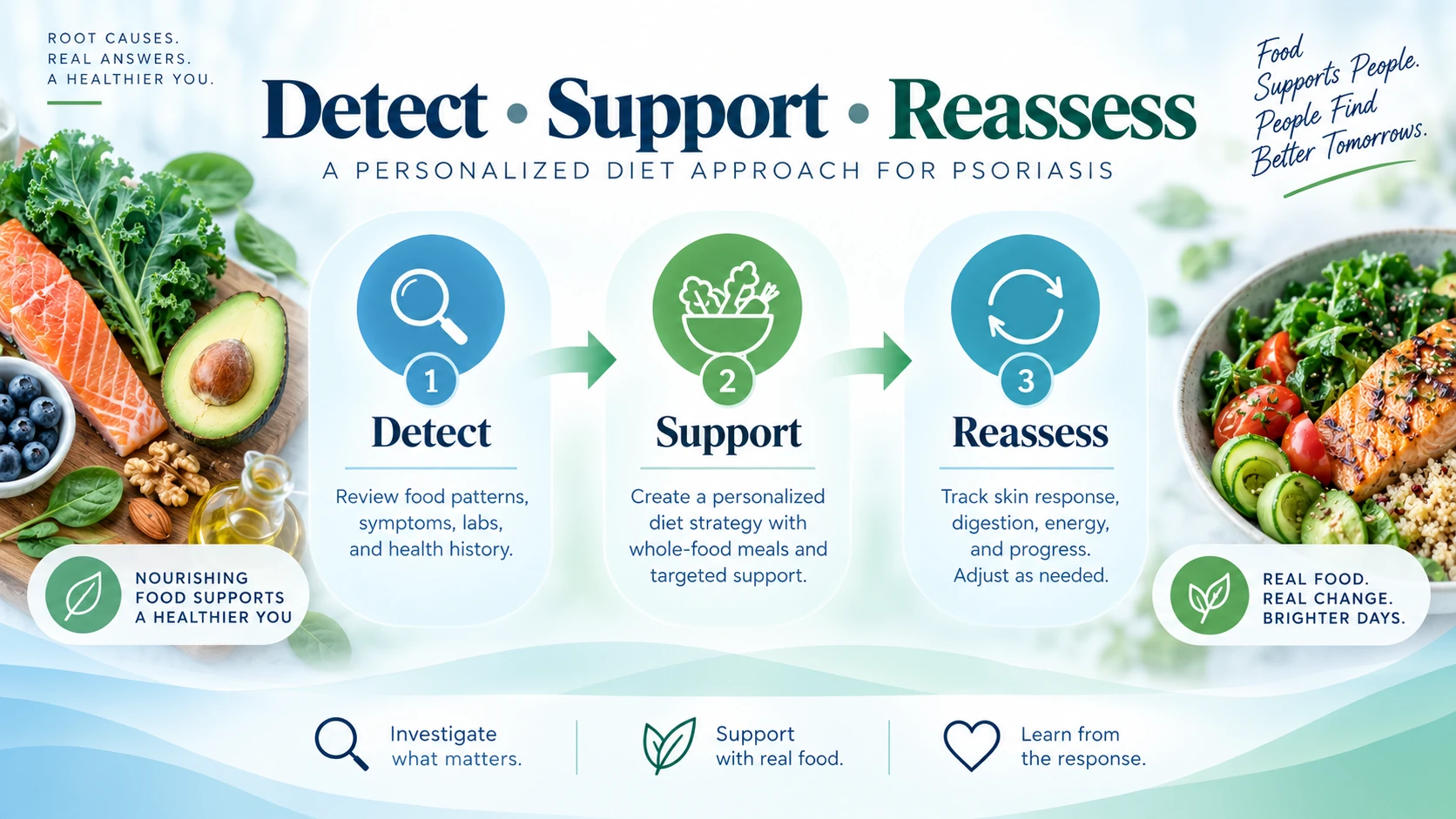
Review diet, symptoms, digestive patterns, metabolic health, food reactions, nutrient status, medications, labs, celiac risk, lifestyle, and the timing of psoriasis changes.
Build the simplest nutritional strategy that addresses the highest-priority findings. That may be a Mediterranean-style whole-food plan, a metabolic-health plan, or a temporary structured elimination approach.
Look at skin activity, digestive symptoms, energy, body composition when relevant, laboratory markers, and quality of life. What changed? What did not? What does the response teach us?
Diet Does Not Need to Compete With Psoriasis Treatment
I consider nutrition a foundational part of how I approach autoimmune disease because food is one of the most consistent environmental inputs we can change.
That does not mean someone should stop topical treatment, phototherapy, biologics, or other appropriate medical care to “see if diet works.” The MEDIPSO trial itself studied dietary change while people remained on stable topical therapy.
The opportunity is to improve the nutritional and metabolic environment around the disease while still controlling active psoriasis and protecting health when medical treatment is needed.
If You Want to Start Today, Do These Five Things
That is useful enough to begin without giving you a rigid protocol that may not fit your physiology.
You can review my 12-week psoriasis supplement protocol and see exactly how I put those foundations together.
Frequently Asked Questions About Diet and Psoriasis
What is the best diet for psoriasis?
There is no single best diet for everyone with psoriasis. The strongest practical starting point is a whole-food pattern that minimizes ultra-processed foods and emphasizes vegetables, fruit, quality protein, fiber-rich plant foods, healthy fats, and fish when appropriate. Mediterranean-style eating currently has some of the best psoriasis-specific evidence.
Can diet cure psoriasis?
No scientifically established diet cures psoriasis. Diet can still matter because it can influence metabolic health, nutrient status, gut health, body composition, and inflammatory signaling. For some people, dietary changes may also improve psoriasis severity, but the response is individual.
What foods should I eat if I have psoriasis?
A reasonable foundation includes vegetables, fruit, legumes if tolerated, nuts and seeds if tolerated, fish, extra-virgin olive oil, minimally processed proteins, and other whole or minimally processed foods. The exact plan should reflect your health history, digestive tolerance, metabolic needs, allergies, and response.
What foods should I avoid with psoriasis?
There is no universal list of foods that everyone with psoriasis must avoid. A useful first step is usually reducing ultra-processed foods, excess added sugar, and excess alcohol. More restrictive eliminations such as gluten, dairy, nightshades, grains, or legumes should have a reason and a plan for reassessment or reintroduction.
Is the Mediterranean diet good for psoriasis?
Yes, it is one of the most promising dietary patterns studied for psoriasis. In the 2025 MEDIPSO randomized clinical trial, adults with mild to moderate psoriasis who received a 16-week dietitian-guided Mediterranean diet intervention improved significantly more than the control group while continuing stable topical therapy.
Should everyone with psoriasis avoid gluten?
No. A gluten-free diet is most clearly justified when someone has celiac disease or other evidence suggesting gluten-related disease. If celiac disease is a possibility, testing should generally be considered before removing gluten because going gluten-free can interfere with diagnostic testing.
Are dairy and nightshades bad for psoriasis?
They are not proven universal psoriasis triggers. Some people report individual reactions, but that is different from evidence that everyone should remove them. If they are eliminated as part of a structured trial, there should be a clear reason and a plan to learn from reintroduction.
Can losing weight improve psoriasis?
For people who have overweight or obesity, weight-loss interventions can improve psoriasis severity and cardiometabolic health. That does not mean weight loss is appropriate for everyone, and the goal should be health improvement rather than blame or extreme restriction.
Is the Autoimmune Protocol diet useful for psoriasis?
The Autoimmune Protocol, or AIP, is a structured elimination and reintroduction framework used in some autoimmune populations. It can be a practical short-term framework in selected people, but psoriasis-specific trial evidence is limited. I do not view AIP as a universal lifelong diet or as a proven cure for psoriasis.
Why do you sometimes use slow-cooker meals with psoriasis clients?
In my clinical experience, slow-cooker meals can make a whole-food plan easier to follow because they simplify preparation and reduce reliance on convenience foods. I do not consider the cooking method itself a psoriasis treatment. The value is that it can make a focused whole-food or temporary elimination plan practical enough to follow consistently.
Do probiotics or supplements belong in a psoriasis diet plan?
Sometimes, but they should not automatically come first. Research on omega-3 fats, probiotics, vitamin D, curcumin, and other supplements is evolving, but results vary and the certainty is often limited. Food quality, metabolic health, true deficiencies, and individualized priorities usually provide a better foundation.
How long should I try a psoriasis diet before deciding whether it helps?
That depends on the type of intervention, but the important principle is to define what you are changing and what you will measure. I prefer a structured trial followed by reassessment rather than making multiple permanent restrictions at once. Skin activity, digestive symptoms, energy, weight or metabolic markers, and quality of life can all provide useful feedback.
Want a Psoriasis Diet Built Around Your Physiology Instead of a Generic Food List?
The goal is not to remove more and more foods. It is to understand which nutritional, metabolic, gut, and lifestyle factors may actually matter in your case, build a focused plan, and learn from how your psoriasis responds.
Important Health Information
Major dietary restriction can create nutritional deficiencies or make existing health problems harder to manage. If you have diabetes, kidney disease, an eating disorder history, significant gastrointestinal symptoms, unexplained weight loss, pregnancy, celiac disease concerns, food allergy, or take medications affected by diet or weight change, discuss major dietary changes with an appropriate clinician.
Selected References & Further Reading
- Barrea L, et al. Mediterranean Diet and Patients With Psoriasis: The MEDIPSO Randomized Clinical Trial. JAMA Dermatology. 2025.
- Wang Q, et al. Evidence-based dietary recommendations for patients with psoriasis: A systematic review. Clinical Nutrition. 2025.
- Peng X, et al. Ultra-Processed Food Consumption and the Risk of Psoriasis: A Large Prospective Cohort Study. Nutrients. 2025.
- Impact of weight-loss interventions on psoriasis severity: A systematic review and meta-analysis. 2026.
- Ford AR, et al. Dietary Recommendations for Adults With Psoriasis or Psoriatic Arthritis From the Medical Board of the National Psoriasis Foundation: A Systematic Review. JAMA Dermatology. 2018.
- Pardali EC, et al. Autoimmune protocol diet: A personalized elimination diet for patients with autoimmune diseases. Metabolism Open. 2025.
- American Academy of Dermatology. What should I eat if I have psoriasis?
- National Psoriasis Foundation. Psoriasis: Dietary Modifications.