
First, Ask What Your Blood Test Was Trying to Find Out
When someone tells me, “My thyroid was checked and everything was fine,” I usually ask to see the report. Were they checking whether the thyroid makes enough hormone, or were they looking for Hashimoto's? Those aren't the same question, though they are certainly related.
A standard thyroid workup often begins with TSH and, when appropriate, free T4. Those tests are important for understanding thyroid function, but antibody testing is often not included in the initial workup. If you have not looked at the actual lab report, you may not know whether anyone checked specifically for thyroid autoimmunity. In many cases, antibodies were not evaluated. That's important when you're trying to understand whether you have Hashimoto's.
Why aren't thyroid antibodies always checked? Routine thyroid care often focuses first on thyroid hormone levels because those results help guide immediate treatment and monitoring decisions. Antibody results may not change those decisions, but they can answer another important question: Is an autoimmune process affecting your thyroid? From a functional medicine perspective, I want to know that. If autoimmunity is present, I want to investigate possible triggers and drivers, consider which factors we might be able to change, and look for opportunities to help dampen the autoimmune process. We cannot assume everyone has the same triggers or promise remission, but identifying autoimmunity can give us more useful questions to investigate.
Is your thyroid producing enough hormone?
TSH and free T4 help describe the pituitary's signal to the thyroid and the amount of circulating, unbound T4. These are important for evaluating thyroid function and managing thyroid hormone replacement.
Is there evidence of an autoimmune response?
TPOAb and TgAb look for antibodies against a thyroid enzyme and a thyroid protein. They can provide information about Hashimoto's even before thyroid hormone levels become abnormal. Finding this early offers an opportunity to investigate what may be triggering or driving the autoimmune process.
If you want a broader explanation of how Hashimoto's is identified, read my guide to Hashimoto's diagnosis. Now let's look more closely at what the individual blood tests can tell you.
TSH, Free T4, T3 and Thyroid Antibodies: What Does Each Test Measure?
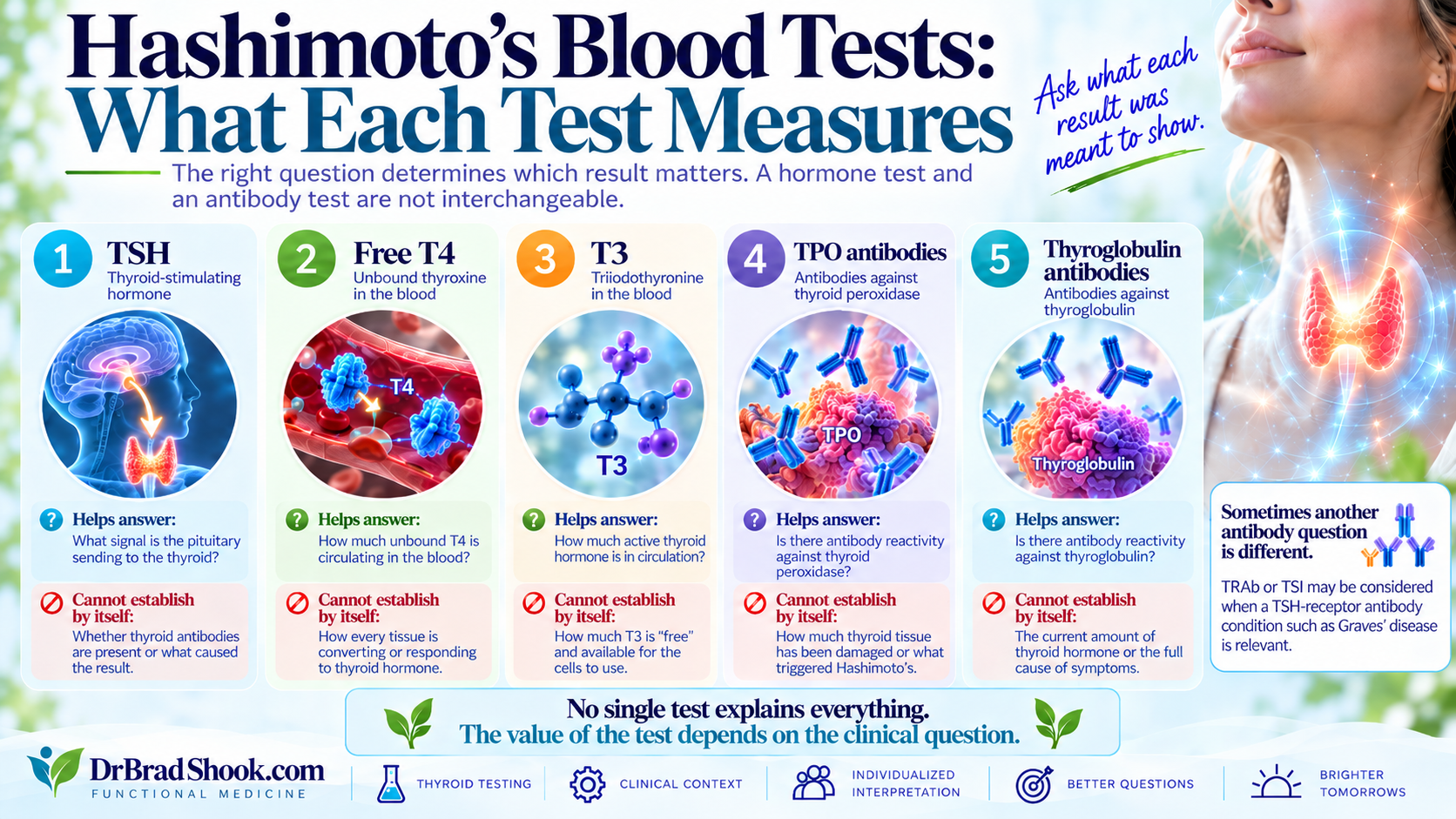
Here's how I explain the most common tests to clients. Each one answers a different question. No single number gives us the complete picture.
| Test | The question it helps answer | What it cannot establish by itself |
|---|---|---|
| TSH | What signal is your pituitary sending to the thyroid? | Whether you have thyroid antibodies or what caused an abnormal result. |
| Free T4 | How much unbound T4 is circulating in your blood? | How every tissue is converting or responding to thyroid hormone. |
| Total T4 | How much T4 is circulating, including hormone bound to proteins? | Whether a change reflects altered binding proteins rather than altered thyroid function. |
| Total or free T3 | What is the T3 level in your blood? | The amount of T4 converted to T3 or the hormone response inside every cell. |
| TPOAb | Is there antibody reactivity against thyroid peroxidase, a thyroid enzyme? | How much thyroid tissue has been damaged or which exposure triggered Hashimoto's. |
| TgAb | Is there antibody reactivity against thyroglobulin, a thyroid protein? | The current amount of thyroid hormone or the full cause of symptoms. |
| TRAb or TSI | Could a TSH-receptor antibody condition, such as Graves' disease, be relevant? | A routine answer for every person with a Hashimoto's diagnosis. |
Why do TSH and free T4 often come first?
TSH is made by the pituitary gland in your brain. When your thyroid is struggling to make enough hormone, the pituitary often produces more TSH, so your TSH level rises. Free T4 tells us how much unbound T4 is circulating in your blood. Together, these results help us assess thyroid hormone production and output.
A high TSH with a low free T4 is consistent with overt primary hypothyroidism. A high TSH with a free T4 that remains in range may suggest subclinical hypothyroidism. An unexpectedly low free T4 without an appropriately raised TSH needs further medical assessment, including consideration of pituitary-related causes. These are patterns, not a diagnosis you should make from one number.
Does checking T3 tell us whether conversion is working?
Your thyroid produces mostly T4, and enzymes in different tissues convert some of that T4 into T3, the more physiologically active thyroid hormone. Conversion is part of the physiology I consider when someone still feels unwell.
But a circulating T3 result is not a direct measurement of conversion inside the liver, brain, muscles, or every other tissue. T3 tests can be especially useful in selected situations, including suspected hyperthyroidism; they are not automatically required for everyone with suspected hypothyroidism. A single low-normal T3 value does not, by itself, establish a conversion problem.
Learn how hormone replacement, absorption, and prescribing decisions fit into Hashimoto's care.
Why Test TPO and Thyroglobulin Antibodies if Your TSH Is Normal?
Because autoimmune activity and thyroid hormone function do not always change at the same time. In Hashimoto's, thyroid antibodies may be detectable while TSH and free T4 are still within their reference ranges. That can be a valuable clue about what is happening long before someone develops overt hypothyroidism.
TPOAb tests for antibodies involving thyroid peroxidase, an enzyme used in thyroid hormone production. TgAb tests for antibodies involving thyroglobulin, a protein used to make and store thyroid hormone. One or both may help support a Hashimoto's diagnosis when interpreted with your history and thyroid findings.
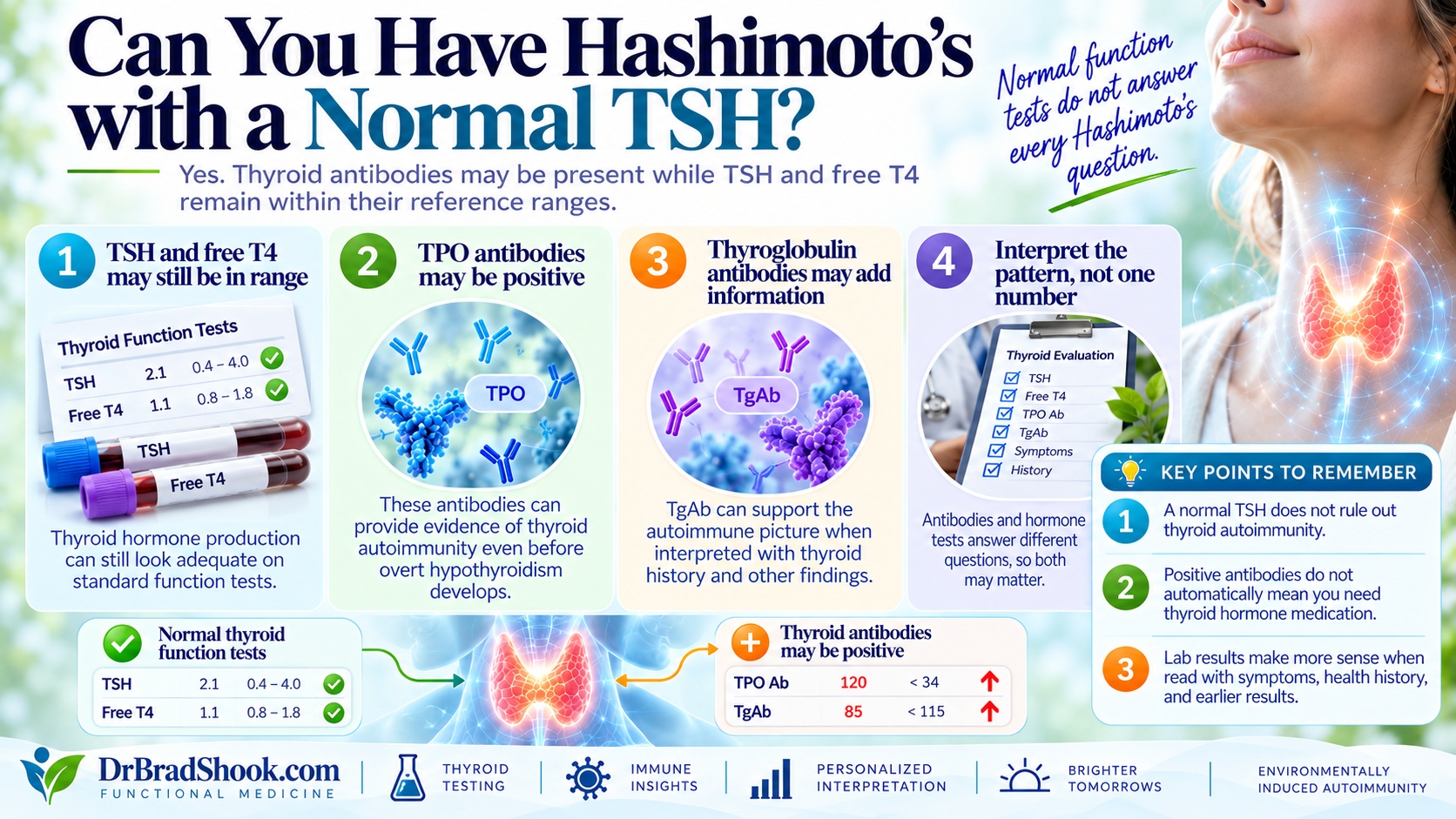
A useful distinction: A normal TSH doesn't necessarily answer the Hashimoto's question. And a positive antibody result does not, by itself, tell us how well the thyroid is functioning.
What if TPO antibodies are negative?
Hashimoto's is less likely when appropriate antibodies are absent, but a negative TPOAb result does not settle every situation. TgAb may add information. If the history and other findings still suggest thyroiditis, a clinician can review earlier results, examine the thyroid, consider other explanations, and use ultrasound when it would help answer a specific question. Imaging and blood tests provide different pieces of information.
What if antibodies are positive but you feel fine?
Some people have positive thyroid antibodies while their thyroid is still producing enough hormone and they feel well. That finding tells us something about thyroid autoimmunity, but it does not measure thyroid hormone production. We can follow thyroid function when appropriate and review the person's history to decide which questions are worth investigating.
What Can Different Hashimoto's Blood-Test Patterns Mean?
I have seen how easy it is to focus on one number and miss the bigger picture. I would rather compare your results with previous tests, the way you feel, your medication history, and what was happening in your life when the blood was drawn.
Antibodies positive, TSH and free T4 in range
Thyroid autoimmunity may be present while the gland is maintaining hormone output. Antibody positivity alone does not establish a hormone deficiency.
TSH elevated, free T4 in range
This can fit a subclinical hypothyroid pattern. Your medical clinician interprets the result with symptoms, history, antibody status, pregnancy considerations, and changes over time.
TSH elevated, free T4 low
This pattern is compatible with overt primary hypothyroidism and deserves medical evaluation. Antibody testing can help clarify whether Hashimoto's is the cause.
TSH unexpectedly low or results changing
Medication, thyroiditis, Graves' disease, illness, and other factors may be involved. A changing test is not automatically proof of an autoimmune flare. Marked symptoms or a concerning mismatch deserve medical evaluation.
Reference ranges and test methods differ. Pregnancy, the postpartum period, acute illness, and medication changes can also change what a result means. If your numbers don't fit your symptoms or your previous results, investigate the discrepancy rather than assuming one isolated test tells the entire story.
Before You Compare Results, Check These Four Details
A lab report captures one point in time. Before we decide what a change means, I want to know what might have affected the result.
If you're using thyroid medication, make dose or formulation changes with your prescribing clinician. Don't stop medication or change supplements based on an online interpretation of one test.
Should You Keep Repeating Thyroid Antibody Tests?
Antibody testing can help us identify thyroid autoimmunity, and I like having a baseline for TPO and thyroglobulin antibodies. But once we know antibodies are present, repeating the same test over and over is not always useful.
Here's what I want you to understand about these antibodies. They recognize proteins in your thyroid. You can think of them as markers that help the immune system recognize a target, but that isn't their entire story. Research suggests that some thyroid antibodies can also help recruit immune cells or activate a system called complement, which may contribute to thyroid inflammation and cell damage. Some TPO antibodies have even blocked the thyroid peroxidase enzyme in laboratory experiments, although we don't know how much that happens inside the thyroid in everyday life. Other parts of the immune system, including T cells, also play an important role in thyroid injury.
When we measure thyroid antibodies in your blood, we're measuring what's circulating. That number does not tell us how many antibodies are attached to thyroid tissue or how much damage is occurring. It also doesn't reliably tell us how you're feeling. Someone can have very high antibodies with few symptoms, while another person has much lower antibodies and feels terrible. Some studies have linked thyroid antibodies with inflammation and symptoms even when thyroid hormone levels are normal, but that does not prove the antibodies themselves caused those symptoms.
That's why I look at antibody results as one part of the picture. There may be reasons to repeat them as we follow changes in your health or the support we're providing, but I don't want us chasing a number. Lower antibodies don't prove Hashimoto's is gone, and higher antibodies don't tell us how much thyroid tissue has been damaged. We also need to follow your thyroid function, your symptoms, your health history, and how you respond over time.
What Blood Work Might Matter Beyond the Thyroid?
What if your TSH and free T4 are stable, but you're still exhausted, constipated, or struggling to concentrate? I would want to know more about your health before assuming every symptom is coming from your thyroid. This is where a detailed health history and a review of earlier lab results can help identify possible explanations that a thyroid panel won't show.
Depending on your history, we may want to look at your blood count, iron and ferritin, vitamin B12 or other nutrients, blood sugar regulation, or whether celiac disease deserves evaluation. Sleep, digestion, thyroid medication absorption, and changes in your stage of life may also matter. I don't start everyone with the same list of tests. I start with your health history and what your results tell us we should investigate.
I also consider other autoimmune conditions when your symptoms, history, or findings suggest we should. A positive antibody test involving another tissue does not automatically mean you have a disease in that tissue. Testing for infections or environmental exposures can also be reasonable when your history points us in that direction or we're trying to rule out other mechanisms. A positive result doesn't automatically prove that an infection or exposure triggered or is driving Hashimoto's. We look at your entire health picture together to get the best understanding we can of the factors that may be triggering or driving the autoimmune process.
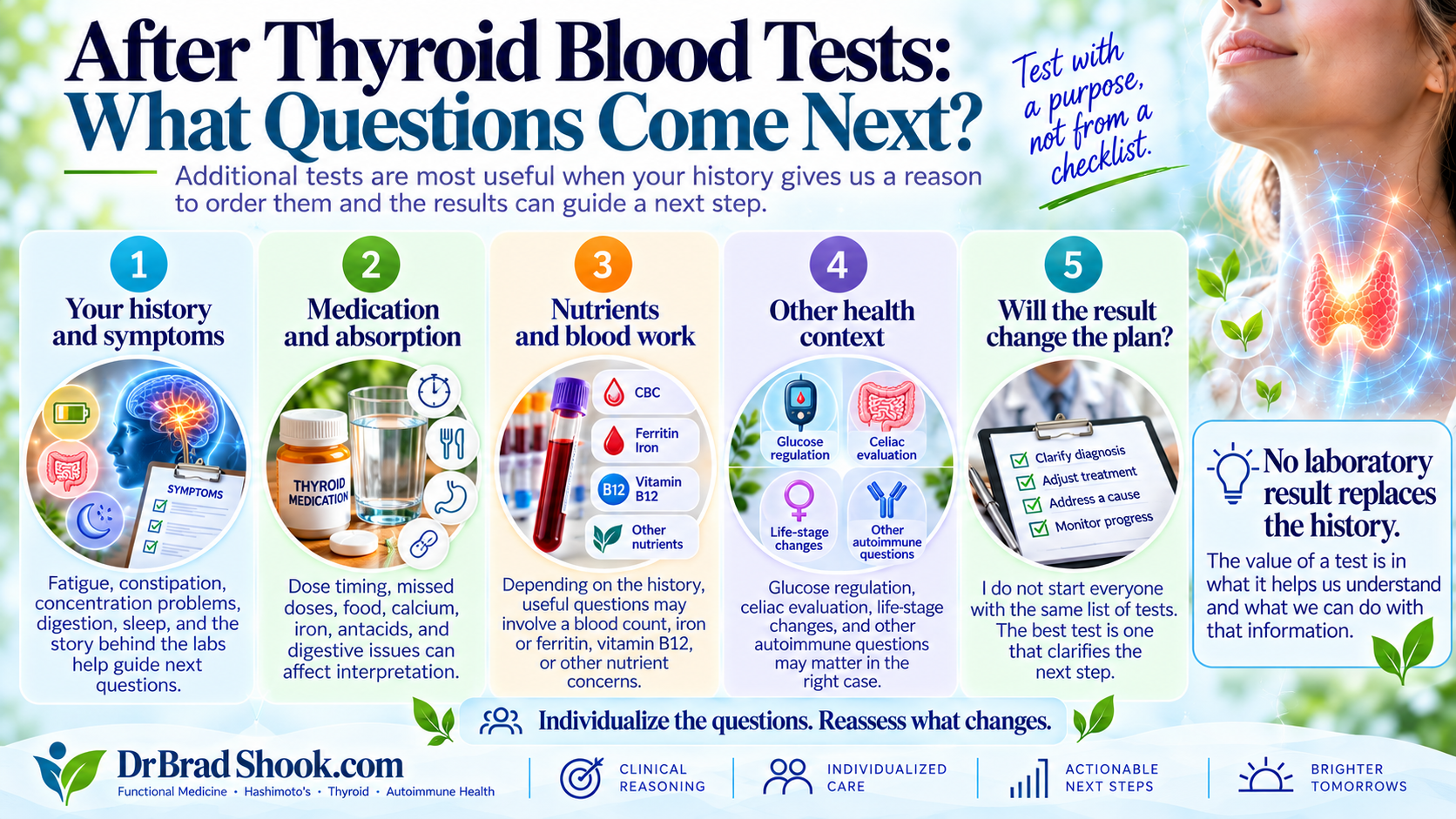
If you want to understand how I decide which tests are worthwhile, read my guide to functional medicine testing. The value of a test is in what it helps us understand and what we can do with that information.
What Do We Do With the Results?
Blood tests help us establish whether your thyroid is making enough hormone and whether there's evidence of autoimmunity. But a Hashimoto's diagnosis does not automatically tell us what set that autoimmune process in motion, what may be contributing to it now, or which factors in your life might be worth changing. That's where I see a new opportunity to understand your health more deeply.
My approach draws on functional medicine and functional immunology through a framework I call Environmentally Induced Autoimmunity. Genetics influence susceptibility, but we also need to investigate your health timeline, potential environmental exposures, relevant infections, gut and other barrier-system health, nutrition, nutrient status, metabolism, sleep, stress, and medication effects. These are possibilities to evaluate, not causes I assume you have. No single blood test can establish the whole story.
The goal is to identify as many relevant triggers and drivers of the autoimmune process as we can, decide where support may help, and learn from how you respond.
DETECT
We review your blood work, thyroid antibody results, symptoms, medications, health records, and history to look for possible triggers and drivers. We may choose to investigate further when your history, test results, or response warrant it.
SUPPORT
We focus on the findings that matter most in your situation. Your plan might involve nutrition, sleep, digestive health, correcting a documented deficiency, or other priorities identified in your evaluation.
REASSESS
We look at how you feel, how you function every day, and what the relevant measurements show. What improved? What didn't? And what does your response tell us to do next?
This work can complement the thyroid care you already receive. When thyroid hormone replacement is needed, it remains an important part of managing thyroid function. At the same time, we can investigate possible autoimmune triggers and drivers and focus on supporting the areas of your health that need attention.
If you want to see what this looks like in practice, explore my functional medicine approach to Hashimoto's.
Questions to Bring to Your Next Thyroid Appointment
- Did my blood work assess thyroid function, thyroid autoimmunity, or both?
- Have thyroid peroxidase and thyroglobulin antibodies been checked?
- How do my latest TSH and free T4 results compare with earlier results?
- Could supplements, thyroid medication timing or absorption, illness, or changes in my stage of life affect these results?
- Do my symptoms suggest that another condition or a nutrient deficiency needs evaluation?
- What changes in my symptoms or test results should we follow over time?
You can use these questions with your prescribing clinician or as a starting point for understanding your existing records. You don't need to order every available test to start asking these questions.
Frequently Asked Questions About Hashimoto's Blood Tests
Which blood tests check for Hashimoto's disease?
TPO antibodies and thyroglobulin antibodies can provide evidence of autoimmune thyroid disease. TSH and free T4 assess thyroid function, not whether an autoimmune response is present. Your clinician interprets the results with your history, examination, and other findings.
Can you have Hashimoto's with a normal TSH?
Yes. Thyroid antibodies may be present while TSH and free T4 remain within range. A normal TSH does not, by itself, rule out thyroid autoimmunity. Antibody results and thyroid hormone measurements answer different questions and should be interpreted with your history.
What is the difference between TPO antibodies and thyroglobulin antibodies?
TPO antibodies react with thyroid peroxidase, an enzyme used to produce thyroid hormones. Thyroglobulin antibodies react with a protein used to make and store those hormones. Both can help investigate Hashimoto's, but neither result tells us how much thyroid tissue has been damaged or what triggered the autoimmune process.
Does a high TPO antibody level mean my Hashimoto's is severe?
Not necessarily. Antibody levels do not directly measure how much thyroid tissue has been damaged or how severe your symptoms are. They must be considered alongside thyroid function and your clinical picture.
Should I get a full thyroid panel including free T3 and reverse T3?
Not necessarily. T3 testing can show how much active thyroid hormone is circulating, but a blood result cannot tell us exactly how much T4 is being converted to T3 in every tissue. Reverse T3 is not routinely recommended for diagnosing Hashimoto's or hypothyroidism. We decide which tests to consider by reviewing your history and results.
Can Hashimoto's blood tests be negative?
Some people with suspected autoimmune thyroiditis have no detectable thyroid antibodies. A clinician may review the overall history, thyroid function, examination, other causes, and ultrasound when indicated. Negative antibodies do not mean every symptom is caused by Hashimoto's.
Can biotin affect thyroid blood test results?
Yes. Some thyroid laboratory methods can give misleading results when a person takes biotin supplements, particularly higher-dose hair, skin, and nail products. Tell the laboratory and your clinician what you take and ask how to prepare for your test.
How often should I retest thyroid antibodies?
There's no standard timetable for repeating thyroid antibodies in Hashimoto's. I like establishing a baseline, and sometimes we may check again while following changes in your health. But antibody levels alone don't measure thyroid damage or tell us how you're feeling. We also need to follow thyroid function, symptoms, and how you're doing over time.
What if my TSH is normal but I still feel tired?
A normal TSH doesn't explain every symptom. Review thyroid test context and medication issues with your clinician, then consider sleep, anemia, nutrient status, digestion, other conditions, and individual circumstances. Symptoms alone do not prove impaired T4-to-T3 conversion.
What should I read after I understand my thyroid tests?
Start with Functional Medicine for Hashimoto's to see how I bring thyroid results together with your health history, possible triggers and drivers, and individual physiology. If you want to explore working together, the Application for Care explains how to get started.
Research and Further Reading
These resources cover thyroid tests, antibody interpretation, immune mechanisms, laboratory limitations, and medication considerations.
- Thyroid Tests. National Institute of Diabetes and Digestive and Kidney Diseases. Definitions and diagnostic purposes of TSH, T4, T3, and antibody tests.
- Hashimoto's Disease. NIDDK. Autoimmune diagnosis, antibodies, and the role of hormone monitoring.
- Thyroid Function Tests. American Thyroid Association. Interpretation of thyroid hormones, antibodies, and limitations of selected assays.
- Biotin Use Can Interfere With the Management of Thyroid Diseases. American Thyroid Association. Laboratory-method interference.
- Thyroid Hormone Treatment. American Thyroid Association. Medication absorption and interactions.
- Hashimoto's Thyroiditis. American Thyroid Association. Explains diagnosis and why repeated antibody testing is not generally needed for routine thyroid monitoring.
- Hashimoto's Thyroiditis. Endotext, NCBI Bookshelf. Reviews the immune mechanisms involved in thyroid injury, including antibodies and T cells.
- Anti-thyroid peroxidase antibodies and inhibition of thyroid peroxidase activity. Clinical and Experimental Immunology (1991). Laboratory evidence that some TPO antibodies can inhibit enzyme activity.
- Thyroid antibodies, inflammation, and symptoms in Hashimoto's thyroiditis. Scientific Reports (2024). Reports associations, not proof of a direct cause.
- Association between anti-thyroid antibodies and quality of life. Systematic review and meta-analysis (2021). Finds mixed evidence and explains limitations in interpreting antibody levels.
Your Blood Tests Tell Part of the Story. What Else Could We Learn?
Your thyroid results matter, but they are only part of understanding Hashimoto's. If you still have questions about your symptoms or what may be driving the autoimmune process, there may be more worth investigating. I want to help you see how we can bring your history, test results, and individual physiology together to identify what deserves attention and build a plan we can learn from.
Interested in working together? Start with the Application for Care. I review each application before providing scheduling information to accepted applicants.