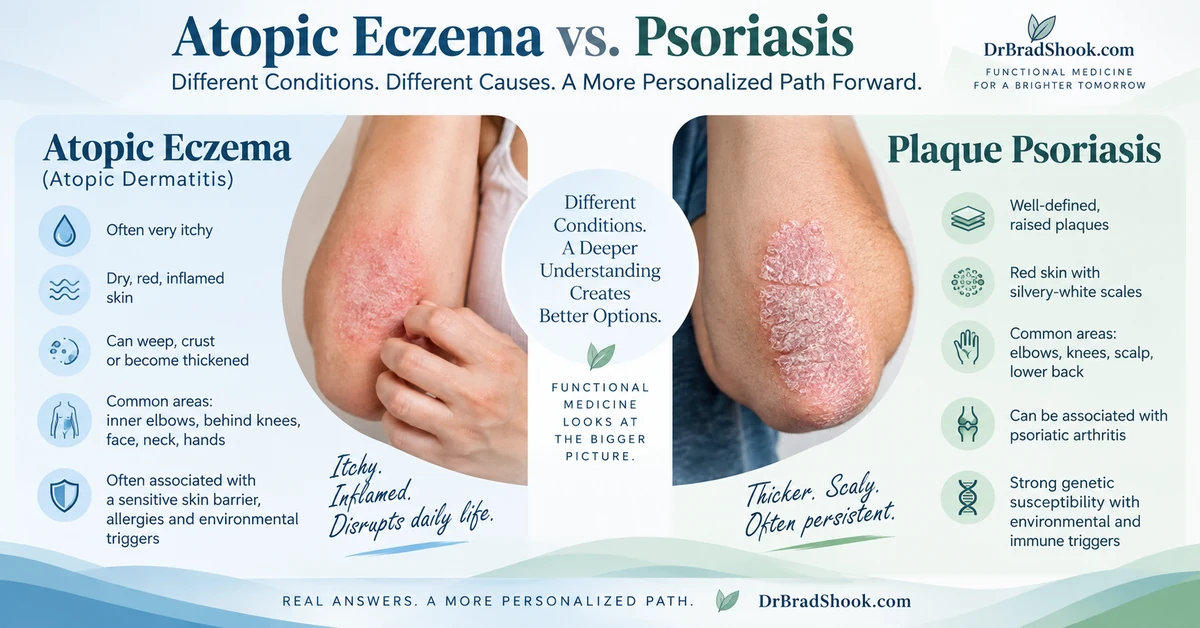
Symptoms of Eczema (Atopic Dermatitis) vs. Plaque Psoriasis
The fastest way to understand the difference is to compare what the skin looks like, how it feels, where it tends to appear, and what else is happening with the person.
| Feature | Atopic eczema | Plaque psoriasis |
|---|---|---|
| Typical appearance | Dry, inflamed, irritated skin that may ooze, crust, crack, or thicken from scratching. | Well-defined, raised plaques with scale; the color can vary by skin tone. |
| Itch | Often intense and may dominate the condition. | Can itch, burn, crack, or hurt, but the degree varies. |
| Common locations | Often the face, neck, hands, and skin folds such as the inside of elbows and behind knees, with patterns varying by age. | Often the scalp, elbows, knees, trunk, lower back, palms, or soles, but it can occur almost anywhere. |
| Skin barrier | Barrier dysfunction is a major part of the disease. | Barrier changes can occur, but the defining disease process is autoimmune and inflammatory. |
| Related conditions | Often associated with asthma, hay fever, allergies, and other atopic conditions. | Can be associated with psoriatic arthritis and important metabolic and cardiovascular comorbidities. |
Eczema is often more intensely itchy, but the presence or absence of itch is not enough to make the diagnosis.
How do doctors tell eczema and psoriasis apart?
A dermatologist usually looks at the shape and borders of the lesions, the type of scale, the distribution on the body, the amount of itch, nail findings, family history, other symptoms, and how the rash has behaved over time. When the appearance is unusual or overlapping, a skin biopsy may sometimes help rule out another condition.
If you are trying to determine whether a rash is psoriasis, eczema, or something else, the goal is not to force the skin into a label from a photograph. It is to get the diagnosis right because the treatment plan can be different.
Causes of Eczema and Psoriasis
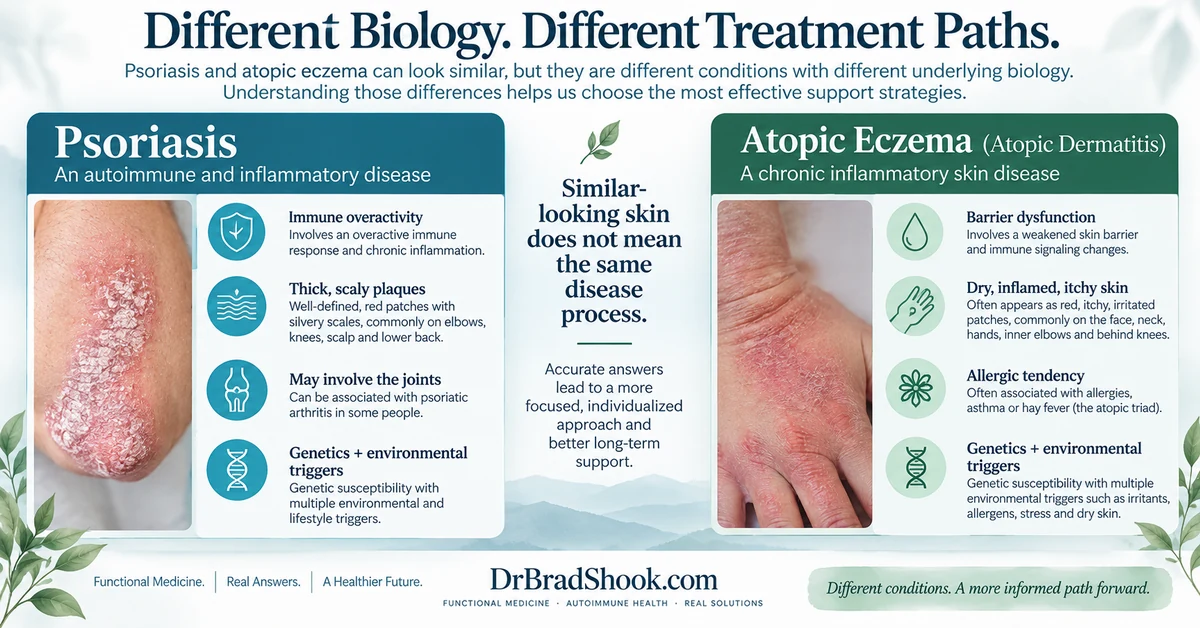
Both diseases reflect an interaction between genetic susceptibility and the environment, but they are not the same biological process.
Atopic eczema
Atopic dermatitis involves a vulnerable skin barrier plus immune dysregulation. Genetics can affect barrier proteins and immune signaling, while dry skin, irritants, allergens, infections, heat, sweat, stress, and other exposures can influence flares.
Psoriasis
Psoriasis involves genetically influenced autoimmune and inflammatory signaling that accelerates skin-cell turnover. Infections, stress, skin injury, smoking, certain medications, and other environmental factors can influence disease activity in susceptible people.
It is too simplistic to say that both diseases are simply “caused by inflammation.” Inflammation is part of both conditions, but the physiology underneath that inflammation is different.
For a deeper discussion of the psoriasis side of this equation, see my functional medicine approach to psoriasis vulgaris and the broader Natural Psoriasis Treatment hub.
Genetics, Environment, and Immune Biology
The question is not whether genetics matter. They clearly do. The more useful question is how genetic susceptibility interacts with the environment and physiology of the individual.
For eczema, that interaction may involve the skin barrier, allergic tendency, irritants, climate, infections, and immune regulation. For psoriasis, the interaction may involve infections, skin injury, medications, smoking, stress, metabolic health, and other environmental or physiological influences.
It does not automatically tell us which triggers or drivers are most relevant to this individual, what changed before a flare, or which factors may be worth changing.
That distinction is central to the way I use functional medicine. I am not looking for one universal root cause. I am looking for patterns that help us decide what deserves attention.
Psoriasis: An Autoimmune Disease
Psoriasis is not simply “skin cells growing too fast.” The accelerated skin-cell turnover is downstream of abnormal immune signaling and inflammation.
That matters because psoriasis can affect more than the skin. Nail disease and psoriatic arthritis can occur, and inflammatory joint disease deserves timely evaluation because untreated joint inflammation can cause permanent damage.
An autoimmune diagnosis creates a new opportunity. It tells us what disease has been identified, but it does not automatically tell us what may have triggered the process, what may be driving it now, or which factors we may be able to change.
That is where I consider functional medicine foundational. It gives us a structured way to investigate diet, nutrition, metabolism, gut health, infections, nutrient status, sleep, stress, environmental exposures, medications, barrier-system health, and other physiological patterns that may be relevant to the individual. I am not looking for one universal root cause. I am looking for the highest-priority patterns that can help us build a more focused plan and learn from how the autoimmune process responds.
Appropriate dermatology and rheumatology care can still be important, especially when psoriasis is severe, rapidly worsening, or affecting the joints. Topical treatment, phototherapy, oral medications, and biologic therapies can reduce disease activity and protect health when they are needed. I do not see these approaches as competitors. The opportunity is to investigate and support the person's physiology while also using appropriate medical treatment when the situation calls for it.
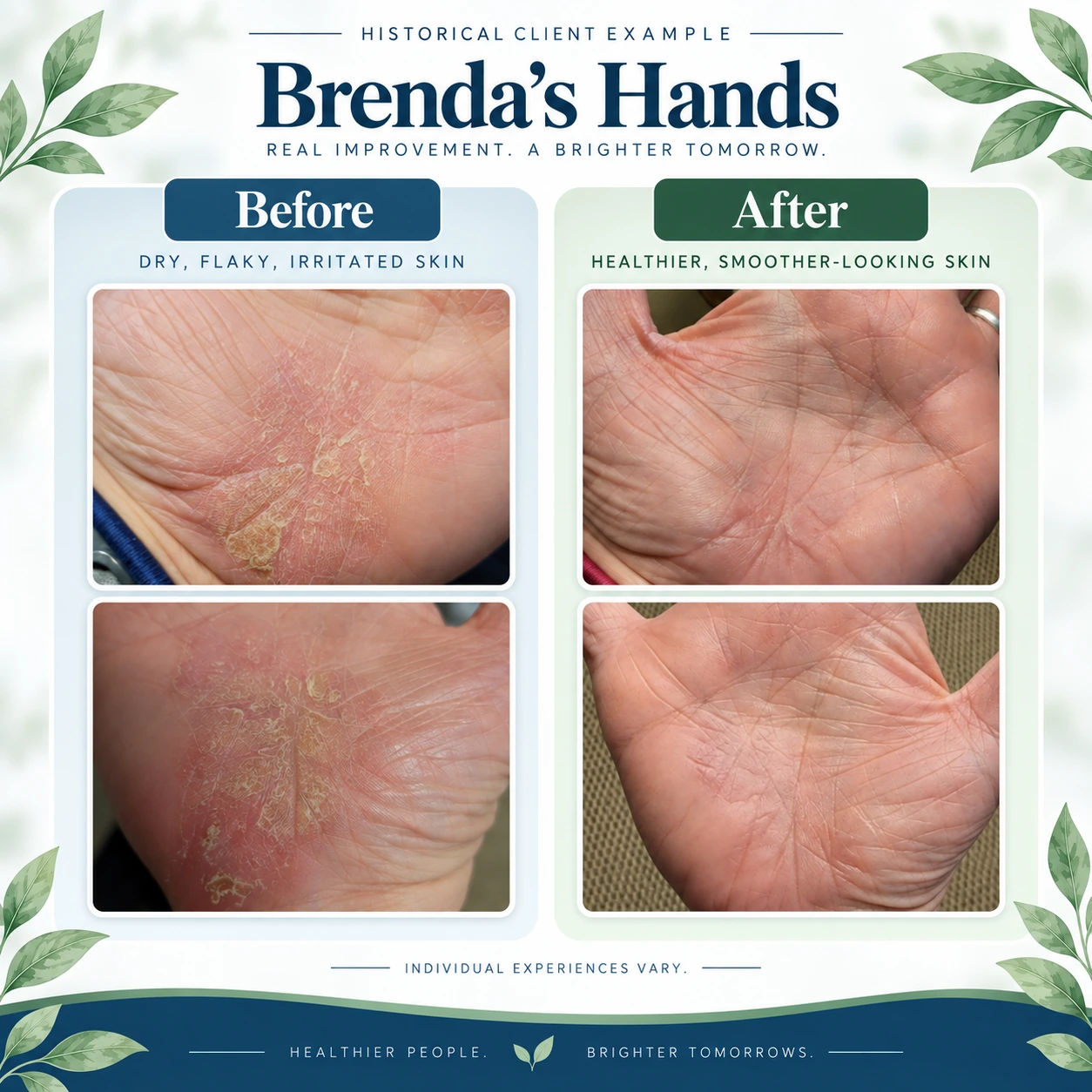
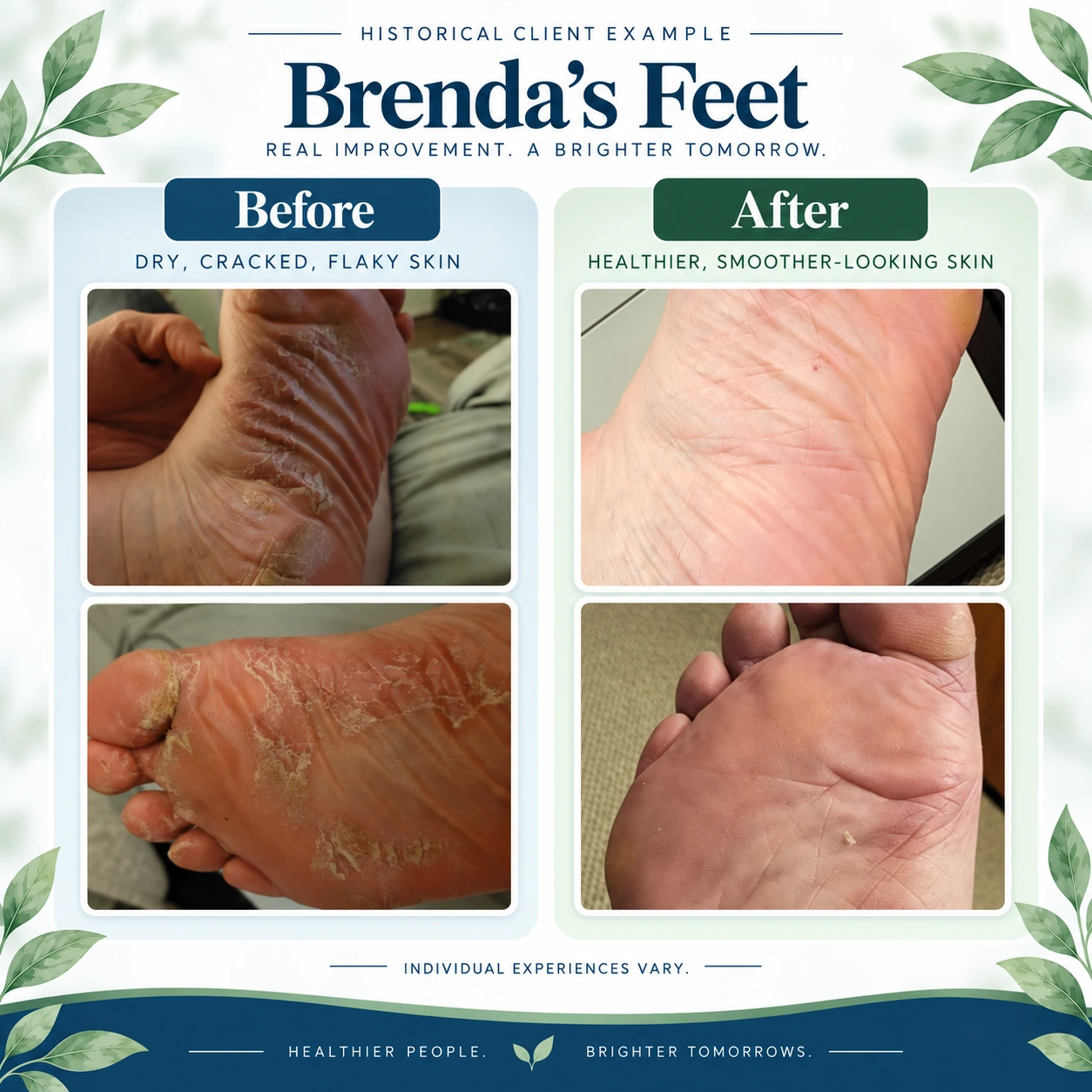
For related treatment and presentation topics, see palmoplantar pustulosis and functional medicine and psoriasis medications and functional medicine.
Psoriasis Causes and Risk Factors
Psoriasis develops from a combination of genetic susceptibility and immune dysregulation. Family history matters, but it is not destiny. Environmental and physiological influences affect whether the disease becomes active and how it behaves over time.
Factors associated with psoriasis or psoriasis severity can include smoking, excess body fat, certain infections, stress, alcohol use, some medications, and other health conditions. These are not interchangeable, and they should not be treated as one list of causes that applies to everyone.
It is, “What does this person's history, physiology, exposures, and response pattern tell us?”
You can go deeper into psoriasis causes and triggers, plaque psoriasis and medications, or the broader discussion of functional medicine for psoriasis treatment.
Eczema and Psoriasis Triggers
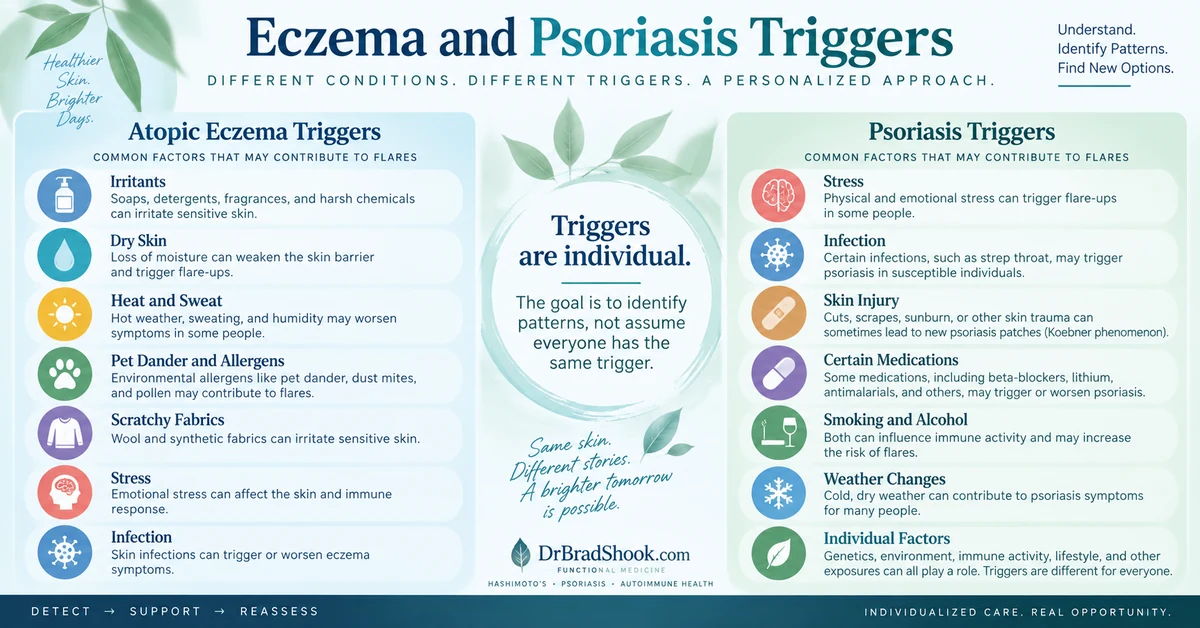
Eczema and psoriasis can both flare in response to environmental or physiological stressors, but the trigger patterns are not identical.
Common eczema flare factors
- dry skin and impaired barrier function
- soaps, detergents, fragrances, and other irritants
- heat, sweat, and climate changes
- allergens such as dust mites, pollen, or pet dander in susceptible people
- scratchy fabrics and friction
- stress
- skin infection
Common psoriasis flare factors
- stress
- certain infections, including streptococcal infection in guttate psoriasis
- skin injury, including cuts, scrapes, burns, and other trauma
- certain medications
- smoking
- weather and dry skin
- other individual physiological and environmental factors
Broad claims that foods such as gluten or nuts are universal psoriasis triggers are not supported by the evidence. Celiac disease, true food allergy, individual dietary patterns, and specific food-related reactions can matter, but no single food should be treated as a universal explanation for psoriasis.
Psoriasis Treatments
When I think about psoriasis treatment, I think there are two important goals: understand what may be driving the autoimmune process in this person, and control active disease well enough to protect health and quality of life.
Functional medicine gives us a new opportunity to work on the first goal from the beginning. We can investigate triggers, drivers, diet, metabolism, gut health, nutrient status, sleep, stress, infections, exposures, medications, and other physiological patterns, then build a focused plan around what appears most important for the individual.
I consider it a foundational way to understand the person around the autoimmune diagnosis. The goal is not to give everyone the same protocol. It is to DETECT meaningful patterns, SUPPORT the highest priorities, and REASSESS what the response teaches us.
Medical treatment remains another important tool when it is needed. Depending on the type, severity, location, comorbidities, prior response, and individual preferences, treatment can include topical medications, phototherapy, oral systemic medications, injectable medications, and biologic therapies. Psoriatic arthritis changes the conversation because controlling joint inflammation and protecting the joints becomes a priority.
Modern psoriasis medications can change inflammatory disease activity, so I would not describe them as merely covering symptoms. At the same time, controlling disease activity does not answer every question about why the process became active in a particular person. That is the additional opportunity functional medicine creates.
For more detail, see topical and systemic medications for psoriasis, mild facial psoriasis, and severe psoriasis treatment.
Does Either Eczema or Psoriasis Ever Go Away?
The answer is different for the two diseases.
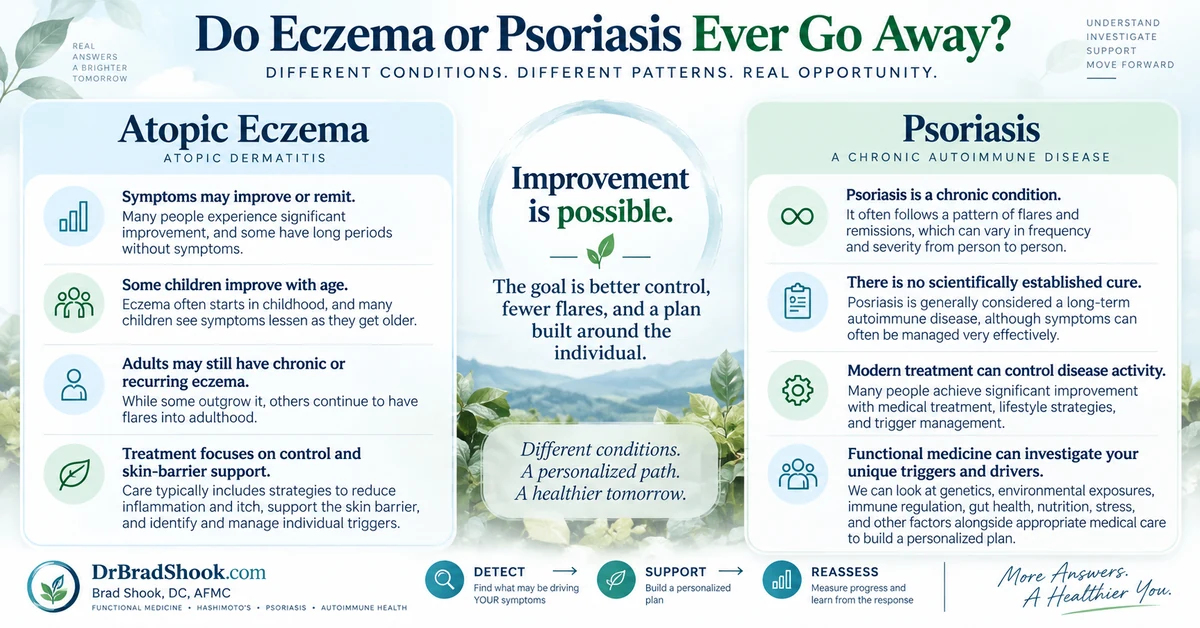
Atopic eczema can improve or remit. Many children improve as they get older, although eczema can persist, recur, or begin in adulthood.
Psoriasis is generally a chronic disease. It often follows cycles of flares and remission. There is no scientifically established cure, but modern treatment can provide excellent control for many people.
For either condition, the most useful long-term strategy is individualized: get the diagnosis right, control active disease appropriately, identify meaningful triggers, support skin health, and learn from how the condition responds over time.
A New Opportunity to Understand What May Be Driving the Process
Once the diagnosis is clear, functional medicine gives us an opportunity to ask questions the diagnosis itself cannot answer: What may have triggered this process? What may be driving or perpetuating it? What is happening physiologically? Which factors can we change?
With autoimmune disease such as psoriasis, I consider this investigation foundational. We are not simply asking how to make a plaque look better. We are trying to understand the person, the environment around the disease, and the physiological patterns that may be influencing how the autoimmune process behaves.
That distinction also matters because atopic dermatitis and psoriasis are not the same disease. Atopic dermatitis is not simply another form of psoriasis, and I would not classify it as a classic autoimmune disease in the same way I describe psoriasis. The investigation still needs to match the biology of the condition and the individual.
This does not mean searching for one universal root cause or ignoring appropriate medical care. It means adding a deeper layer of investigation so that treatment is not limited to the diagnosis alone.
Look for meaningful patterns in history, symptoms, diet, digestion, metabolism, sleep, stress, medications, infections, exposures, skin-barrier health, nutrient status, and other relevant information.
Build a focused plan around the highest-priority findings instead of giving everyone the same “eczema protocol” or “psoriasis protocol.”
Measure what changed, what did not change, and what the response teaches us about the individual's physiology.
To go deeper into psoriasis, read understanding functional medicine for psoriasis or compare psoriasis care options.
Frequently Asked Questions About Psoriasis vs. Eczema
What is the main difference between eczema and psoriasis?
Atopic eczema and psoriasis are different inflammatory skin diseases. Atopic eczema is strongly associated with skin-barrier dysfunction, intense itching, and immune dysregulation. Psoriasis is a chronic autoimmune and inflammatory disease in which immune signaling accelerates skin-cell turnover and produces characteristic plaques.
Which is usually itchier, eczema or psoriasis?
Eczema is often intensely itchy, and itch can be one of its most dominant symptoms. Psoriasis can also itch, burn, crack, or become painful, so itch alone cannot reliably distinguish the two.
Can you have both eczema and psoriasis?
Yes. Some people can have both conditions, and there can be overlap in how the skin looks. When the diagnosis is uncertain, a dermatologist may use the distribution, appearance, history, treatment response, and sometimes a skin biopsy to clarify the diagnosis.
Is psoriasis an autoimmune disease?
Psoriasis is a chronic autoimmune and inflammatory disease involving dysregulated immune signaling. It is not simply a problem of skin growing too fast. The immune process drives the accelerated skin-cell turnover and inflammation.
Is atopic eczema an autoimmune disease?
Atopic dermatitis involves immune dysregulation and impaired skin-barrier function, but it is not generally classified as a classic autoimmune disease in the same way psoriasis is. Genetics, the immune system, the skin barrier, allergens, irritants, and environmental factors can all be relevant.
Can eczema or psoriasis be cured?
There is no scientifically established cure for psoriasis, although treatment can control disease activity very effectively and remission can occur. Atopic eczema may improve substantially or remit, especially in some children, but it can also persist or recur into adulthood.
What types of triggers can cause eczema or psoriasis flares?
Triggers vary by individual. Eczema can flare with dry skin, irritants, allergens, heat, sweat, scratching, stress, and infections. Psoriasis can flare with stress, infections, skin injury, certain medications, smoking, weather changes, and other individual factors. A trigger is not the same thing as one universal root cause.
How are eczema and psoriasis treated?
Treatment depends on the diagnosis, location, severity, and individual response. Functional medicine creates an opportunity to investigate individual triggers, drivers, nutrition, metabolism, sleep, stress, gut health, exposures, and other physiological patterns. Topical treatments, phototherapy, systemic medication, or biologic treatment may also be appropriate depending on the condition and severity. The goal is to understand the person while also controlling active disease when needed.
Want to Understand What May Be Driving Your Psoriasis?
A diagnosis tells us what disease has been identified. Functional medicine gives us a new opportunity to investigate what may have triggered the process, what may be driving it, what is happening physiologically, and which factors may be changed. That is the foundation of how I approach psoriasis and autoimmune health.
Important Health Information
Skin rashes can have many causes, and eczema and psoriasis can sometimes overlap with other conditions. Seek medical evaluation for a new, severe, rapidly spreading, infected, painful, or otherwise concerning rash. Joint pain, swelling, prolonged morning stiffness, swollen fingers or toes, or persistent heel pain in someone with psoriasis also deserves appropriate evaluation.
Selected References & Further Reading
- American Academy of Dermatology. What's the difference between eczema and psoriasis?
- National Institute of Arthritis and Musculoskeletal and Skin Diseases. Atopic Dermatitis: Overview, Symptoms, and Causes.
- NIAMS. Atopic Dermatitis: Diagnosis and Treatment.
- NIAMS. Psoriasis: Overview, Symptoms, and Causes.
- NIAMS. Psoriasis: Diagnosis and Treatment.