What Is Guar Gum?
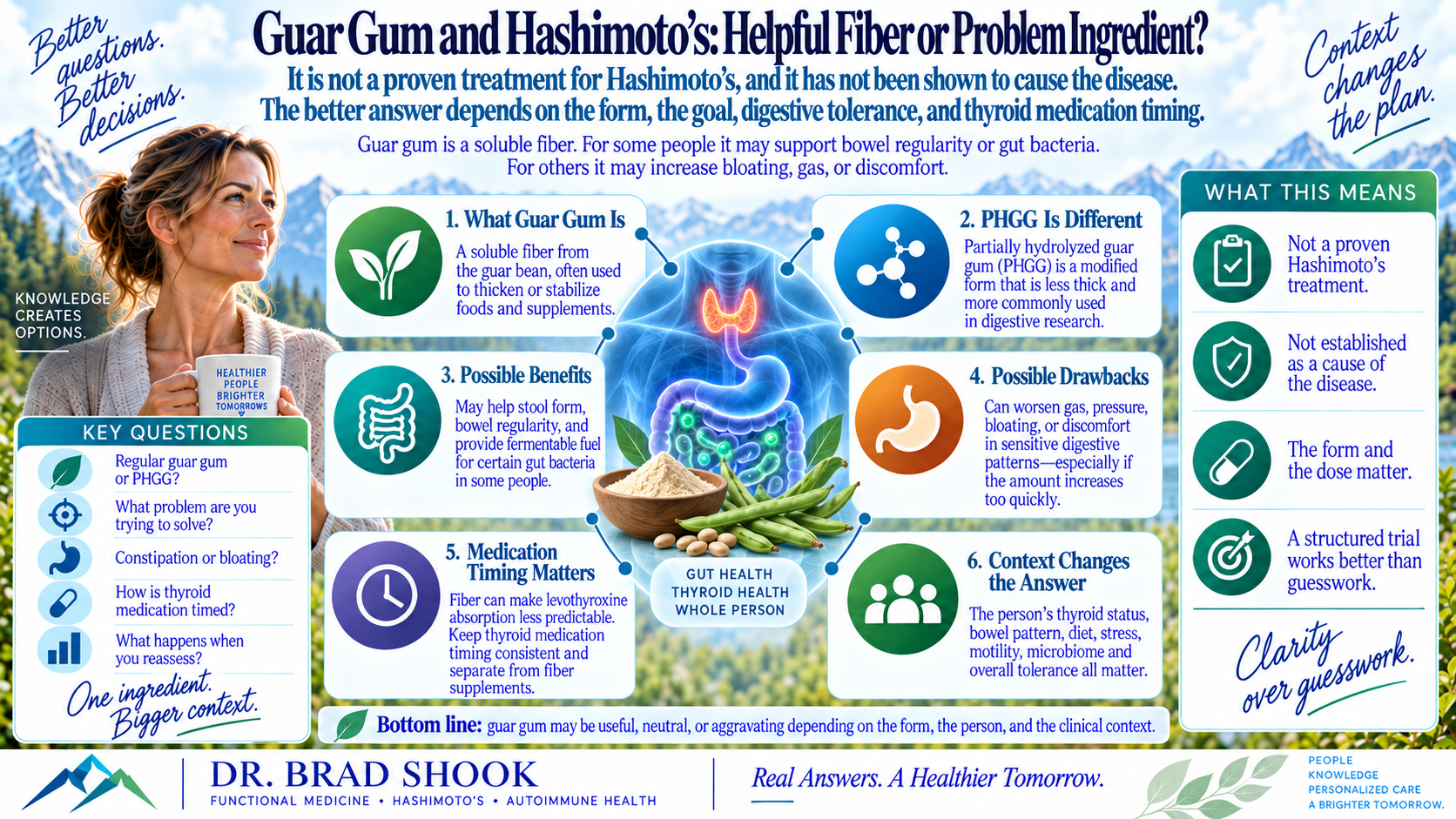
Guar gum is a carbohydrate-rich soluble fiber made from the seed of the guar plant. Food manufacturers use it to thicken and stabilize products such as sauces, dairy alternatives, gluten-free baked goods, dressings and supplements.
On an ingredient list, it may appear as guar gum or the food-additive designation E412. It comes from a legume, but the purified gum is mostly a long carbohydrate called galactomannan. It is not gluten, casein or a thyroid protein.
Soluble fiber absorbs water and can be fermented by intestinal bacteria. That gives guar gum several possible effects: it can change stool texture, alter how quickly nutrients move through the digestive tract and provide fuel for specific microorganisms. Those effects can be useful, neutral or uncomfortable depending on the person and the form of guar gum.
A reaction to a food is not automatically an autoimmune trigger. Gas, pressure or a change in stool after guar gum may reflect fermentation, dose or motility. Hives, swelling or breathing difficulty suggests an allergy question. Neither pattern by itself proves that guar gum caused Hashimoto's.
Guar Gum and Partially Hydrolyzed Guar Gum Are Not Identical
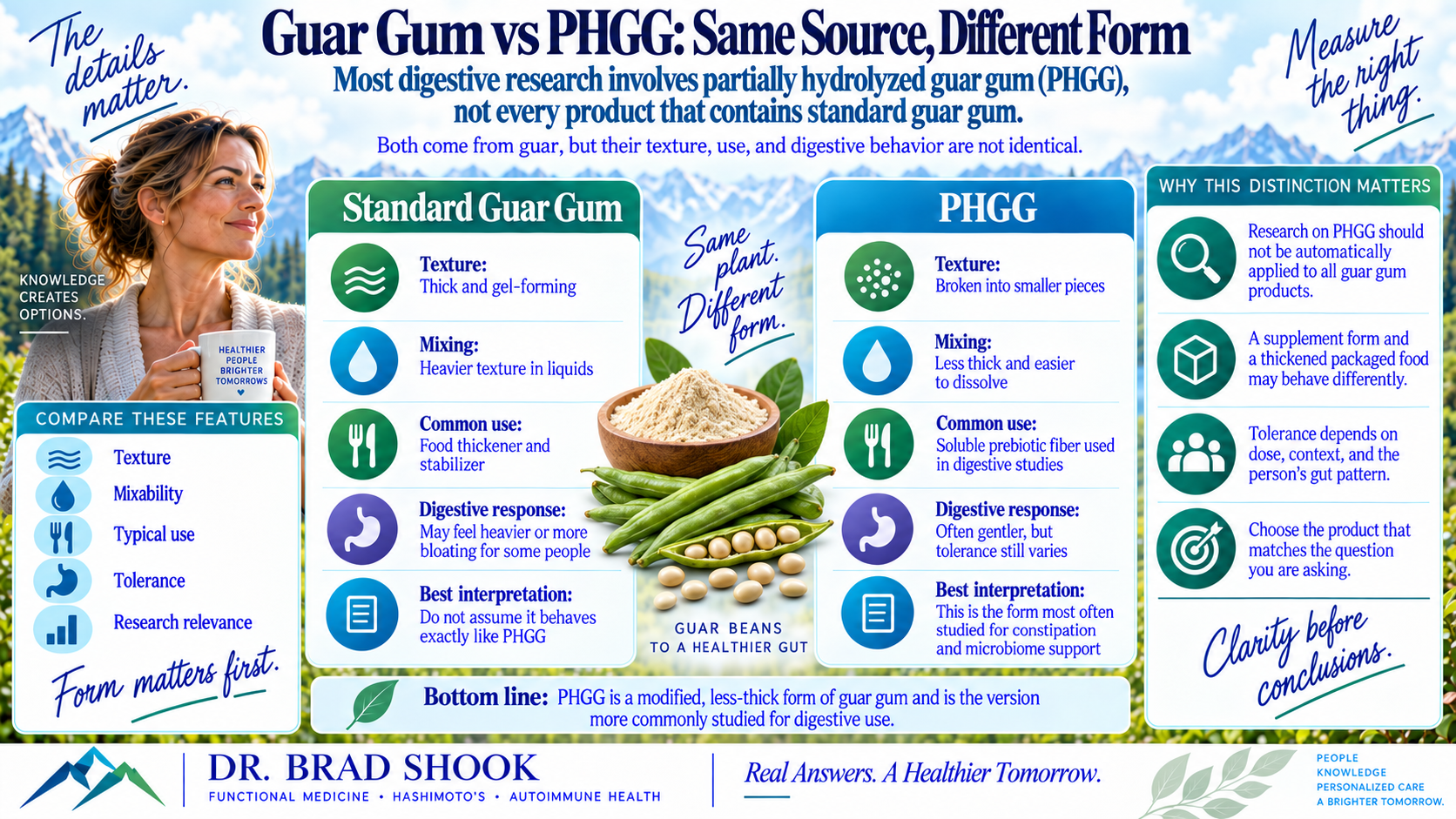
Much of the human digestive research involves partially hydrolyzed guar gum, commonly abbreviated PHGG. Enzymes are used to cut standard guar gum into smaller pieces. PHGG remains a soluble fiber, but it is much less thick and is easier to mix into liquids.
| Feature | Standard guar gum | Partially hydrolyzed guar gum |
|---|---|---|
| Texture | Highly viscous and strongly thickening | Low viscosity and easier to dissolve |
| Common use | Food stabilizer, thickener and binder | Supplemental soluble or prebiotic fiber |
| Research transfer | Do not assume PHGG trial results apply to every standard guar product | Studied in several constipation and digestive-symptom trials |
| Tolerance | Can cause gas, bloating or a strong gel effect | Often selected for lower viscosity, but it can still cause symptoms |
What Is the Connection Between Guar Gum and Hashimoto's?
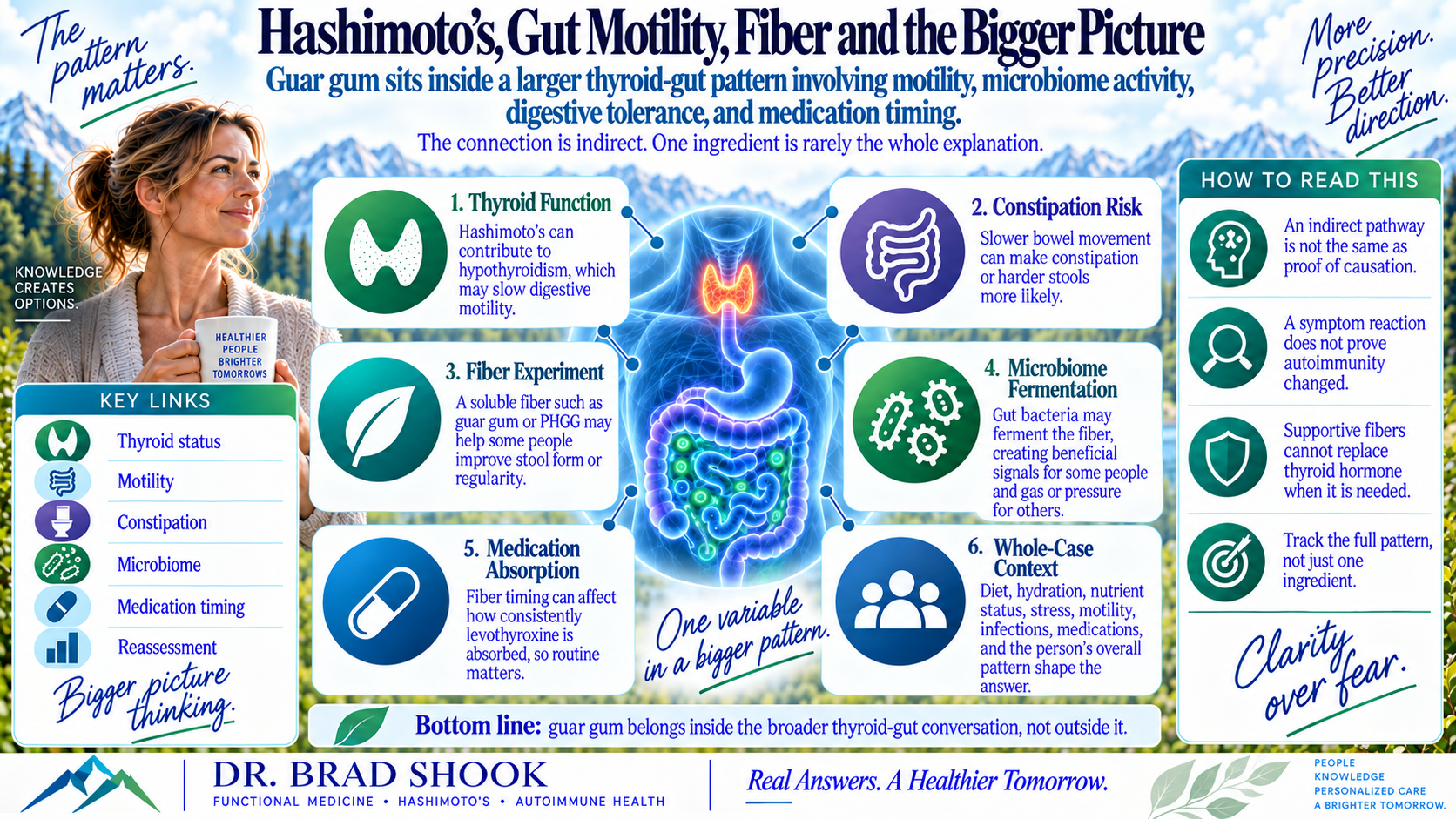
The most plausible connection is indirect and runs through bowel function, the gut microbiome, digestive tolerance and thyroid medication absorption. There is no clinical evidence that guar gum directly treats thyroid autoimmunity or lowers thyroid antibodies.
1. Low thyroid function can slow the bowel
Hashimoto's can damage the thyroid and lead to hypothyroidism. When thyroid hormone activity is low, intestinal movement may slow and constipation can become more likely. A soluble fiber may improve stool form or regularity for some people, but fiber cannot replace thyroid hormone when replacement is needed.
2. Gut bacteria can ferment guar gum
Some intestinal bacteria break fermentable fiber into short-chain fatty acids such as acetate, propionate and butyrate. These compounds help fuel colon cells and participate in intestinal and immune signaling. The Kharrazian Institute gastrointestinal framework includes guar gum among several fibers that may support microbiome diversity, while emphasizing a much broader hierarchy that includes digestion, motility, barrier function, immune tolerance, microbial balance and diet diversity.
This does not mean one fiber repairs the entire gut. Different fibers feed different organisms, and microbiome responses vary with the starting community, diet, amount and duration. A diverse range of tolerated plant foods is usually a stronger foundation than depending on one isolated ingredient.
If intestinal permeability and barrier health are part of the larger question, see my guide to leaky gut, Hashimoto's and autoimmunity.

3. Digestive tolerance is individual
The same fermentation that may support beneficial microbial activity can also increase gas. If someone already has slow motility, constipation, significant bloating, irritable bowel syndrome or suspected small-intestinal bacterial overgrowth, a rapid increase in fermentable fiber may create more pressure and discomfort.
4. Fiber can affect thyroid medication absorption
Levothyroxine has a narrow absorption window. Food, supplements and gastrointestinal conditions can change how consistently it reaches the bloodstream. An older clinical study found that a fiber-enriched diet reduced levothyroxine bioavailability in some adults with hypothyroidism. That does not mean fiber should be avoided. It means a major change in fiber intake should not be hidden inside an inconsistent medication routine.
What Does the Research on PHGG Actually Show?
Human research supports a possible digestive role for PHGG, but the results are not uniform and should not be translated into claims about Hashimoto's.
- A randomized placebo-controlled IBS trial found improvement in bloating and gas with PHGG, while several broader IBS outcomes did not clearly differ.
- A randomized trial in older long-term-care residents found less laxative use after four weeks of PHGG, but did not find a significant difference in bowel frequency or stool characteristics between groups.
- A randomized study of an inulin-PHGG mixture in constipated women found changes in selected fecal bacteria, while bowel outcomes were comparable with placebo and fecal short-chain fatty acids did not change.
- Other small human studies report changes in stool form or selected bacterial groups. Products, doses, populations and outcomes differ, which limits broad conclusions.
The evidence boundary is important: digestive studies can support a trial for a defined bowel or tolerance question. They do not show that guar gum reverses Hashimoto's, stops thyroid destruction, lowers TPO antibodies or replaces a comprehensive plan.
When Guar Gum or PHGG May Be Worth Considering
A trial may be reasonable when there is a clear question and a way to measure the answer. Examples include:
Constipation or irregular stool
PHGG may help some people improve stool form or reduce reliance on laxatives. Thyroid status and other constipation causes still need attention.
A low-fiber diet
A supplement may help bridge a gap while a person gradually expands tolerated vegetables, fruit, legumes, nuts, seeds or other whole-food fibers.
A specific prebiotic experiment
PHGG can be tested as one way to change microbial fuel, especially when the product and outcome are clearly defined.
Stool consistency support
Soluble fiber can hold water and may sometimes help normalize stool texture rather than acting only as a simple laxative.
The objective is not to take guar gum because it appears on a list of recommended Hashimoto's supplements. The objective is to decide whether this particular fiber helps a specific problem in your case.
When Guar Gum Can Make You Feel Worse
Guar gum may not fit every digestive pattern. Reconsider the amount, form or timing if you develop:
- More gas, bloating, cramping or abdominal pressure.
- Worsening constipation after adding thick fiber without enough fluid.
- Loose stool or urgency.
- A change in thyroid symptoms or TSH after a large change in fiber or medication timing.
- Symptoms that consistently follow one processed food but not other sources of guar gum, suggesting another ingredient may be involved.
Dry, highly swelling fiber can be a swallowing hazard. Mix and use any product exactly as directed, take it with adequate liquid, and do not use it if you have difficulty swallowing or a known narrowing or blockage in the gastrointestinal tract unless a qualified clinician has advised you.
Get urgent help for trouble breathing, swelling of the lips or tongue, fainting, severe or increasing abdominal pain, repeated vomiting, inability to pass stool or gas, black or bloody stool, or difficulty swallowing after taking a fiber product.
Guar Gum, Fiber and Thyroid Medication Timing
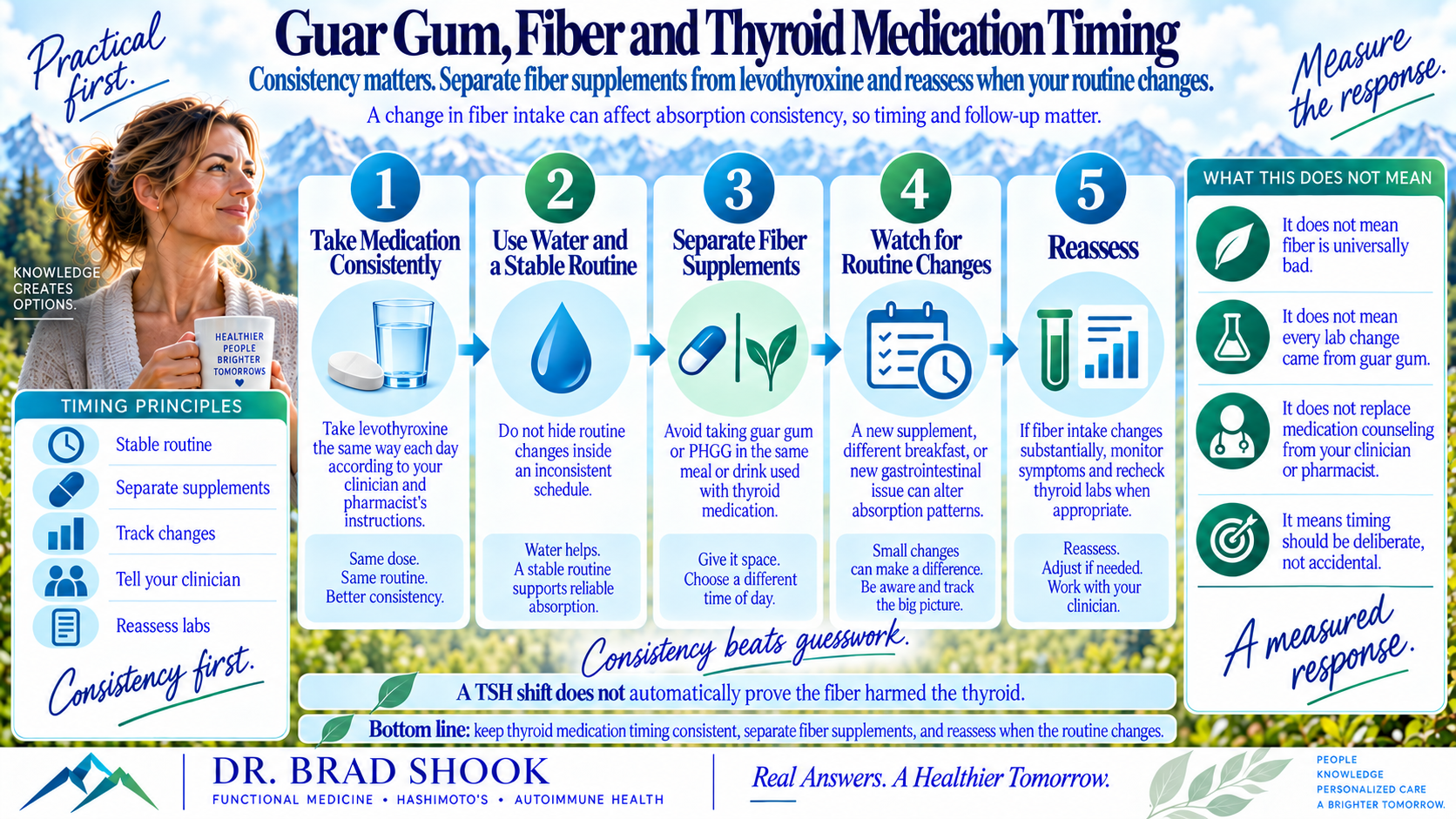
Do not mix a guar gum or PHGG supplement into the same drink or meal used to take levothyroxine. Take thyroid medication the same way each day and follow the timing instructions from your prescriber and pharmacist. If your fiber intake changes substantially, tell the clinician monitoring your thyroid so the effect can be evaluated rather than guessed.
A shift in TSH does not automatically mean guar gum harmed the thyroid. It may reflect altered medication absorption, inconsistent timing, a dose that needs review, another interacting supplement or medication, a gastrointestinal condition, or normal variation in testing. The timeline helps separate these possibilities.
For more on thyroid-hormone timing, absorption and persistent symptoms, see How Long Does It Take to Feel Better on Thyroid Medication?
Do You Need Testing Before Using Guar Gum?
There is no standard laboratory test that tells every person whether guar gum is good or bad for them. Start with the clinical question: are you trying to improve constipation, increase fiber diversity, test tolerance, or address a broader digestive pattern?
A complete baseline may include bowel frequency and stool form, bloating, pain, food pattern, fluid intake, medication and supplement timing, thyroid function, celiac risk, nutrient status and other clues from the history. When the case is more complex, targeted testing may evaluate gastrointestinal function, microbial or fermentation patterns, intestinal inflammation, barrier-associated immune reactivity, food immune reactivity or related autoimmune patterns.
These tests answer different questions. A barrier-associated antibody does not prove that guar gum caused intestinal permeability. A stool result does not prove that one organism caused Hashimoto's. A food antibody result does not automatically mean lifelong avoidance. The new opportunity is to combine objective data with symptoms, timing and response so the plan begins from a more individualized place.
Learn more about functional medicine testing for Hashimoto's and the broader Hashimoto's diet framework.
How to Run a More Useful Guar Gum Trial
A controlled experiment is more informative than adding several fibers, probiotics and supplements at the same time.

How I Look Beyond One Ingredient
Guar gum may be a helpful tool or an unnecessary problem, but it is rarely the biggest question in a complex Hashimoto's case.
I use the Environmentally Induced Autoimmunity model to understand the relationship among immune triggers, protective barrier systems, diet, gut motility, microbial balance, metabolism, nutrient status, stress, sleep, infections, chemical exposures, medications and your individual response. The purpose is to identify the important connections without reducing the entire case to one food additive.
| Step | What it means for guar gum and gut symptoms |
|---|---|
| DETECT | Establish a baseline and identify likely triggers using your history, symptom timeline, diet, bowel pattern, thyroid status and targeted testing. |
| SUPPORT | Build the plan around the highest-priority findings. Support thyroid function, motility, food diversity, hydration, nutrient status and the gut patterns that appear most relevant. |
| REASSESS | Track your symptoms, bowel function, tolerance, energy and objective findings. Continue, adjust or stop the plan based on how you are doing. |
The goal is a plan that is specific enough to be useful and simple enough to follow. For the full framework, see the Hashimoto's Doctor Method or return to the Hashimoto's resource hub.
Frequently Asked Questions
Is guar gum bad for Hashimoto's?
There is no good evidence that guar gum is universally harmful for people with Hashimoto's. It is a soluble fiber, and tolerance varies. Some people may find it helpful for bowel regularity, while others develop gas, bloating or discomfort.
Can guar gum trigger autoimmune disease?
Human research has not established guar gum as a cause or universal trigger of Hashimoto's or autoimmune disease. A personal digestive reaction can be important, but it is not the same as proof that guar gum activated autoimmunity.
Is partially hydrolyzed guar gum the same as guar gum?
Partially hydrolyzed guar gum, often shortened to PHGG, is made by breaking standard guar gum into smaller pieces. It is much less thick and is commonly used as a soluble prebiotic fiber. Research on PHGG should not automatically be applied to every guar gum product.
Is guar gum gluten-free?
Guar gum comes from the guar bean and does not naturally contain gluten. If you have celiac disease, check the finished product for gluten-free labeling because manufacturing and other ingredients determine cross-contact risk.
Can guar gum help constipation with hypothyroidism?
Partially hydrolyzed guar gum has improved some constipation outcomes in human studies, but it does not correct low thyroid hormone or every cause of constipation. Persistent constipation deserves a broader review of thyroid status, fluid intake, movement, medications, pelvic-floor function and gastrointestinal conditions.
Can guar gum make bloating or SIBO symptoms worse?
Yes. Fermentable fiber can increase gas, pressure or discomfort in some people, especially when the amount rises quickly or significant bloating and altered motility are already present. Symptoms alone do not diagnose SIBO.
Does guar gum heal leaky gut?
No human evidence shows that guar gum alone heals intestinal permeability in people with Hashimoto's. Fiber can influence the microbiome and its metabolites, but barrier health also depends on the underlying condition, digestion, nutrition, medications, infections, inflammation and other factors.
Can guar gum interfere with levothyroxine?
Dietary fiber can reduce or make levothyroxine absorption less predictable in some people. Do not mix a guar gum supplement into the same meal or drink used to take thyroid medication. Keep medication timing consistent and ask your prescriber or pharmacist how to separate it.
Is guar gum the same as xanthan gum?
No. Guar gum is a galactomannan fiber from the guar bean. Xanthan gum is produced through bacterial fermentation. They can perform similar thickening jobs in foods, but they are different ingredients and may be tolerated differently.
How can I tell whether guar gum agrees with me?
First identify the exact product and form, record a baseline for bowel movements and symptoms, keep other variables stable, introduce only one change, and reassess. Stop and seek appropriate care for allergic symptoms, severe pain, vomiting, inability to pass stool or gas, or trouble swallowing.
When the Gut and Thyroid Story Is Bigger Than One Ingredient
If you are reacting to multiple foods, struggling with constipation or bloating, or still feeling poorly despite a careful Hashimoto's diet, I can review the full pattern. The Application for Care is the next step for exploring an individualized investigation of thyroid function, triggers and drivers, gut health, diet, metabolism, nutrients, stress, sleep, exposures and your response.
References and Clinical Resources
- Niv E, Halak A, Tiommny E, et al. Randomized clinical study: partially hydrolyzed guar gum versus placebo in patients with irritable bowel syndrome. Nutr Metab. 2016;13:10.
- Chan TC, Yu VMW, Luk JKH, et al. Effectiveness of partially hydrolyzed guar gum in reducing constipation in long-term-care residents. J Nutr Health Aging. 2022;26(3):247-251.
- Waitzberg DL, Pereira CCA, Logullo L, et al. Microbiota benefits after inulin and partially hydrolyzed guar gum supplementation. Nutr Hosp. 2012;27(1):123-129.
- Ohashi Y, Sumitani K, Tokunaga M, et al. Consumption of partially hydrolyzed guar gum stimulates bifidobacteria and butyrate-producing bacteria in the human large intestine. Benef Microbes. 2015;6(4):451-456.
- Liel Y, Harman-Boehm I, Shany S. Evidence for a clinically important adverse effect of a fiber-enriched diet on levothyroxine bioavailability. J Clin Endocrinol Metab. 1996;81(2):857-859.
- U.S. Food and Drug Administration. Questions and Answers on Dietary Fiber.
- Kharrazian Institute. Gastrointestinal and autoimmunity course materials concerning gut motility, microbiome diversity, short-chain fatty acids, immune tolerance and intestinal barrier function. Used as professional education with current evidence and patient-specific findings.